



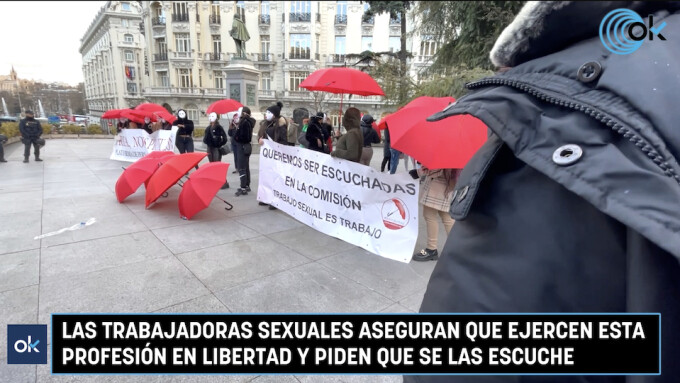
MADRID — Spanish sex workers, including adult producers and performers, continue to denounce a government attempt to outlaw all forms of commercial sex, starting with a controversial law deemed “dangerous” by human rights advocates.
A group of sex workers carrying red umbrellas, many wearing blank white masks to conceal their identities, demonstrated last week before Spain’s Congress of Deputies and denounced the efforts by the coalition government led by Pedro Sánchez of the Spanish Socialist Workers’ Party. The group singled out Minister of Equality Irene Montero, of the progressive Podemos party, for her part in the campaign to abolish all sex work.
A spokesperson for the group Platform of People Affected by the Abolition of Prostitution, which participated in the demonstration, mocked Montero as “a lady who speaks about sexual freedom, while she’s trying to curtail ours.”
Asserting that Montero does not represent all women, the spokesperson explained, “She tried to paint us as ‘victims of gender violence’ and hand us 400 euros, which it’s not enough to rent even one room in my apartment.”
A sex worker named Raquel told newspaper OK Diario that the group wants “prostitution to be legal, to pay taxes and to have the same right as any other workers.” She added that regulation, not criminalization, would ensure more safety for sex workers.
Lack of Meaningful Consultation With Affected Sex Workers
The group urged the government to engage in meaningful consultation with the affected sex workers, something the Sánchez administration has refused to do in its relentless campaign to outlaw commercial sex.
“We’d like to remind the political parties with parliamentary representation that there is a basic principle in a democracy, and that is to listen to the persons who could be affected by the laws, to know about their work environment and about the conditions in which they perform their professional activities,” the group said through a statement.
The sex workers also challenged the fundamental basis of the government’s position, stating unequivocally that “trafficking is not prostitution,” a slogan they displayed on large signs before the parliamentary buildings.
Earlier last week, a spokesperson for the minority Basque nationalist PNV, Joseba Agirretxea,
agreed with the sex workers and lambasted the government for offering “an exclusively punitive answer” to a complex question that generates a wide-ranging social debate and that is currently undefined by the courts.
A ‘Dangerous’ New Law
Last month, prestigious nonprofit Human Rights Watch published an opinion piece by Erin Kilbride, a researcher in its Lesbian, Gay, Bisexual, and Transgender Rights Program, urging Spanish lawmakers to reject a “dangerous” law being debated in parliament, which would criminalize sex work.
The law in question is the controversial “Only Yes is Yes” consent law, promoted by abolitionist politicians at the core of the Sánchez government, which seeks to criminalize all sex work, including adult productions.
“Research across Europe consistently shows that laws criminalizing the purchase of sex, known as the Nordic Model, increase sexual violence and harassment against sex workers, while having no demonstrable effect on human trafficking or the demand for sex,” Kilbride wrote.
Kilbride cited examples from France, Ireland and Northern Ireland, showing the failure of criminalization policies.
The Spanish bill, she wrote, “also threatens the right to housing, stipulating up to four years in prison for anyone (including other sex workers) who rents a room to ‘facilitate the prostitution of another person, even with their consent.’ This could criminalize sex workers who live and work together as a safety measure.”
Spanish lawmakers, Kilbride advocated, “should act on what credible data consistently shows: criminalizing clients does not make workers safer, nor eliminate demand. Rather, it opens the door to further exploitation, forces sex workers to abandon security measures, and erodes the work of human rights defenders.”
Consensus Among Adult Producers
Kilbride’s findings echo the consensus against the law among the adult industry in Spain. As XBIZ reported, last June, creators Paulita Pappel, Erika Lust, Noel Alejandro and Lemon, and companies Lust Cinema, XConfessions, Else Cinema, Lustery, HardWerk and SexSchoolHub spoke out against the proposed new law on social media.
“According to PSOE,” the group’s manifesto declared, “Article 187 of the Penal Code is incomplete because it only punishes prostitution that is ‘exploitative,’ while it should ‘punish prostitution widely’; that is, ‘any form of obtaining profit from the prostitution of others,’ no matter if the practice is carried out under exploitation (banned under current law) or with explicit consent from all parties involved, and following ethical production practices.”
The proposed law, the statement concluded, “only reinforces the stigma against sex work and the porn industry, demonizing prostitution and pornography as among the main causes of violence against women, and condemning sex workers to more precariousness, secrecy and violence.”



