



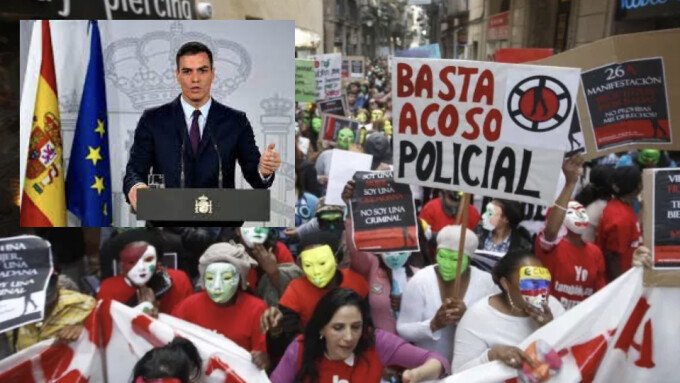
MADRID — Spain's Congress of Deputies moved forward Tuesday with a proposed new law backed by the ruling party, aiming to “prohibit pimping in all its forms” with the final aim to “abolish prostitution.”
As XBIZ reported, the bill introduced May 19 aims to outlaw all sex work, including all sexual performance deemed to be "pornographic." The legislation moved forward this week with 232 votes in favor, 38 against and 69 abstentions.
The ruling Spanish Socialist Workers' Party, or PSOE, introduced the proposal as “an abolitionist law against sexual exploitation,” something that had been included in the party's platform.
The draft includes Section 187, which explicitly outlaws audiovisual productions, magazines or internet content deemed “pornographic.”
Prominent European feminist adult industry figures Erika Lust and Paulita Pappel expressed dismay about the PSOE attack on all forms of sex work.
Prime Minister Pedro Sánchez has actively campaigned for “the abolition of prostitution,” including during the most recent PSOE convention, in Valencia last October.
Other prominent politicians within PSOE, which took power in 2019 after several years of conservative rule under the Partido Popular, have taken up the abolition of sex work as their personal cause. These include the party’s General Vice-Secretary Adriana Lastra, who last month took to the press to promote the change in the Spanish penal code to mandate up to three years of jail time for anyone paying for sex.
“We must abolish prostitution because it is incompatible with human rights,” added the spokesperson for the PSOE's Equality Commission, Laura Berja.
Lastra framed the effort as an attempt to reach out to the right, saying she hoped both the conservative PP and the left-wing minority alliance, Unidas Podemos, would vote for it.
Reviving Franco-Era Policing of 'Pimping' and 'Brothel Keeping'
The proposed legislation would revive the crimes of “proxenetismo,” meaning pimping or pandering, and “tercería locativa,” or brothel-keeping. Both were removed from the penal code in 1995 by a previous PSOE administration.
The language in the bill exclusively uses the Spanish feminine “prostituta,” which is both stigmatizing and criminalizing, and also essentializes sex work as a female occupation. The law also conflates legal minors with the much vaguer “persons in situation of vulnerability,” which could be deployed by authorities to apply to whomever they wish.
Feminist reporter Noemí López Trujillo pointed out several specific technical issues with the draft, which would involve law enforcement in consensual commercial sex to a degree not seen in Spain since the Francisco Franco dictatorship and its Political-Social Police Brigade.
López Trujillo consulted with several legal experts, who confirmed that “proxenetism” or pimping is already penalized in Spain, as long as it is tied to exploitation. The new law will expand the definition to include any kind of aid or support to sex workers, regardless of exploitation or consent.
“Although the introduction to the law claims that relatives of sex workers will not be prosecuted,” López Trujillo noted on Twitter, “the legal definition as drafted says nothing about it.”
“If anyone lives off of the income of the ‘person in situation of prostitution,’ it is understood that there may be a profit motive,” she explained, adding that if such a third party knows about what kind of work the person does, “t can be interpreted that they are enabling it or promoting it.”
Legal Experts Point Out Dangers of Re-Criminalization
López Trujillo’s article for the Newtral news site provided an in-depth analysis of issues with the law, which establishes a souped-up version of the Nordic Model and goes against the wishes of most active sex workers and sex work advocacy groups, which were not consulted by the PSOE's anti-sex-work activists.
A central issue with the law is its interpretation of “tercería locativa,” which establishes criminal liability for any third-party location that the state would consider is functioning as a brothel.
López Trujillo spoke with Miren Ortubay, law professor at the Universidad del País Vasco, who pointed out that “when a type of crime is so broad, you dilute the legal certainty,” and leave the enforcement to the “ideological biases of those doing the judging,” particularly racism and classism.
“If it is a cop who is taking advantage, somehow, of a woman prostituting herself,” Ortubay, a criminologist and penalist, explained, “the judge most likely won’t consider him a pimp. But if it’s a foreigner, the biases will increase the possibility that he will be considered ‘a pimp,’ even if the behavior is the same.”
Inés Olaizola, a penal law academic at the Universidad Pública de Navarra, added that the PSOE proposal “takes agency out of the consent of the women who work as prostitutes.”
By classifying all prostitution as “exploitation” — and thus erasing sex workers' ability to consent — the proposed law essentially treats women “like minors,” Olaizola explained.



