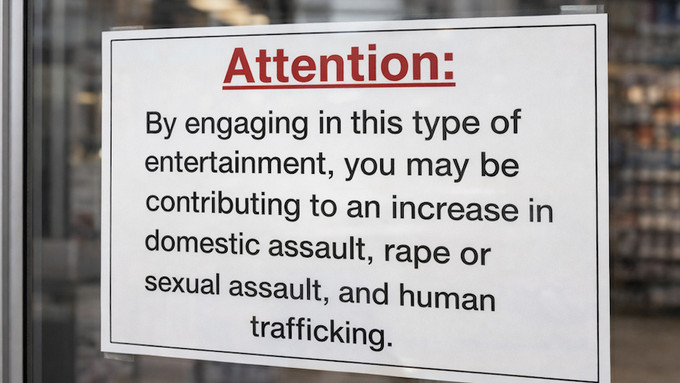
NASHVILLE, Tenn. — Governor Bill Lee on Tuesday signed into law a bill requiring adult stores, theaters and other establishments in Tennessee to post warning signs cautioning patrons that they “may be contributing” to sexual assault and human trafficking.
The new law adds provisions to Tennessee’s Adult-Oriented Establishment Registration Act of 1998, prohibiting county boards from issuing licenses to covered businesses unless a sign is posted at each entrance stating: “Attention: By engaging in this type of entertainment, you may be contributing to an increase in domestic assault, rape or sexual assault, and human trafficking.”
Additionally, establishments that sell or rent “sexually oriented materials, including print, video, and other media” must also post signs on all displays of such material, stating: “For your information: Production of these materials may contribute to an increase in domestic assault, rape or sexual assault, and human trafficking.”
The law requires signs to be at least 8 1/2 by 11 inches and printed in at least 48-point type in boldface black letters on a white background.
Covered “adult-oriented establishments” include bookstores, theaters and any other business that principally offers “sexually oriented material, devices, or paraphernalia or specified sexual activities, or any combination or form thereof, whether printed, filmed, recorded, or live and that restricts or purports to restrict admission to adults or to any class of adults.”
When the Tennessee State Senate passed the bill in April, industry attorney Corey Silverstein told XBIZ, “Conditioning licensure on compelled speech like this raises serious First Amendment concerns, particularly where the government is requiring private businesses to convey a stigmatizing message about their own lawful activity.”
The issue of “compelled speech” has also arisen in other states, where legislators have introduced online age verification bills that would require adult sites to post notices warning users of alleged physical, mental and social harms associated with pornography — despite a previous federal court ruling against such requirements.
A report last month by the Memphis Flyer, a Tennessee newsweekly, raised serious doubts about the reasoning behind the bill, noting vague, shaky evidence and tenuous connections put forward by the bill’s sponsor, Republican state Sen. Janice Bowling, to justify the warning signs.
Now that it has been signed into law by the governor, the legislation becomes effective immediately.