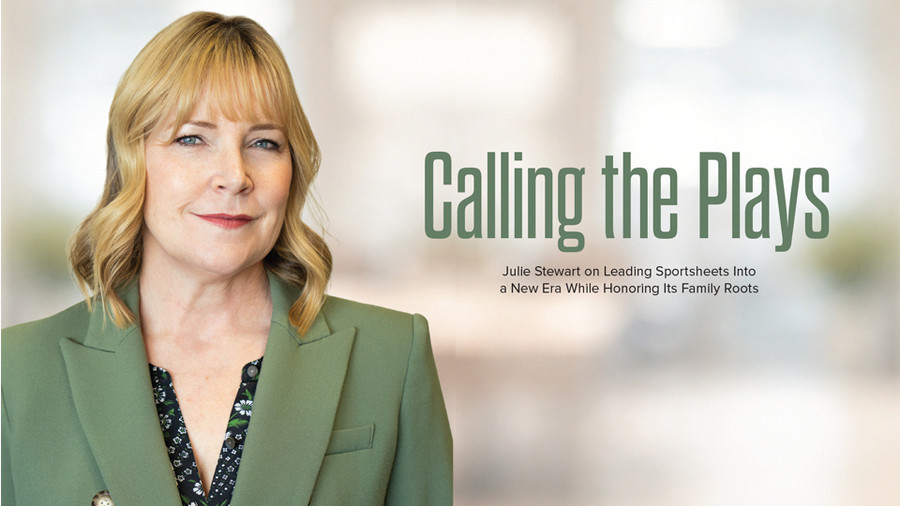
When Sportsheets founder Tom Stewart retired at the start of 2020, he left the company in the capable hands of his sister, Julie Stewart. Since taking over as CEO, she has guided Sportsheets through an era of transformation, resilience and renewed purpose.
Even before stepping into the top job, however, Julie Stewart was already a defining force behind Sportsheets. She joined the company in 1995 and went on to become a business partner and vice president before being promoted to president in 2012.
Employees, customers and vendors need to know they are cared about.
Stewart fondly recalls Sportsheets’ early days and humble beginnings. The brand, she says, began as a wild idea. Tom was working as a commercial pilot, landing helicopters on Los Angeles high-rises, while also serving in the U.S. Navy Reserve. After college, Julie moved from Alaska to Southern California. After crashing with her brother for a while, she decided to stay and pitch in on the new venture.
“During those first five years, we were just trying to survive,” she remembers. “We borrowed some money; we were so desperate. Tom’s cellphone kept getting turned off, and his car was constantly running out of gas. We ate at Del Taco because it was so cheap. That was tough, but it was also fun.”
Hitting the Curveball
Just a few months after she took over the CEO spot, Stewart’s leadership was sorely tested. The company had just moved its headquarters to a larger facility in Cerritos, California, when COVID-19 hit.
“I had signed the lease all by myself,” Stewart sighs. “We had a riverbed behind the old building and I remember I went outside, looked at the riverbed and just cried, thinking, ‘What the hell did I do? This is it — the ship is going to sink.’ Then sales skyrocketed, and two months later, the real problem was that we didn’t have enough inventory. It was such a roller coaster.”
The move to Cerritos was intended to streamline operations and position the company for the future. Instead, Stewart and her team had to adapt to unprecedented circumstances with agility and creativity. Like businesses worldwide, Sportsheets faced uncertainty as supply chains tightened, workplace safety grew critical and communities dealt with the wider impact of the pandemic.
“When COVID hit, it was like being in a washing machine,” Stewart recalls. “It was a huge success, but that brought its own stress. All of a sudden, we had L.A. County mask mandates. We spent tens of thousands of dollars on COVID tests, hand sanitizer and temperature-taking devices. But we got through it.”
One of the most notable initiatives was a pivot to producing protective face coverings during the early months of the crisis. Leveraging the company’s existing manufacturing capabilities, the Sportsheets team began sewing masks for local businesses and organizations. The effort eventually expanded into a new venture called Jane Care Inc., dedicated to producing protective masks for communities in need.
Through this initiative, the team produced and distributed more than 15,000 masks to local businesses, industry partners and individuals at a critical juncture when protective equipment was in short supply.
In the warehouse, Product Operations Manager Durante Brown and Warehouse Operations Manager David Lopez worked tirelessly to keep production and inventory moving despite widespread supply-chain disruptions.
Brown recalls, “At the beginning of COVID, when businesses were shutting down, Julie didn’t sit and wait to see what was going to happen next. She was proactive in creating another avenue for several departments to stay afloat, including my department.”
For Lopez, the way the company responded to this challenging curveball reflects Stewart’s overall leadership style.
“She has always been transparent about the organization’s vision and is realistic about obstacles,” Lopez shares. “This helps build trust and makes it easier for the team to stay aligned.”
Team Spirit
That alignment has always been one of Stewart’s goals. Put simply, she wants to make sure Sportsheets is a good place to work.
To that end, cultivating a supportive, family-like environment carries over into everyday operations. Employees’ birthdays and anniversaries are celebrated. Teams are encouraged to connect and collaborate across departments. All-teams meetings allow everyone to interact on Zoom, with a different person leading the session each week and “icebreaker” activities that enable participants to share about themselves and learn about their colleagues.
This approach isn’t just about good human resources policies or a positive office environment. One key principle Stewart has gleaned in the course of her three-decade career in the pleasure sector is that people are the backbone of a company’s long-term success.
Stewart recalls studying accounting at Golden West Community College in Huntington Beach, California, during Sportsheets’ early years, then hiring a classmate as one of the company’s first managers, Dawn Kirchofer.
“She was with us for 13 years and contributed a lot,” Stewart says. “She helped us design all of our strap-ons. She would go home and come back, often saying, ‘No, you have to change this.’ I think that’s one of the cool things we’ve had going for us: We’ve had these contributions from everyone who’s been part of the team across different eras of business. I look at our ‘Keeping Couples Connected’ tagline, which was Todd Carter’s idea.”
Stewart describes leadership as not necessarily in-your-face.
“It isn’t always the most vocal person who proves to be the most natural leader,” she said. “Leadership is about building trust and holding people accountable. It’s about creating a safe work environment and encouraging people to give their best while keeping an open mind.”
Among the requirements for a role at Sportsheets is passion. The company looks for people who genuinely care about the work they do and the impact it has on customers, retailers and the broader conversation around intimacy and wellness. That enthusiasm often translates into a collaborative energy within the workplace, where team members are encouraged to share ideas, support one another and take pride in contributing to a brand that has helped shape the pleasure industry for decades.
“Passion shows — whether it's for people in that lifestyle or just genuinely appreciating the connection aspect of it,” Executive VP Kelly Sofferman said. “This world may not be for everyone, but understanding the weight and responsibility of making the customers happy or educating them is crucial. Everyone here shares that mindset.”
These days, Stewart reflects, she feels more like a “coach” than anything else — perhaps fittingly, given the company’s name. As a family-owned company, Sportsheets has always been a close-knit team that runs on collaboration, trust and shared responsibility. It’s a dynamic that inspires loyalty, as evidenced by the array of team members who have stuck around for over a decade.
Regional Sales Manager Sylvia Lopez is one such employee. She still remembers the moment when Stewart offered her a sales representative position.
“She believed in me and shared encouraging words, expressing confidence in my ability to succeed,” Lopez recalls. “That support completely changed my mindset. I felt trusted, which motivated me to focus, embrace challenges and give my best effort. With her encouragement, I was able to grow and succeed in the role — and here I am, 17 years later, still thriving.”
Accounting and office administrator Julie Nguyen-Elligo says that Stewart made a big impact on her by encouraging her to take on a leadership role in a challenging project.
“Her confidence in my abilities gave me the motivation I needed to grow professionally,” Nguyen-Elligo attests. “That experience not only improved my skills but also increased my confidence in handling greater responsibility.”
Newer employees also praise Stewart’s inclusive creativity. Marketing Manager Elyse Bonner, who joined the company early last year, credits Stewart’s openness with making a meaningful impact on the company’s marketing efforts.
“She does not default to ‘This is how we have always done it,’” Bonner says. “Instead, she listens, asks thoughtful questions and is willing to consider new approaches when they make strategic sense. That creates an environment where innovation feels encouraged rather than restricted. It keeps our work dynamic and forward-moving.”
As Sportsheets has grown, it has also maintained that forward momentum by tapping the talents of industry vets like Brand Ambassador Rin Musick and Regional Sales Manager Kristin Zuri-Godskin.
Says Stewart, “Freshness, new ideas and people coming in to shake things up are essential. Ideas can come from anywhere.”
It’s an idea that has proved contagious. Sofferman, who was named Executive VP in February 2025, says that Stewart’s trust in her team has taught her the value in letting others take the reins.
“Julie has reinforced that strong leadership isn’t about carrying everything alone,” Sofferman noted. “It’s about creating the space for the team to think critically, collaborate and take ownership. That approach builds stronger outcomes and stronger people.”
Sofferman discusses a team-building activity she encourages.
“I have always required everyone I hire to spend one hour with every other employee here besides me,” she reveals. “I truly believe people should have an honest opinion of their manager and the work environment, and be able to describe their role in their own words. I don't care how you spend that hour; it can be sharing your background, talking about your favorite music, what you ate for dinner, or discussing what you do here and your vision for it. I think this has helped foster cross-communication and collaboration. I've received feedback that everyone has enjoyed it. You're learning so much in the first few weeks of a new job, trying to be at your best. So, it’s just a little moment to take a deep breath and really get to know each other.”
Stewart beams at the chance to have a front-row seat to some of the biggest milestones for her team.
“Seeing our first executive vice president step into that role, planning and then watching the launch of new products has been amazing,” she beams.
Over the past three years, being able to rely on her team to manage the day-to-day operations of the business has turned out to be a crucial support for Stewart personally.
“I have been able to step back from daily activities to spend time with my husband during his cancer treatment, to have both of my hips replaced, to send our daughter off to college, and to be with my family and mother when she passed away last summer,” she shares. “Because I trust the leadership and the team at Sportsheets, I could be present for my family without worrying about the business.
Leading With Legacy
When Tom Stewart stepped down as CEO after nearly three decades at the helm, Sportsheets had built a reputation for creating approachable bondage products designed to help couples explore intimacy in a comfortable, accessible way. While his retirement marked the end of an era, Julie Stewart’s tenure has provided natural continuity since she and her brother share similar views about the brand and its target audience.
Julie Stewart shares, “Tom was genuinely a visionary, especially when he created the Original Sportsheet. He was really focused on creating a transformative experience centered on pleasure, connection — and a touch of being a little freaky.”
Sportsheets traces its origins back to one fateful evening during the late 1980s. Tom Stewart was watching an episode of “Late Night with David Letterman,” in which the talk-show host donned a Velcro suit and stuck himself to a Velcro wall.
For Tom Stewart, that visual immediately suggested a playful and practical option for couples looking to explore light bondage in a safe, approachable way. This inspired the Original Sportsheet, which featured Velcro restraints that could be peeled off a plush bedsheet with strategically placed anchor points, allowing partners to experiment with restraint while maintaining a simple and reassuring release mechanism.
COO Ed Hayes, who is also Julie Stewart’s husband, recalls: “In the old days, Sportsheets’ tagline was ‘You’re only as tied up as you want to be.’”
Offers Stewart, “At the time, it was a bit out there. But Tom was trying to make it accessible, which I appreciated.”
In particular, Stewart felt that the Sportsheet could help make BDSM exploration less intimidating for women.
“Trying something different in bed depends on trust and safety first,” she says. “Without those, it’s hard to have truly wild fun and connection. We try to meet people where they are and then guide them along the journey: ‘Here’s the path for when you want to try something.’”
These days, the range of ages and backgrounds on Sportsheets’ female-dominated executive team contributes to the brand’s emphasis on celebrating and accommodating diversity.
“Perspectives change with age,” Stewart says. “A lot of the women who worked in our manufacturing department, sewing and doing similar tasks, were mothers. I didn’t fully realize what a challenge that was until I had a child of my own. That experience gave me a much deeper appreciation for women with children — and they had multiple kids, not just one, as I did.”
One area where a female perspective made an impact early on: packaging.
“I thought we should soften the packaging a bit,” Stewart recalls. “We needed to make the product more approachable, and clearly communicate that on the packaging to avoid turning people away. It reflects who we are. That’s why we include different sizes and skin tones on the packaging — and the team continues to advocate for that, which I really appreciate.”
Built on Quality
Since customers use Sportsheets products in very personal ways, quality is naturally also essential. This has guided the company’s commitment to earning customers’ trust with durable materials and rigorous standards.
“They can’t fall apart,” Stewart declares simply. “When someone is sharing intimacy and vulnerability, we can’t be the strap that breaks.”
The attention to detail that Sportsheets dedicates to its products also stems from its roots, she notes.
“In the past, Tom would step in and say, ‘It has to be stitched this way,’” Stewart recalls. “Engineering was very important to him. I think that’s something we’ve never compromised on. We still genuinely care about how things look and that they function properly.”
As an example of Sportsheets’ commitment to quality, Hayes cites a situation that arose many years ago. The company detected a problem with a certain product release, but couldn’t trace the individual defective items.
“So we recalled all those units, even the good ones, and replaced them all,” Hayes says. “We don’t want anything out there that falls apart.”
Reaching Out to Retail
Maintaining that “family” feel isn’t just about employees. For Stewart, the goal is also to stay close to Sportsheets’ partners.
“We walk stores, we visit distributors, we listen to feedback from retail teams,” she affirms. “That connection keeps us grounded and prevents us from becoming distant or overly corporate. Growth does not mean losing heart. For us, it means strengthening the infrastructure so the heart can beat louder.”
Sofferman agrees, and has made a point of traveling with the sales team frequently over the last two years. She often fields requests for new products, which the company takes into serious consideration.
“We get asked all the time to make certain products,” Sofferman shares. “That trust means a lot to us. Even when a request is super granular, we know it’s coming directly from the consumer, and that enthusiasm is really gratifying. Because we plan our launches pretty far in advance, we’re able to stay flexible and make changes when there’s enough time.”
Rather than contribute to the flood of products on the market, Stewart says, Sportsheets will only ever introduce carefully curated collections backed by merchandising tools and meaningful education that drives sell-through.
“Our focus is on launching groundbreaking collections that shape the direction of bondage in retail,” Stewart says. “Every launch is built as a complete ecosystem.”
That means leaning into innovative concepts, giving retailers tools to tell a story on the sales floor while making bondage products feel more approachable and stylish. It means glossy product photography, lifestyle images that showcase diverse models, and informative descriptions and renderings to educate shoppers.
Bonner explains, “If you’re interested but not entirely sure, I believe our packaging helps open that door for you. I know when I go into stores, I might not talk to a rep but I will look at the box. If it does what I need, I’ll buy it. It’s a really effective sales tool for the show floor.”
Stewart observes, “Independent retailers are navigating rising costs, competition from online marketplaces, and advertising restrictions that hinder customer acquisition. At the same time, there’s an oversaturation of undifferentiated products, especially private-label and low-cost imports. That makes brand authority and quality more important than ever.”
Neighbors and Friends
During her time in the pleasure industry, Stewart has seen the bondage category grow from niche to mainstream.
“I was just in a store, and there was this couple shouting to each other from one end of the shop to the other about a collar,” she laughs.
Bonner is quick to confirm this observation.
“Kink wear and similar items are becoming more popular, with people wearing collars and cuffs, even if it’s just at a club or for cosplay,” Bonner notes. “A member of our team, Joseph, shared how he went to a comic con and saw girls wearing these garters that we are about to launch. So it’s definitely becoming much more mainstream.”
Stewart sees greater openness and less judgment, not just among younger generations but also with older couples. Women seek her advice about pleasure products for their husbands because they lack interest in having sex with them.
“It makes me remember that these aren’t faceless consumers out there," she said. "These are real people using these products to help sustain their relationships. These are our neighbors and friends who are facing issues in their bedrooms or trying to improve things.”
Stewart herself remains a firm believer in the deeper benefits of exploring kink.
“Bondage is more than sex,” she affirms. “It’s connection, sensation and a chance to be intimate with someone in a way that you’re probably not with most people.”
It’s How You Play the Game
Ask members of the Sportsheets team about their boss, and most will describe her as fully invested — in the product, the people and the future of the company.
Says Bonner, “Her level of involvement motivates the team to rise to the same standards. She is actively involved in team-building and strategic discussions, and it is motivating to hear her draw on decades of industry experience.”
Sofferman cites Stewart’s resiliency.
“Julie has navigated over 30 years in an industry that has experienced major cultural shifts, economic cycles, regulatory changes and evolving retail landscapes,” Sofferman says. “She has also built and maintained leadership in a field that was traditionally male-dominated. That requires resilience not only professionally but also personally.”
Ask Stewart how she measures success, and she will talk about much more than market share.
“That’s part of it,” she admits. “That feeling when I go into a store and see how many square feet Sportsheets has. But even more, it’s when the clerks and people in general ask, ‘You work for Sportsheets? Oh my God, I love that! I have this, I have that.’”
During a recent trip to Salt Lake City, Stewart and her daughter visited adult stores bustling with excited couples.
“It was really inspiring,” she gushes. “People were excited to be there. I love walking into a beautiful store. One had the most amazing lingerie, and we bought a bunch of stuff. I don’t ever buy lingerie! I never go into stores to shop. I’m always only asking, ‘Where is the Sportsheets stuff?’
“It was cool to browse through the store through my daughter’s eyes a little bit and think, ‘Oh, this is really pretty. This is cool. This is fun,’” Stewart recalls. “I should look at things that way myself, but sometimes I’m too deep in business. I need to remember that the point of all this is this beautiful connection — it’s truly a gift from God.”
As a custodian of that gift, Stewart remains resolutely focused on strengthening the company’s foundation while continuing to innovate. New product launches, expanded marketing initiatives and deeper retailer partnerships all play a role in that vision. At the same time, she continues to prioritize the family-oriented culture that has defined Sportsheets since its founding.
“We still make decisions together in a room,” affirms Stewart. “We still debate passionately. And we still care deeply about the people behind the work.”
What does she hope her own legacy at Sportsheets will be?
“For the company to be bigger and better than my wildest dreams,” Stewart says. “To be that source of trust for the consumer and the retailer, to continue to be a safe environment to work in, a creative workspace and a caring company. I think that’s what matters. I just want to see it rocket ship into the atmosphere. For the next generation to take it on and go places I couldn’t or didn’t.
“I’ve always felt the company had a kind of soul that was beyond Tom and me,” Stewart adds. “I hope it continues long after my time here.”