



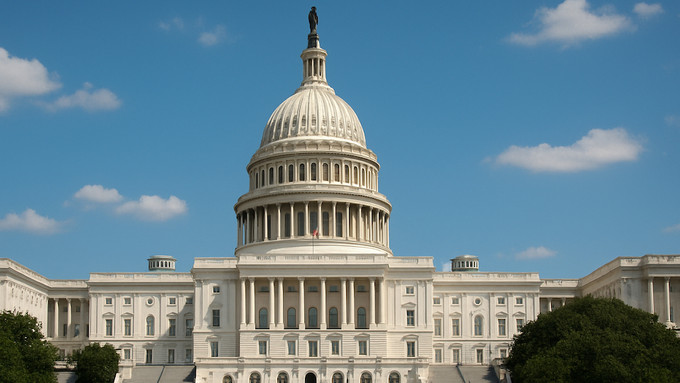
WASHINGTON — The U.S. House of Representatives Committee on Energy and Commerce will meet Thursday to consider and potentially amend the Kids Internet and Digital Safety (KIDS) Act, which includes provisions to make age verification by adult websites federal law.
The KIDS Act is an omnibus bill combining a suite of online safety bills. One of the bills incorporated into the KIDS Act is the Shielding Children’s Retinas from Egregious Exposure on the Net (SCREEN) Act — a federal age verification bill introduced a year ago by Sen. Mike Lee of Utah and Rep. Mary Miller of Illinois.
An updated version of the SCREEN Act, amended by Congressman Craig Goldman of Texas, forms the basis of Title I of the KIDS Act, which is labeled “Shielding Minors From Obscenity.”
That section mandates that adult sites must implement a ‘‘technology verification measure,’’ defined as “technology that (A) employs a system or process to determine whether it is more likely than not that a user of a covered platform is a minor; and (B) prevents access by minors to any sexual material harmful to minors on a covered platform.”
In order to comply, sites or their third-party AV providers must not only use such a “technology verification measure” to verify the age of a user, but also take “reasonable measures” to address circumvention of technology verification measures — a provision apparently aimed at countering the widespread use of virtual private networks (VPNs) to avoid age verification requirements.
About half of all U.S. states currently have AV laws on the books. If the KIDS Act becomes law, its AV provisions will supersede those state laws. While federal laws generally preempt state laws, the bill additionally spells this out, stating: “No State, or political subdivision of a State, may prescribe, maintain, enforce, or continue in effect any law, rule, regulation, requirement, standard, or other provision” that requires age verification by adult sites.
If passed and signed into law by President Trump, the KIDS Act would take effect one year after enactment.
Failure to comply with the proposed law would be treated as a violation of the Federal Trade Commission Act’s prohibition against unfair or deceptive acts or practices. Violators would therefore be subject to civil penalties of up to $10,000 for each violation.
If the Committee on Energy and Commerce approves the KIDS Act following Thursday’s markup session, the bill could next be heard by the full House of Representatives.



