



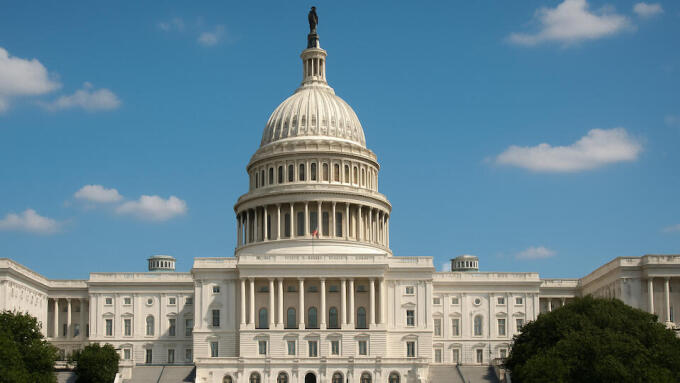
WASHINGTON — A U.S. House of Representatives subcommittee voted Thursday to amend the SCREEN Act, which would make site-based age verification of users seeking to access adult content federal law, and to advance the bill for review by the full Committee on Energy and Commerce.
As XBIZ reported last month, the Subcommittee on Commerce, Manufacturing, and Trade has been working to advance a suite of online safety bills, including the Shielding Children’s Retinas from Egregious Exposure on the Net (SCREEN) Act.
As XBIZ reported when Republican Sen. Mike Lee of Utah and Rep. Mary Miller of Illinois introduced the bill in February, violations of the SCREEN Act’s requirements would be treated as a violation of the Federal Trade Commission Act’s prohibition against unfair or deceptive acts or practices. Violators would therefore be subject to civil penalties of up to $10,000 for each violation.
On Thursday, Congressman Craig Goldman of Texas told the House Subcommittee on Commerce, Manufacturing, and Trade that his amended version “follows the same playbook as Texas,” a reference to HB 1181, the state age verification bill that sparked the pivotal Supreme Court case Free Speech Coalition v. Paxton.
“It updates the SCREEN Act to align it with the successful Texas statute, and federalizes it across the country,” Goldman said. “The protections that the courts have already upheld for children in Texas should not stop at our border. Every child in America deserves the same consistent standard of safety as a child in Texas has. We must protect children from harmful online content, and we can accomplish this better by updating the SCREEN Act.”
Goldman's amended version changes the language of the bill in several places, but the changes do not appear specifically designed to make the SCREEN Act resemble Texas' state AV law.
“This is not a mirror of the Texas law,” observed industry attorney Lawrence Walters. “It would likely render the Texas law unenforceable due to federal preemption.”
Not only do federal laws generally preempt state laws, but the amended version of the SCREEN Act includes a section specifically affirming the proposed federal rule's primacy. That section reads, "No State or political subdivision of a State may prescribe, maintain, or enforce any law, rule, regulation, requirement, standard, or other provision having the force and effect of law, if such law, rule, regulation, requirement, standard, or other provision relates to the provisions of this Act."
About half of all U.S. states currently have AV laws on the books. If the SCREEN Act becomes law, its provisions will supersede those state laws.
The subcommittee approved Goldman’s amendment by a voice vote, clearing it for consideration by the full Committee on Energy and Commerce.



