

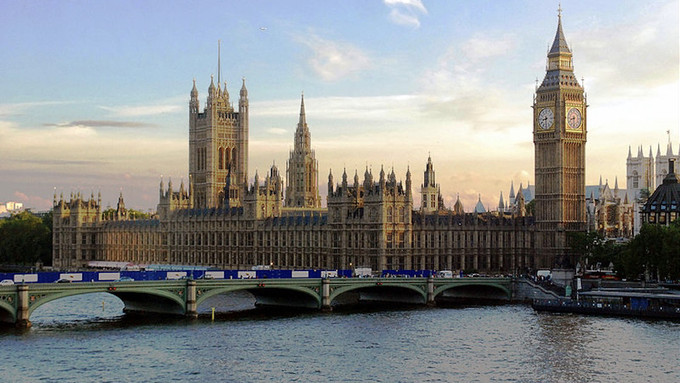
LONDON — The U.K.’s Crime and Policing Bill received final passage in Parliament on Monday, including provisions criminalizing depictions of “non-fatal strangulation” as well as sexual content in which adults portray underage characters.
The Crime and Policing Bill had its first reading in the House of Commons in February 2025 and has since undergone more than a year of debate and amendments. For XBIZ's coverage of the process, click here.
Official enactment will occur once King Charles III grants Royal Assent, but that is a ceremonial step and there is no realistic prospect of Royal Assent being withheld.
‘Choking’ Ban
Under the newly approved law, possessing or publishing “pornographic images of strangulation or suffocation” is now a priority offense under the Online Safety Act. Possession of such material could lead to up to two years in prison, while publication could result in sentences up to five years.
The drive toward a “choking” ban gained momentum following the February 2025 release of a “pornography review” that recommended banning adult content deemed “degrading, violent and misogynistic.” At the time, industry and free speech advocates condemned plans to ban “extreme” content.
Ban on Sexual Content Featuring Adults Portraying Underage Characters
Publication or possession of sexual content in which adults portray characters under 16 is now also banned.
The new law specifies “sound or information associated with the image” as the relevant criteria indicating whether a performer is portraying a character under 16. This apparent designation of audible dialogue, titles and content descriptions as the only admissible evidence of a violation replaces broader language in an earlier draft of the bill, which would have included elements such as costume and setting as evidence of an adult performer portraying a character under 16.
The law notes, “A person is not to be taken as pretending to be under 16 if it is fanciful that they are actually under 16 in the way pretended.” In addition, a government memorandum notes that the law is “not intended to criminalize a pornographic image of someone who is clearly an adult where the only marker of childhood is the fact that he or she is in school uniform.”
Final Law Drops Blanket ‘Step’ Ban, Consent Withdrawal
Two potentially impactful measures failed to make it into the final law: a proposed blanket ban on “step” content, and a provision that would have invalidated talent contracts.
While the new law does include language outlawing depictions of incest involving blood relatives, the ban only applies to “step” content if a performer is portraying someone under the age of 18. The government has stated that this provision is meant to ensure that the law only criminalizes material that portrays sex that would be illegal in real life.
The final law also leaves out an amendment proposed in the House of Lords, which would have allowed anyone appearing in adult content to withdraw consent to publication and distribution at any time, regardless of whether they previously consented or signed a contract.
In lieu of that provision, a House of Commons amendment requires the Secretary of State to conduct an overall review of sites’ age and consent verification procedures and then present the results to Parliament within a year. The law also gives the Secretary of State new powers to intervene on this issue and potentially regulate sites’ age and consent verification duties without further authorization by Parliament.
Prospects for Future Regulation
The U.K. government’s Violence Against Women and Girls (VAWG) strategy includes a “joint pornography team” with a mandate to address the issues detailed in the 2025 pornography review and to “rigorously examine the evidence to inform the government’s approach to pornography policy.”
The team is comprised of representatives from the Home Office, the Department for Science, Innovation and Technology, the Ministry of Justice, and the Department for Culture, Media and Sport. It reportedly began its work in December 2025. Its recommendations are expected to inform future legislative initiatives and potentially the policies of U.K. media regulator Ofcom.