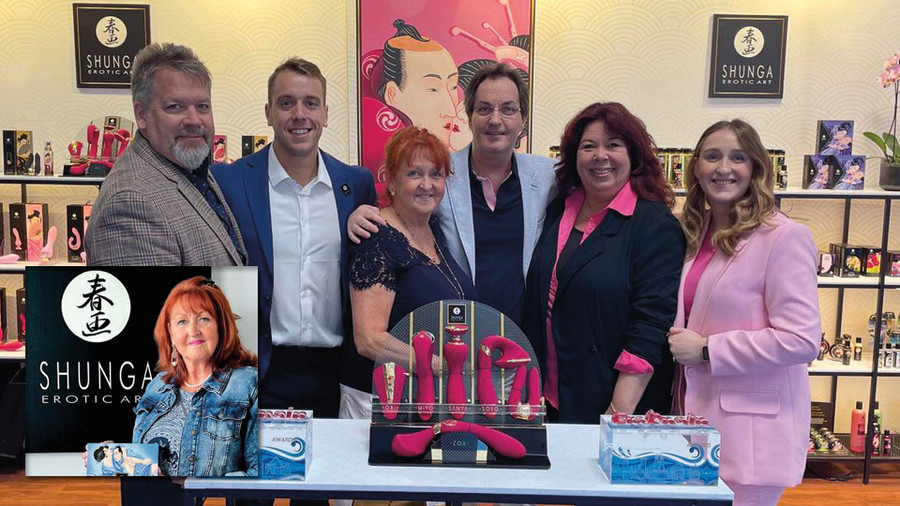
Shunga Erotic Art is best known for its boutique vibe, its stunning Japanese art visuals and of course, its curated line of oils, lotions and potions meant to be touched, tasted and smelled. Shunga bath and body products have been a staple of the pleasure sector for 24 years, making French-Canadian founder Manon Vallee a long-celebrated figure in the industry.
Perhaps the only thing more intriguing than Shunga’s recently debuted, proprietary line of vibrators is the seldom-told backstory of how a business power couple came to dominate the sensuals sector of the sex toy trade. That story begins in Vallee’s home city of Montreal, Quebec, where she initially worked in the restaurant industry.
I believe that Shunga has been a pioneer in the rise of the quality and refinement that we see in today’s market.
“My journey is quite unique,” says Vallee of her early career days. “Nothing predestined me to work in this field.”
Indeed, Vallee never had any intention of building an adult brand, though she traces her penchant for pleasing customers back to her days serving restaurant patrons.
“I love people!” says Vallee. “Those years of interacting with the public greatly helped me in business.”
Vallee later trained to work in the cosmetics field, where she met her soon-to-be husband and lifelong business partner, Sylvain Séguin. The pair quickly built their first company and discovered something even more rare than true love: an instantly successful business.
“At the beginning of our business venture in 1988, my partner and I created a concept for a range of revolutionary cosmetic products for that time, combining cosmetics and bathroom decor,” recalls Vallee. “In just a few months, we were exporting our products to 30 different countries. We rode this success for about a decade. By the end of 1999, we began exploring other markets.”
The initial seeds of Shunga’s creation were two seemingly insignificant and unrelated events that would later turn out to be very important indeed.
The first took place on an otherwise average day, when Vallee and Séguin popped in to visit a friend who owned an adult boutique. Aware of the pair’s line of work, the friend suggested the two start their own collection of adult cosmetic products. Vallee and Séguin browsed the shop’s offerings of massage and sensual body products to get a sense of the competition.
“We asked our friend, ‘Do you sell a lot of these products?’” recounts Vallee. “She replied, ‘I sell tons of them!’ That’s when we realized that this market really needed some love, and that the expertise of our chemists and our R&D team could make a significant difference.”
Right from the start, Vallee notes, both product quality and the portrayal of refinement and elegance were of utmost importance.
“We developed our brand with an artistic approach,” says Vallee. “We wanted to far surpass anything that was being done at the time.”
The second event occurred right around that same time. Séguin was browsing in a bookstore when he stumbled upon a volume on Shunga, a Japanese erotic art form spanning the 16th to 18th centuries. Like a Japanese version of the Kama Sutra, the Shunga paintings depicted couples in all manner of private positions. Thumbing through the pages, Séguin discovered several striking artworks that struck him as the ideal visual representation of what the pair wanted their brand to embody.
“The only problem was that none of the images could be used because Shungas, in most cases, are very explicit, and we really didn’t want to go in that direction,” says Vallee.
That meant they had to find a workaround to maintain the traditional appearance of the Shungas while dialing down the more arousing aspects.
“The artistic quality of these works was of great value, so we collaborated with renowned Quebec artists to recreate the paintings, concealing the intimate parts with fabrics without ever compromising the quality of the artworks,” says Vallee.
In this way, Vallee’s creative venture both funded local artists and ensured that the Shunga brand’s packaging would stand out from the retail crowd.
“Each Shunga Erotic Art product is adorned with a different Shunga,” explains Vallee. “Each canvas is drawn and painted by hand. Creating one Shunga takes an average of 100 to 200 hours of work. It’s a very lengthy process that requires a lot of development. Not to mention the development of the products in our laboratories, which also takes several months of work.”
When Shunga first hit the trade show floor in 2000, Vallee says, it was still very much a man’s world. She and Séguin say they felt “like aliens” selling products that catered to a woman’s pleasure, all while surrounded by booths filled with products aimed at pleasing only men. Even buyers wondered where Shunga fit into such an industry. But change was on the way, undoubtedly in part due to brands like Vallee’s.
“I saw a massive shift in the image of sexuality throughout our trade and society in general,” observes Vallee in retrospect. “There is now space for education, opinions and democratization of products. The world is a more sex-positive place and the main actors in the industry are no strangers to it. If we were able to contribute to this evolution, all the better!”
Unsurprisingly, the one place Vallee never had to prove her company’s worth was amongst other French speakers. Vallee praises her fellow French Canadians for believing in her and never batting an eye at a woman fronting an adult business.
“French Canadians are very open-minded,” says Vallee. “In fact, our first market was Quebec. When we launched the Shunga range, we had planned for six months of product inventory. We sold everything in the first two weeks.”
After 24 years in business and distribution across 70 countries, Vallee is deservedly proud of her company’s past as well as excited for its future. Perhaps symbolizing that future, Vallee and Séguin’s daughter, Kim Chanel, now brings a youthful perspective to the Shunga team — and just last year, the company debuted its first line of luxury vibrating sex toys for women and couples.
“I believe that the philosophy behind the Shunga brand has allowed us to win the hearts of millions of couples around the world,” concludes Vallee. “By offering refined, high-quality, effective and safe products, we have fulfilled a demand. Twenty-four years later, the success remains undiminished. Without wanting to sound presumptuous, I believe that Shunga has been a pioneer in the rise of the quality and refinement that we see in today’s market.”
As for continuing that rise, Vallee adds: “We have many exciting things in the works.”