As an entrepreneur and brand developer, I approach all product categories with the same attitude: curiosity.
What are people picking up off the shelf in this space? What’s the problem in their lives that they’re looking to solve? How do they want to feel about themselves? Getting detailed consumer information is always the key to creating a perfect product. You have to be a good listener if you want to tap into a loyal market.
We are finally seeing specially-designed products that answer the questions gay men have been asking, namely, ‘Why aren’t there lubes specifically for gay male sex?
I launched a multi-million-dollar business in the beauty industry where I’ve worked for more than 20 years simply by taking the time to find out what women want. Of course, it took a gay man to finally listen to women, right? But seriously, getting the inside scoop of a woman’s daily beauty regime was all I needed to get placed in Sephora, Ulta, QVC and more. That’s why I took the same approach when United Consortium reached out to me as a consultant on their new gay men’s line.
People forget how new the gay market is in the U.S. and around the world. It’s not that we didn’t exist, but it was all happening underground. As recently as the 1960s, you could not be out and proud, so marketing and advertising were restricted to local newsletters, storefronts and maybe back-of-the-newspaper ads. It was so limiting. Then the New York City Stonewall riots of 1969 began to change that, when gay people fought back and said, “You know what, I have a right to be here.” That was the beginning of putting a public face to the gay community — and also when people started using the term “gay community!” You began to see companies recognize that this was a thriving demographic looking for products.
Fast forward 10 years after that, and you had the Florida orange juice boycott of 1977 where [anti-gay rights activist] Anita Bryant was demonizing gay people publicly while she poured OJ for her children in commercials saying, “It’s not just for breakfast anymore.” Orange juice producers took a substantial hit in sales during that boycott (because, spoiler alert, most Americans don’t support discrimination!) and the business world took notice. Product developers suddenly saw multi-million-dollar opportunity in the gay market. Their takeaway message became, “What can we sell gay people?”
At the same time, we’ve seen a revolution in sexual health and wellness products. Condoms, lubricants, sex toys, sex games — you name it — they all came out of the closet in the 1970s when sex became a much more mainstream topic of conversation. Over the past decades, I’ve watched these two worlds begin to dovetail: the empowered gay community and the sexual health and wellness product space. Now we are finally seeing specially-designed products that answer the questions gay men have been asking, namely, “Why aren’t there lubes specifically for gay male sex?”
When United Consortium asked me to help them develop a gay men’s lubricant brand, I knew this was my chance to get creative and find a solution to that question. I consider it a “passion project” (no pun intended) because I was genuinely interested in being part of this sexual wellness history. So, our first step was to organize focus groups and find out what gay men were looking for. And what they were looking for was a lubricant that’s Ph-balanced for the booty, not the vagina. What a surprise, right? And vitamin E and aloe to prevent tissue damage. The idea became, “Let’s come up with a ‘bottom-approved’” line that will essentially be the first lube created by gay men for gay men.
Now that the line is out and thriving, it’s fun to focus on the community aspects that bring the whole project full circle. It’s all about supporting our gay brothers and sisters and the LGBTQ community! Our community is considered to be a trendsetting group where clientele can be fiercely loyal, especially when a brand shows support where it matters most. As innovators in the gay male sexual health space, it’s really our responsibility to get the word out that finally there is a brand made by gay men for gay men. We host booths at Pride events that are hugely popular because we’re known as an authentic voice — and, okay, it might also be the male models wearing tight riding pants, helmets and sunglasses. Spanks and samples are both free, so that doesn’t hurt either.
I came out in the 1990s when wellness products for sexual health were still pretty much all targeted toward women or heterosexual couples. Gay men could adapt to these products of course, and the overall positive of having adult stores that were more than just pornography vendors was still new and exhilarating. Later, the exploding over-the-counter supplement market like Horny Goat Weed, Nitric Oxide, Ginseng (all claiming to support hormone function and encourage blood flow) made it feel like progress had arrived. But there was definitely at least one solution missing, and after decades of product development, it’s been my honor to be the one to answer the question, “Where are the gay male lubes?”
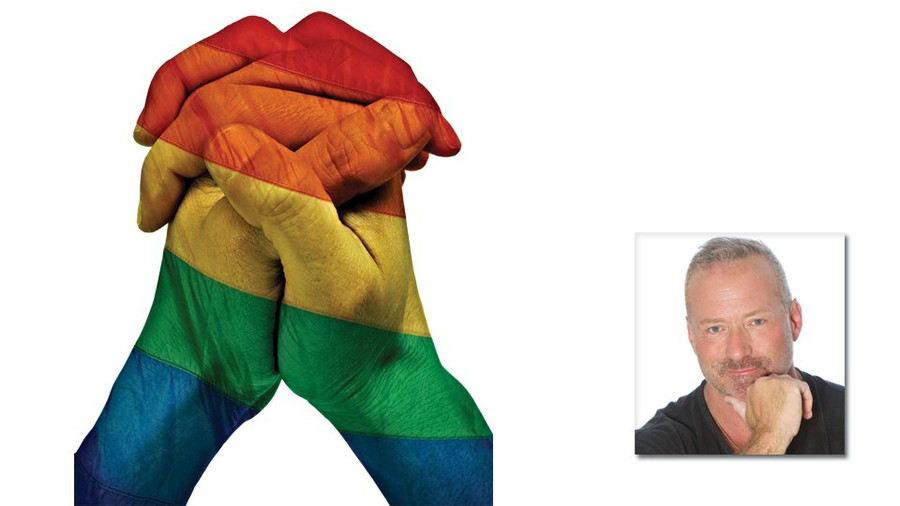
Richard Anderson is an entrepreneur and product and brand developer with 20 years experience in the beauty industry. He created Per-fekt, a skin care and makeup line for women that is available on QVC and at Sephora and Ulta. Anderson consults in the sexual health and wellness industry, most notably at United Consortium where he helped launch Bucked, the first brand of gay male lubricants specifically made for men, by men.