



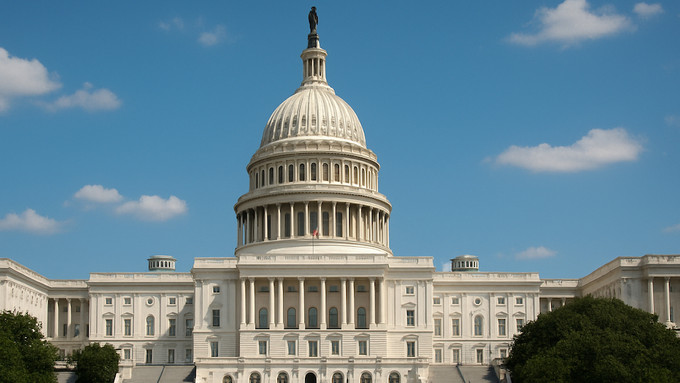
WASHINGTON — The U.S. House of Representatives on Monday passed the Kids Internet and Digital Safety (KIDS) Act, which includes provisions to make age verification by adult websites federal law, but the bill still faces tough going in the Senate.
As XBIZ reported when the House Committee on Energy and Commerce approved the bill in March, the KIDS Act is an omnibus bill combining a suite of online safety bills. One of those bills is an updated version of the Shielding Children’s Retinas from Egregious Exposure on the Net (SCREEN) Act, which would impose nationwide age verification requirements for adult websites.
At the time, the KIDS Act passed the committee on party lines, with Republicans supporting and Democrats opposing the bill. Last week, however, Republican and Democratic committee leaders agreed on compromise language intended to improve the legislation’s prospects before the full House.
That strategy appears to have paid off, as the bill passed the House by a vote of 267 to 117, including 104 Democrats voting in favor.
‘Duty of Care’ Sticking Point
Little attention has been paid to the KIDS Act’s age verification provisions, in Congress or in the media. Instead, opposition has centered around another of the bills in the package: the Kids Online Safety Act (KOSA).
Democrats have objected to the KIDS Act's softening of language in KOSA that would have assigned a “duty of care” to social media platforms, obliging them to prevent and mitigate potential harms to minors. For the same reason, the KIDS Act has been vocally opposed by some 44 state attorneys general and by a coalition of online safety organizations.
Because the KIDS Act specifically rules out a duty of care, it is certain to hit a roadblock in the Senate, which is considering a version of KOSA that does include “duty of care” language.
If the House and Senate do ultimately reconcile their different versions of KOSA, the age verification section of the KIDS Act could make the cut in any final package or could fall by the wayside.
AV Provisions in the KIDS Act
As amended and passed by the House, Title I of the KIDS Act, labeled “Shielding Minors From Obscenity,” mandates that adult sites must implement a “technology verification measure,” defined as “technology that employs a system or process to determine whether it is more likely than not that a user of a covered platform is a minor,” which goes beyond self-declaration.
In addition to verifying users’ ages and preventing those identified as minors from accessing adult content, sites or their third-party AV providers would also have to take “reasonable measures” to address circumvention of technology verification measures — a provision apparently aimed at countering the widespread use of virtual private networks (VPNs) to avoid age verification requirements.
Failure to comply with any section of the proposed law would be treated as a violation of the Federal Trade Commission Act’s prohibition against unfair or deceptive acts or practices. Violators would therefore be subject to civil penalties of up to $10,000 for each violation.
Complicated Compliance Landscape Would Persist
About half of all U.S. states currently have AV laws on the books. If the KIDS Act becomes law, its AV provisions will supersede those state laws.
However, while the legislation originally included language stating that its passage would invalidate state AV laws, the amended version passed by the House specifies that the new federal law would only preempt state laws to the extent that such laws conflict with the Act. It also explicitly permits states to enact and enforce requirements stricter than those included in the KIDS Act.
This constitutes a significant difference for adult site operators who may have hoped that complying with a single federal law would at least be preferable to navigating dozens of widely varying state laws.
In March, industry attorney Corey Silverstein told XBIZ, “The various state-level AV laws have created absolute havoc throughout the industry, containing small differences that make compliance a nightmare for service providers,” while fellow attorney Lawrence Walters noted that the age verification mandate in the earlier version of the KIDS Act appeared “more forgiving” than most state AV laws.
The amended bill passed by the House will instead likely leave most existing AV laws in place, while imposing new federal standards in states currently lacking AV laws.



