



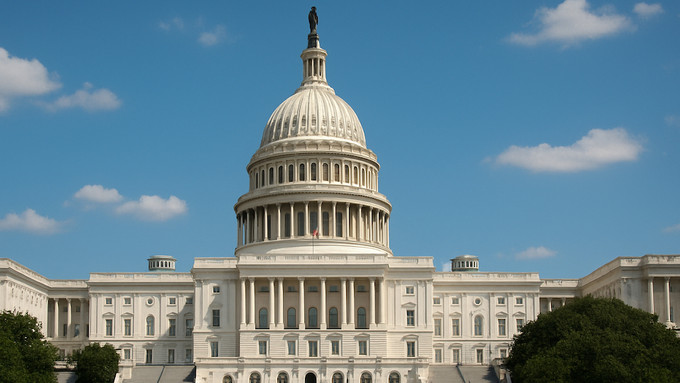
WASHINGTON — A newly announced bipartisan agreement in the U.S. House of Representatives Committee on Energy and Commerce may soon bring a proposed federal age verification law before the full House, but the measure continues to face an uphill battle.
As XBIZ reported when the committee approved the bill in March, the Kids Internet and Digital Safety (KIDS) Act is an omnibus bill combining a suite of online safety bills. One of those bills is an updated version of the Shielding Children’s Retinas from Egregious Exposure on the Net (SCREEN) Act, which would impose nationwide age verification requirements for adult websites.
At the time, the KIDS Act passed the committee on party lines, with Republicans supporting and Democrats opposing the bill. To improve its chances before the full House, Republican committee chair Brett Guthrie worked with Democratic ranking member Frank Pallone Jr. to reach compromise language.
In a statement released Monday, the two said, “We worked across the aisle for many months and have now found common ground on policies to significantly improve the digital environment for kids.”
Specific updates to the bill have yet to be revealed, but they are unlikely to involve the age verification provisions impacting adult sites. Most attention has instead been focused on another of the bills in the package: the Kids Online Safety Act (KOSA). Democrats have objected to the softening of language in KOSA that would have assigned a “duty of care” to social media platforms, obliging them to prevent and mitigate potential harms to minors.
Although bipartisan support from the committee leaders provides a boost for the KIDS Act, it does not guarantee passage by the full House. If the bill does reach the Senate, the “duty of care” issue is likely to halt its progress, since the Senate is considering a version of KOSA that does include “duty of care” language.
If the House and Senate ultimately work to reconcile their different versions of KOSA, the age verification section of the KIDS Act could make the cut in any final package, or could fall by the wayside.
AV Provisions in the KIDS Act
About half of all U.S. states currently have AV laws on the books. If the KIDS Act becomes law, its AV provisions will supersede those state laws.
Title I of the KIDS Act, labeled “Shielding Minors From Obscenity,” mandates that adult sites must implement a “technology verification measure,” defined as “technology that (A) employs a system or process to determine whether it is more likely than not that a user of a covered platform is a minor; and (B) prevents access by minors to any sexual material harmful to minors on a covered platform.”
In order to comply, sites or their third-party AV providers must not only use such a “technology verification measure” to verify the age of a user, but also take “reasonable measures” to address circumvention of technology verification measures — a provision apparently aimed at countering the widespread use of virtual private networks (VPNs) to avoid age verification requirements.
Failure to comply with the proposed law would be treated as a violation of the Federal Trade Commission Act’s prohibition against unfair or deceptive acts or practices. Violators would therefore be subject to civil penalties of up to $10,000 for each violation.



