



WASHINGTON — The U.S. Supreme Court on Friday issued its decision in Free Speech Coalition v. Paxton, striking a blow against the online adult industry by ruling in support of Texas’ controversial age verification law, HB 1181.
HB 1181 was passed by the Texas legislature in May 2023 and is a much-augmented version of Louisiana’s age verification law and its many copycat versions in other states. FSC has condemned the law as “blatantly unconstitutional” and a “violation of the First Amendment rights of creators, consumers and platforms.”
The issue before the court was what standard of review should apply to such a law, which aims to protect minors — but in the process may burden adults’ access to protected speech. The United States Court of Appeals for the 5th Circuit applied only the “rational basis” standard, whereas FSC, its fellow plaintiffs and free speech advocates maintained that the highest level of judicial review, “strict scrutiny,” should apply.
The Supreme Court declared instead that only "intermediate scrutiny" is required because HB 1181 "only incidentally burdens the protected speech of adults," and that applying intermediate scrutiny shows the Texas law to be constitutional.
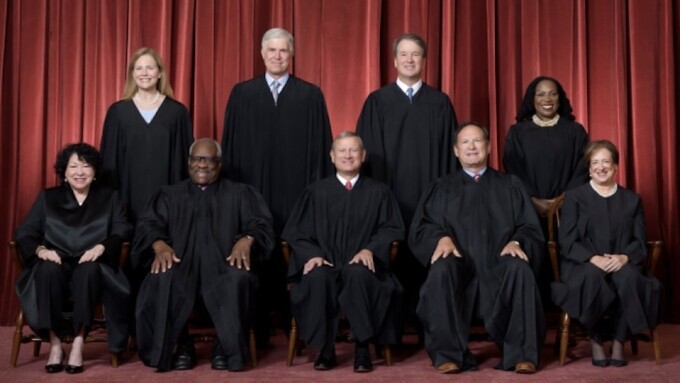
The decision was 6-3. Justice Thomas wrote the opinion for the majority, with Justices Roberts, Alito, Gorsuch, Kavanaugh and Barrett joining. Justice Kagan dissented, joined by Justices Jackson and Sotomayor.
"H.B. 1181 has only an incidental effect on protected speech, and is therefore subject to intermediate scrutiny," the decision reads. "The First Amendment leaves undisturbed States’ traditional power to prevent minors from accessing speech that is obscene from their perspective. That power includes the power to require proof of age before an individual can access such speech. It follows that no person — adult or child — has a First Amendment right to access such speech without first submitting proof of age."
The decision calls the petitioners’ counterarguments "unpersuasive," noting that the contention by FSC and its fellow plaintiffs that "other means of protecting children are more effective and that children are likely to encounter sexually explicit content on other websites" due to HB 1181's requirements does not apply, since intermediate scrutiny does not require states to adopt the "least restrictive means" of protecting minors online.
Industry and Free Speech Advocates Respond
Alison Boden, executive director of the Free Speech Coalition, responded to the ruling, saying, “As it has been throughout history, pornography is once again the canary in the coal mine of free expression. The government should not have the right to demand that we sacrifice our privacy and security to use the internet. This law has failed to keep minors away from sexual content yet continues to have a massive chilling effect on adults. The outcome is disastrous for Texans and for anyone who cares about freedom of speech and privacy online.”
Industry attorney Corey Silverstein called the ruling "a major blow to the First Amendment, free speech and the entire adult entertainment industry."
"Future challenges against laws like Texas’ age verification are going to have a difficult time moving forward," he told XBIZ. "The court’s application of intermediate scrutiny vs. strict scrutiny is incorrect in my opinion, but the Supreme Court has spoken. This decision will embolden states that already have age verification laws in place to pursue enforcement actions sooner rather than later — and states that have been waiting for this decision to push forward with their own age verification laws won’t hesitate to move forward.
"Each and every website offering adult entertainment products and services now has some challenging decisions to make and should be consulting with their legal advisors immediately,” Silverstein added.
Aaron Mackey, who serves as free speech and transparency litigation director at the Electronic Frontier Foundation, called today’s decision "a direct blow to the free speech rights of adults."
"This ruling allows states to enact onerous age verification rules that will block adults from accessing lawful speech, curtail their ability to be anonymous, and jeopardize their data security and privacy," Mackey said. "These are real and immense burdens on adults, and the court was wrong to ignore them in upholding Texas’ law."
Industry attorney Lawrence Walters observed that in upholding the Texas law under intermediate scrutiny, the court applied a standard that "was not seriously argued by any party to the case."
"Application of intermediate scrutiny to this type of law is an unfortunate development for the First Amendment, user privacy and the adult industry," Walters told XBIZ. "However, the court did not go as far as Texas wanted, or as far as the 5th Circuit decided, by upholding the law based on the rational basis test. Some age verification laws may go too far and fail the intermediate scrutiny test set forth by SCOTUS. Future cases will determine the scope of First Amendment protection of adult access to sexually explicit content under this new test."
Foundation for Individual Rights and Expression Chief Counsel Bob Corn-Revere issued a statement saying, "This wrongheaded, invasive result overturns a generation of precedent and sacrifices anonymity and privacy in the process. Data breaches are inevitable. How many will it take before we understand the threat today’s ruling presents? Americans will live to regret the day we let the government condition access to protected speech on proof of our identity."
'Backwards Reasoning'
In her dissent, Justice Kagan declares, “In today’s opinion, speech rights are pushed to the sidelines, or entirely off the field.”
“Texas’s law defines speech by content and tells people entitled to view that speech that they must incur a cost to do so,” her dissent reads. “That is, under our First Amendment law, a direct (not incidental) regulation of speech based on its content — which demands strict scrutiny.”
Kagan also argues that the court's decision departs from precedents set in past cases such as 1997's Reno v. ACLU and 2004's Ashcroft v. ACLU.
Writing for the majority, Thomas explains this apparent departure in part by noting, "With the rise of the smartphone and instant streaming, many adolescents can now access vast libraries of video content — both benign and obscene — at almost any time and place, with an ease that would have been unimaginable at the time of Reno and Ashcroft II."
Kagan, however, warns that some individuals will forgo accessing protected speech — adult content — because of the requirement “to identify themselves to a website (and maybe, from there, to the world) as a consumer of sexually explicit expression.” The requirement to verify their age by using either a government-issued identification or transactional data, she writes, is a deterrent, imposing a “chilling effect.”
Kagan also accuses the majority of “backwards reasoning” in the case.
“The usual way constitutional review works is to figure out the right standard (here, strict scrutiny because H. B. 1181 is content-based), and let that standard work to a conclusion,” she states. “It is not to assume the conclusion (approve H. B. 1181 and similar age verification laws) and pick the standard sure to arrive there.”
“A State may not care much about safeguarding adults’ access to sexually explicit speech; a State may even prefer to curtail those materials for everyone,” Kagan's dissent concludes. “Many reasonable people, after all, view the speech at issue here as ugly and harmful for any audience. But the First Amendment protects those sexually explicit materials, for every adult. So a State cannot target that expression, as Texas has here, any more than is necessary to prevent it from reaching children.”
The court’s ruling is expected to impact implementation of state age verification laws around the country, as well as other pending litigation. Some cases that were put on hold in anticipation of the court’s decision in this case, including in Texas, Indiana and Florida, can now be expected to advance, as can similar legislative proposals in other states.



