



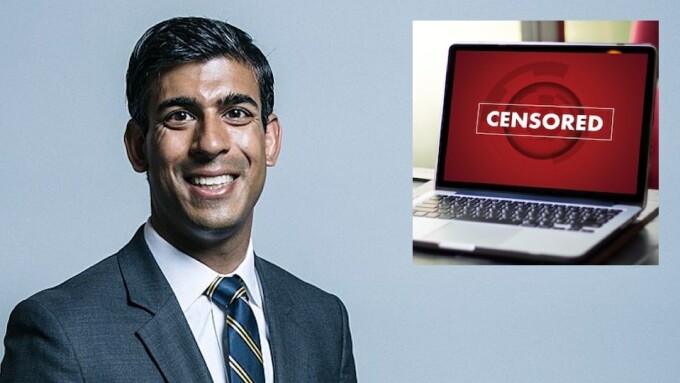
LONDON — Rishi Sunak, the Conservative prime minister of the U.K., has ordered a full review of British pornography laws.
The news was first reported on Monday by The Telegraph.
Sunak, the conservative newspaper explained, “wants all legislation covering pornography both on and offline to be reviewed to ensure that it is ‘fit for purpose’ in tackling exploitation and abuse.”
The Prime Minister’s Office released a statement noting, “There are currently different regimes that address the publication and distribution of commercial pornographic material offline, such as videos, and online. The Government wants to ensure any pornography legislation and regulation operates consistently for all pornographic content.”
The U.K. — a monarchy with no written constitution and an unelected chamber of Parliament dominated by aristocrats — has no blanket free-speech protection like the U.S. First Amendment.
Sunak’s review comes in response to a campaign to influence the Tory government’s controversial Online Safety Bill, led by Conservative MPs Miriam Cates and Sir Bill Cash, as well as Conservative peer James Lord Bethell. Cates and Cash are elected members of the House of Commons; Bethell holds an unelected, hereditary seat in the House of Lords.
As XBIZ reported, after years of delays, the Sunak government has made the controversial bill a priority, seeking to hand a victory to social conservatives, religious crusaders and SWERF activists. Those groups have been conducting a moral panic campaign around “harmful content” — which for many of them includes all porn — through the U.K. media, marketing the bill as a “save the women and children” measure while disregarding or minimizing privacy and technical issues.
The latest version of the bill, The Guardian pointed out in November, has gone through four prime ministers and seven secretaries of state since initially being proposed in an “online harms” white paper during former PM Theresa May’s tenure.
A Weak Prime Minister Bows to 'Rebel' Conservatives
Last week, Sunak was pressured into backing a “rebel amendment,” not part of the original proposal, which will require “highly effective” age verification.
“Under a further amendment, social media bosses will also face jail if they allow child sexual abuse content to remain on their platforms,” The Telegraph reported, noting that the newspaper had intervened in the debate by “exposing a loophole” in the original legislation.
Bloomberg reported in January that anti-porn Tory MPs threatened a rebellion that “prompted Sunak to cave in to demands for Big Tech directors to face jail if they fail to remove harmful content.”
The Online Safety Bill has been stuck in conceptual chaos since its very beginnings, juggling various unclear goals such as “protecting children,” “outlawing hate speech,” “cleaning up the internet” and other fuzzy notions popularized through various media panics concerning online content.
The Prime Minister's 'Pornography Review'
Sunak’s Pornography Review aims to “make sure that illegal and harmful content, such as that which features child sexual abuse and exploitation, or where adults are being exploited, is robustly dealt with,” the Prime Minister’s Office stated.
Tory Technology Minister Paul Scully told The Telegraph that the first priority of any government is keeping the public safe, especially with technology moving faster than ever.
“We cannot take our eye off the ball in exploring what more we can do,” said Scully. “Our Pornography Review will look closely at the laws and regulations relating to offline and online content, informing our next steps in tackling the heinous crimes of exploitation and abuse, wherever it occurs.”
The Online Safety Bill has been universally criticized by free speech and digital rights advocates for its arbitrary and expansive definition of what constitutes “harmful content.” More moderate members of the Conservative Party have also criticized the bill for its potential to erode freedom of expression and privacy.



