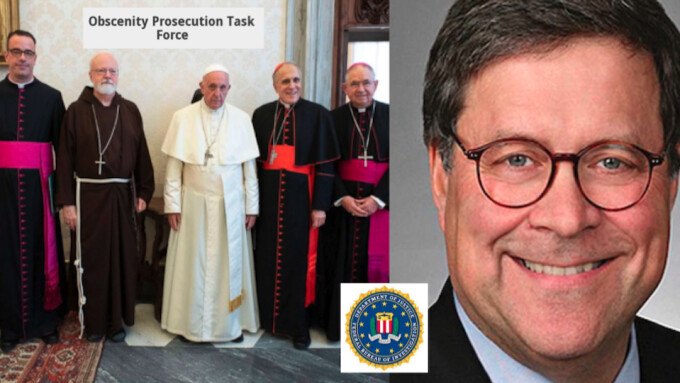
LOS ANGELES — A group of Catholic bishops wrote a letter to the Department of Justice last Thursday urging Attorney General William Barr to revive its Obscenity Prosecution Task Force to target the legal adult entertainment industry in the U.S.
“We write to you today to urge you to confront the ongoing harms wrought by the pornography industry and to protect its victims,” the U.S. bishops wrote in their April 30 letter, according to Catholic news organizations.
The Catholic leaders, in co-ordination with faith-based groups like Exodus Cry (an offshoot of the controversial Midwestern evangelical ministry International House of Prayer) and the Mormon-based Fight the New Drug, made their argument based on debunked War On Porn notions like “all porn is human trafficking,” “no porn can be consensual,” “porn addiction is a medical issue” and “pornography is a public health crisis.”
“As pastors,” the bishops wrote, “we frequently see the pain that results from a pornography habit. Marriages that are injured or even broken by a spouse’s pornography use, which some divorce lawyers report as a factor in over half of their cases, have a ripple effect on children and society.”
Catholic clergy have been known to make sweeping pronouncements about sexual expression, human sexuality, the sexuality of women and LGBTQ+ people, and the sexualization of minors, even as Church leadership has repeatedly acknowledged their egregious mishandling of persistent sexual abuse of children by their priests.
Following the lead of NCOSE (a faith-based group formerly known as Morality in Media), the Catholic bishops have tried to take advantage of the current COVID-19 public health crisis to stamp their request for state censorship and prosecution of sexual expression.
“With pornographic website traffic spiking while countries remain on lockdown, the bishops of the United States are urging the Justice Department to protect victims of human trafficking and exploitation by enforcing obscenity laws and prosecuting producers of violent pornography,” reported the Catholic news media.
The Bishops' Pornhub Obsession
Like other War On Porn crusaders, the Catholic bishops targeted many of their efforts on a single tube site, Pornhub, lambasting their free premium subscription marketing campaign for citizens of countries on lockdown during the current health crisis.
“The bishops,” wrote the Catholic Telegraph, “acknowledged that many people are suffering through lockdowns and isolation alone, and echoed Pope Francis’ call to recognize the importance of ‘belonging as brothers and sisters’ in the midst of crisis."
According to the Catholic clergymen, “pornography is the antithesis of this” because it “diminishes the health of users’ relationships with others.”
The bishops also pointed out “that at least 15 states have declared pornography a public health crisis,” showing their co-ordination with other War On Porn crusaders — particularly Evangelical and Mormon legislators — which have attempted to deflect funding and initiatives from actual public health issues towards hiring anti-porn groups to “train” state employees.
The DOJ’s Obscenity Prosecution Task Force was founded under George W. Bush in 2005 and was dissolved by Eric Holder, Obama’s attorney general, in 2011.
Last December 2019, four members of Congress asked AG Barr to revive the task force. On March 9, Senator Ben Sasse (R-Nebraska) echoed their message and specifically targeted one company, Pornhub, in a letter to Barr, going against standard GOP policy concerning state intervention in free markets.