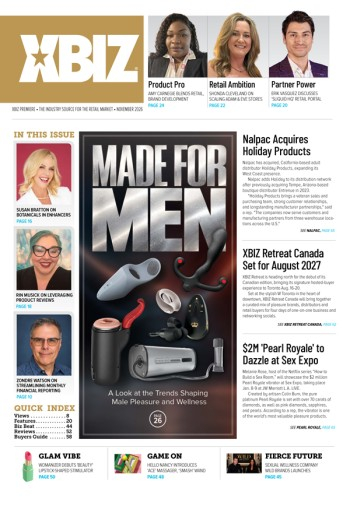

In 2012, Amy Carnegie was pursuing a master’s degree in forensic psychology and looking for a part-time job close to home when she discovered Good Vibrations’ newly opened Oakland location. The store was on the same bus route she took to school, making it a convenient option. She didn't anticipate the position would lead to a nearly 15-year career, during which she would rise through the ranks to become head of buying and product development for Good Vibrations, Babeland and Camouflage.
For Carnegie, the appeal went beyond convenience. She was immediately drawn to Good Vibrations' welcoming atmosphere.
Ultimately, seeing customers leave happy and so thrilled to introduce the toys to somebody else makes me happy.
"Walking into the store for the first time and thinking, this is a really cool, comfortable space," she recalls. "Wait, I'm encouraged to ask questions. Wait, you can actually give me an answer and not judge me."
That sense of openness resonated with Carnegie, whose academic background had already sparked an interest in human behavior, sexuality, and the importance of creating spaces where people could express themselves.
She began as a part-time sales associate, then moved into a full-time role, eventually becoming a lead, assistant manager and store manager. Her career continued to advance as the company expanded its retail operations, creating opportunities that would take her far beyond her original Oakland location.
The same day Carnegie was promoted to store manager, the company announced its acquisition of Babeland. The acquisition introduced her to another retailer with a similar mission and approach to sexual wellness, ultimately opening the door to additional leadership responsibilities.
In 2018, Carnegie was asked to manage Babeland's Seattle store for the summer. After helping build the team and promote employees to leadership roles, she received an unexpected call informing her that she had been named Babeland's area manager.
Before long, she was traveling between Seattle and New York, overseeing four Babeland locations while continuing to supervise her original Good Vibrations store in Oakland.
The responsibilities became even more demanding when the COVID-19 pandemic disrupted retail operations. In New York, Carnegie helped navigate shifting regulations, implement safety protocols, coordinate curbside pickup, and prepare employees to reopen stores.
Listening Comes First
Although Carnegie's career took a different direction from the forensic psychology field she originally studied, she sees a strong connection between her education and her work in the pleasure industry.
Her academic training emphasized the importance of listening, understanding individual experiences and recognizing that people approach sensitive conversations with different needs and expectations.
"Actually, listening is really key in this industry," she explains. "It's about hearing what someone is telling you — their needs and what they're looking for — and remembering that this experience isn't about you; it's about them and the trust they place in you to share very intimate details."
That philosophy remains central to Carnegie's approach to retail operations and product selection. As head of buying and product development, she evaluates merchandise, develops private-label offerings, and collaborates with the marketing team on vendor sponsorships and promotions. However, unlike buyers who work primarily behind the scenes, Carnegie still spends time in stores.
Her extensive operational background enables her to assist with staffing, train employees, troubleshoot technical issues, and work directly with shoppers. These interactions are especially valuable because they offer insights that sales reports or secondhand feedback may not capture.
"I get to connect with customers and hear their feedback firsthand, learn about possible misconceptions, and help clear them up,” she says.
She sees this blend of customer interaction and product development as a practical extension of her psychology background: it lets her observe consumer behavior and apply those insights to purchasing decisions.
Curating With Purpose
When evaluating new products, Carnegie considers several factors, including design, functionality, packaging, materials and overall customer appeal.
Having worked across multiple stores and markets, she also understands that a product's success can depend on the customers who visit a particular location.
"I want to be mindful of bringing in products that you may not find at every single place," she notes.
Evolving With Customers
Carnegie has seen significant changes in consumer behavior throughout her career, especially since the pandemic.
She recalls a time when many customers gravitated toward familiar products and were reluctant to try new ones. Since then, increased exposure to online shopping and digital content has introduced more consumers to a wide range of pleasure products.
Carnegie cites the company's decision last year to introduce sexual enhancers as an example of adapting longstanding merchandising policies in response to evolving products, consumer interests and available information.
The decision required careful research and consideration of how the category aligned with the retailer's educational approach.
"We want to be able to meet people where they're at and be mindful about what we put out in the world, because people are coming to us for advice," she explains.
Her satisfaction with bringing new products to market becomes especially apparent when she sees customers enjoying something she helped develop for Good Vibrations’ own brand.
During a recent shift at the San Francisco store, Carnegie was promoting a new private-label toy when a shopper enthusiastically recommended it to a friend, calling it life-changing. Knowing she had helped choose and develop the product made the interaction especially rewarding for Carnegie.
"Ultimately, what makes me happiest is seeing customers leave excited about their purchases and eager to share their new toys with someone else," she says.
Building on Experience
Looking back, Carnegie credits mentors and industry colleagues with helping her develop her understanding of product selection and manufacturing.
Among those who influenced her was former Good Vibrations buyer Coyote Days, whose approach to evaluating merchandise left a lasting impression.
Carnegie recalls visiting warehouses, learning about manufacturing processes, and observing how products move from development to the retail floor.
She also remembers attending early vendor training sessions with industry professionals, including Lovehoney Group’s Kim Card, Lupe Martinez of CalExotics, and Brent of Aneros, whose expertise helped shape her early understanding of the business.
Today, she finds it rewarding to work with some of those same professionals, now in a position to make purchasing decisions herself.
As Good Vibrations approaches its 50th anniversary in 2027, Carnegie is eager to honor the retailer's history while continuing to pursue growth opportunities.
"My goal is to continue to meet people, collaborate on awesome ideas, and make pleasure something people are thrilled to approach, and something that is just very normalized," she gushes.