
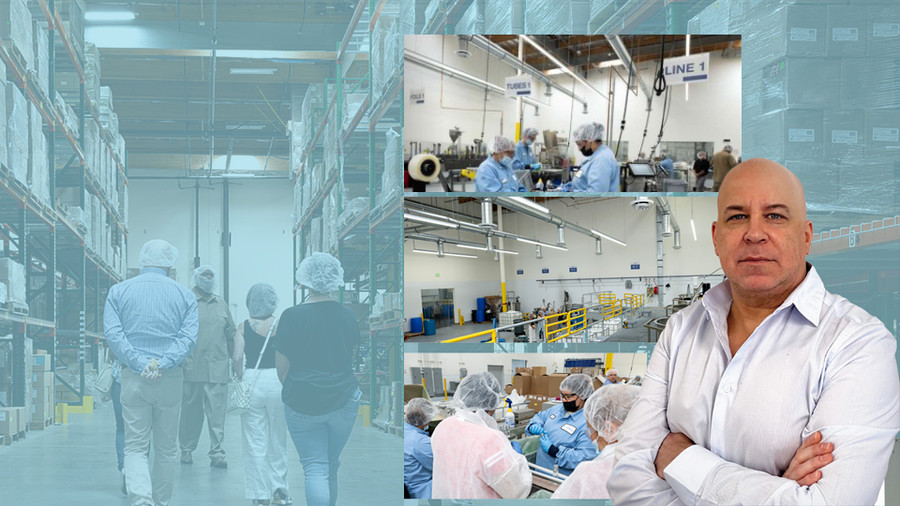
Stepping through the front doors of CC Wellness’ 215,000-square-foot headquarters, you first encounter the lubricant manufacturer’s comprehensive process in the company’s wall of plaques, which celebrate more than 25 formulas that have received FDA 510(k) clearances for medical devices.
Within its walls, ingredients go through a carefully managed process that includes formulation, compounding, filling, inspection, testing, warehousing and distribution. This setup provides the infrastructure necessary to produce products for its own brands as well as for external partners.
From the moment raw materials enter our production facility, through testing in our laboratory and R&D lab, our extensive in-house testing sets us apart.
“We do a lot of contract manufacturing,” said Timothy Ferencz of CC Wellness during a recent tour of the facility. “That’s a big part of the business right now. If a company or a person creates a product and needs manufacturing, they can come to us.”
The scale is a dramatic change from CC Wellness’ beginnings. According to Ferencz, the company began manufacturing in a single room before expanding to approximately 15,000 square feet. Today, its headquarters dedicates 21,000 square feet to manufacturing, 2,000 square feet to R&D and quality operations, and 80,000 square feet to warehousing and distribution.
The move has also allowed CC Wellness to build dedicated areas for processes that previously competed for space. During the facility tour, visitors pass through separate areas for preweigh, compounding, filling, cleaning, quality, laboratory, maintenance, receiving and warehousing. The layout is designed to keep materials moving in a defined sequence while consolidating more steps under one roof.
The upgrades to CC Wellness’ facilities include additional filling lines, improved automation, larger-capacity equipment and processes that reduce changeover time and increase batch throughput and consistency.
The resulting operation gives the company the ability to formulate and manufacture liquids and emulsions across categories that include personal lubricants, cosmetics, skincare, haircare, lotions, creams, shampoos and conditioners.
“All the capabilities we have and what we’ve built out is to not just do sexual wellness,” Ferencz said.
“Really, anyone who has a liquid-type product, we can do.”
Production follows a carefully defined path.
CC Wellness Director of Production Calvin Jeffers walked visitors through the facility’s production flow, beginning with the pre-weigh area, where raw ingredients are measured before being delivered to the compounding team.
Ingredients used multiple times per day are kept in the area, while less frequently used materials are stored nearby. The pre-weigh team generally works about two days ahead of the compounders, helping to ensure that the correct materials are ready when a scheduled batch begins.
Once ingredients are released, they move into compounding. One kettle is reserved exclusively for silicone products to prevent crossover, while other vessels handle water-based formulas that can be produced on shared equipment after cleaning. Purified water continuously circulates through the facility’s system, whether it is actively being used in production or not.
Each ingredient kit is scanned and checked against the production system before mixing begins. After a batch is compounded, a sample goes to quality assurance. The product can only be transferred into a drum or tote after it passes the required checks.
CC Wellness can produce batches ranging from 25 kilograms to 2,000 kilograms. Smaller volumes are typically transferred to drums, while larger batches are moved to totes weighing approximately 2,000 pounds when full. Employees use tablets to document their work, recording the start and end times of each production stage to support traceability and performance monitoring.
During the tour, the compounding department was producing approximately 30 to 32 batches per week. New 300- and 500-gallon kettles were expected to increase output to approximately 38 to 40 batches per week.
“These two new kettles will allow us to do heating and cooling all in one,” Jeffers explained. “Each kettle will have its own heating and cooling mechanism. This is a game changer.”
CC Wellness also has a dedicated cleaning room located between the filling and compounding areas. Equipment is cleaned and swabbed to ensure no residue remains. Additional planned automation includes industrial washing equipment to streamline that process.
Filling capabilities support a wide range of formats.
The facility fills products using bottle, tube and sachet technologies. Its bottle capabilities range from 1 ounce to 55-gallon drums, while tube formats range from 0.34 ounces to 8 ounces. Sachet production begins at 0.34 ounces.
Four bottle lines use similar filling technology but are assigned to different container sizes to simplify scheduling. Across its production lines, the filling department typically produces approximately 200,000 to 210,000 units per week. Depending on a product’s packaging complexity, a line may require anywhere from three to 15 employees.
After filling, bottles are weighed, capped, induction-sealed and labeled. Products may also receive a lot number, expiration date and unique device identification information when required. Finished units are then packed according to each customer’s specifications before moving into the warehouse.
Quality check begins when materials arrive.
CC Wellness operates a Quality Management System compliant with ISO 13485. Employees are required to know the company’s quality policy, which is posted throughout the facility and emphasizes customer service, product quality and continuous improvement.
The process begins at receiving. Raw materials, labels, cartons and other packaging components remain quarantined until they are inspected and released. Inspectors use statistical sampling plans based on quality control standards to determine how many units to evaluate and whether a shipment meets its specifications.
“If it hits the threshold for defects, then we fail it,” explained Jezreel Lobos, the company’s director of quality and regulatory affairs. “Otherwise, it gets released.”
Approved product “standards” are maintained in a restricted-access room. These samples provide a “source of truth” for how a finished product, label and package should look. When a standard is checked out for use on the production floor, the activity is logged, and the sample is transported in a protective lockbox.
“Everything that gets inspected is inspected against an approved standard,” Lobos said. “It’s basically our reference point to confirm that this is what it’s supposed to look like.”
Quality inspectors work alongside production personnel, conducting in-process checks as products move along the line and performing final inspections before products leave the manufacturing area.
In-house testing supports regulatory compliance. The in-house team also performs raw-material evaluation, stability studies and microbial testing for bacteria, yeast and mold. Performing those functions on-site reduces turnaround times and allows the quality, production and R&D teams to investigate concerns together.
That level of control is especially important for personal lubricants regulated by the Food and Drug Administration as medical devices. Ferencz said CC Wellness has 27 formulas with FDA 510(k) clearances. The company also applies its broader quality standards to cosmetics and other products that are not subject to 510(k) requirements.
“Lubricants are a medical device,” Lobos said. “Sooner or later, companies are going to have to take it seriously and recognize that, aside from being a sex product, it goes into people’s bodies, and they should be inspecting and testing for this stuff.”
For Ferencz, the company’s primary advantage is the ability to connect every stage of that journey within one facility.
"From the moment raw materials enter our production facility, through testing in our laboratory and R&D lab, our extensive in-house testing sets us apart," he said.