Are you the same size across clothing brands? I can’t say that I am. Not because my body shape fluctuates all that much, but rather because the size charts are inconsistent.
Consumers have demanded standardized clothing sizes for years. As you are no doubt aware, this would make shopping, especially online, so much easier! However, such changes are yet to be forthcoming.
Customers are known to use product-sizing issues to justify returns of adult goods they simply did not like.
I’m based in Australia, where if you’re a size 4 in women’s clothing, for example, it’s generally assumed that you’re equivalent to a size 0 in the U.S., 4 in the United Kingdom, 5 in Japan, 32 in France and Spain, 34 in Germany and 36 in Italy.
As if that weren’t complicated enough, size 4 does not correspond to the same measurements even just within Australia. With some brands, it can mean bust, waist and hip sizes of 31.5 inches, 25 inches and 35 inches, while at others it can be 29.5 inches, 21.5 inches and 31.5 inches, respectively.
Try converting that to international charts! Which version of size 4 would you use?
Imagine how much easier it would be shopping for clothing locally, internationally and online if size charts used the same measurements universally. Well, the same applies to adult goods.
Sizing up the problem
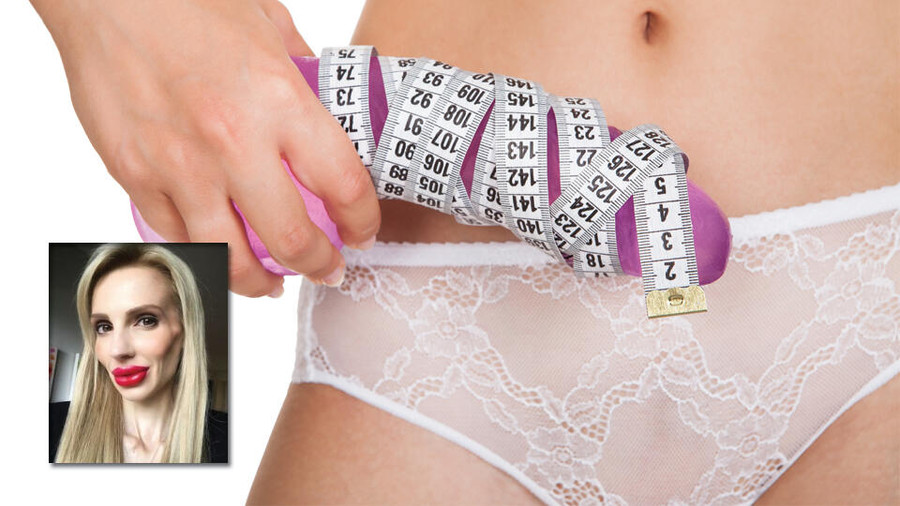
When you hear that a dildo is seven inches long, what exactly does that mean? Is it the length from the tip of the shaft to the base? But what counts as the base?
If the dildo has a scrotum and a suction cup, is seven inches the length you can insert into a bodily orifice? In other words, is the distance measured from the tip of the shaft to the top of the scrotum? Or is it the distance from the tip of the shaft to the base of the scrotum? You may even assume it is the distance from the tip of the shaft to either the top of the suction cup or the underside.
Depending on the manufacturer, it could be any of those possibilities.
Now imagine that you’re a novice adult-goods shopper. You visit an online retailer because it’s less intimidating than walking into a brick-and-mortal store, and search for your first dildo.
You’re inexperienced, but 7 inches seems manageable — albeit larger than the average male. Yes, gentlemen, that’s what the research says.
However, when you receive your highly anticipated order, the insertable length is only 5.3 inches while the overall length from the tip of the shaft to bottom of the suction cup is 7.7 inches.
So, where did "7 inches," as stated in the product title, come from?
It turns out that was the length from the tip of the shaft to the base of the scrotum, excluding the suction cup altogether. Confusing? Yes. But those are the measurements of a dildo currently on the market.
As the shopper, you may be relieved. The shaft is not as flexible as you imagined, so the shorter-than-expected insertable length will make it easier to use.
On the other hand, you may be bitterly disappointed. You were hoping for something larger than your partner or average Tinder date and this toy does not measure up — literally.
If you’re shopping at a brick-and-mortar store, you may be able to hold a toy sample in your hands and judge whether the fit will be right for you. If not, you may find a life-sized image or measurements printed on the packaging. But if you’re shopping online, you put all your faith into the accuracy, clarity and comprehensiveness of the retailer's description.
Measurements demystified
As the creator behind listings for a major online retailer of adult goods, I do not allow new toys to be displayed on our website without having measured them.
You would be surprised how many times the measurements stated in product titles, on packaging and throughout manufacturer catalogs and websites differ from the real thing.
Some of this is due to differences in the anchors used to measure: returning to the dildo-with-suction-cup example, the length could be the distance from the tip of the shaft to any one of several points treated as the “base,” or it could be only to the top of the scrotum — in other words, the insertable part. In some cases, the stated length is just plain wrong altogether, a typo if you will.
Regardless of how a manufacturer defines product length, or width or depth, I aim to make this clear to shoppers.
It’s not just dildos that are of concern. Vibrators, butt plugs, masturbators, cock rings and other toys are also vulnerable to measurement confusion.
For example, is the length of a bullet vibrator the distance from the tip to the base of the shaft or from the tip to the end of an on/off button protruding from the base? Is the length of a rabbit vibrator the distance from the head to the clitoral stimulator — in other words, the insertable part of the shaft — or does it extend to the base of the toy in its entirety? Is the length of a masturbator the distance from end to end, or just the portion that a user can insert themselves into? Would you consider the width of a cock ring to be the distance between the two outermost points or the innermost points — the “gap” the user can insert their shaft into? You may even assume that the width is the thickness, though others may refer to this as depth.
These details may not matter to all consumers, and retailers may brush them off as trivialities, but we are, after all, in the business of bringing people joy.
Plus, it affects the company bottom line. In the absence of actual faults, customers are known to use product-sizing issues to justify returns of used adult goods they simply did not like. “It’s too big,” “It’s not big enough,” “The advertisement is misleading.” All these reasons can be given in hope of receiving a refund or credit for a toy that did not satisfy.
Standardized size charts for adult goods may not eliminate this problem, but as someone at the coalface, I have faith that they would help.
In the meantime, I encourage retailers, especially online, to do what they can to make product sizes as easy as possible for consumers to visualize and understand:
Provide the overall and insertable lengths and widths of dildos, vibrators, butt plugs and other toys, the girth/circumference and even weight, particularly if the item is made from a heavy material such as steel or glass.
Also consider offering imperial and metric conversions. Even though the Australian consumers who comprise most of our customer base use the metric system, they still talk sex using imperial terms!
Providing images of adult toys alongside common objects to indicate relative size can be useful, but take care. The often-used soft drink can, coin and newspaper are not necessarily the same size across countries, so it can be misleading.
Picturing toys in a person’s hands can also be a helpful way to indicate relative size, but if it’s being sold on third-party platforms, ensure this does not breach policies where such imagery is considered demonstration of an adult product in use.
So, where to from here?
Let’s work towards an industry-wide understanding of how to measure adult goods, developing clear size charts that manufacturers and retailers can voluntarily adopt to simplify the merchandising and shopping process. Once we agree on the basics, we can get more granular.
Then, maybe we can teach the fashion industry a lesson or two!
Vanessa Rose is content lead and in-house product expert at Wild Secrets, Australia and New Zealand’s largest online retailer of adult goods. She has a background in psychology, gender studies and corporate wellness, and gets physical outside the office as a qualified personal trainer.