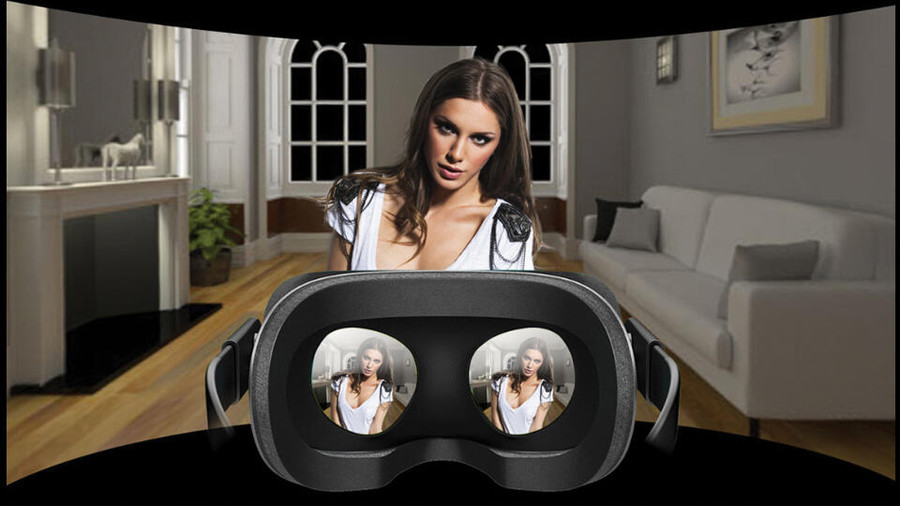
From cameras to headsets to controllers, software and more, virtual reality technology is more than the VR content experience itself — it also surrounds the tools that are needed to create and consume it.
Recently, XBIZ asked some of adults’ VR experts, “What’s the latest hardware you’re taking advantage of to produce top-notch VR content?” Here are the insights they shared:
Speaking from the standpoint of a company that offers live streaming, we are working on an affordable home setup, so independent models can live stream in VR away from a studio, which is very exciting and opens the door to unlimited models and unlimited experiences. -Fabian Grey, AliceX
VixenVR CEO Jimmy Hess said the most exciting hardware currently available is Oculus with Touch controllers and HTC Vive, which also has controllers.
“For us, it is truly about combining the computer-generated 3D environments you can walk through and interact with and the cinematic 360-degree stereoscopic film,” Hess told XBIZ. “We are creating destinations in which the user can walk into The Gold Club San Francisco VR, take a seat and make it rain! Of course, we still offer a wide range of adult content options for the new user on a cardboard or Samsung Gear VR on VixenVR.com and VRClubz.com.”
YanksVR CMO Todd Spaits told XBIZ the company recently upgraded to dual Canon EOS 5D Mark IV cameras with custom rigging depending on the specific shooting needs.
“Other than that,” Spaits said, “good lighting, great scenery and stellar Yanks Girls complete the shoot!”
AliceX CEO Fabian Grey thinks the PlayStation VR headset is one piece of hardware the industry has yet to capitalize on from a consumer’s point of view.
“Speaking from the standpoint of a company that offers live streaming, we are working on an affordable home setup, so independent models can live stream in VR away from a studio, which is very exciting and opens the door to unlimited models and unlimited experiences,” Grey told XBIZ. “This integration will attract a huge database of fans and increase consumer awareness of VR live streaming.”
Reality Lovers’ CEO Rene Pour said it is important to note that the quality of the VR content does not come so much from using a specific camera because the same equipment is used by many competitors.
“It is more in the infrastructure and modifications around them, such as proper synchronization, a fail-proof power supply, remote control and the latest and brightest LED lighting available on the market,” Pour explained. “We wanted to be able to concentrate on producing content without getting distracted by camera troubleshooting.”
For some companies, relying on outside experts rather than courting the bleeding edge of technology in-house (and learning the hard way how that blood flows along with your bankroll as you pursue the latest and greatest hardware systems), is a preferable strategy.
For example, Grooby Productions’ president Steven Grooby told XBIZ he’s working with Paradigm Net Media for VR production.
“[They] are on top of all the latest hardware and techniques and I think in our first run, we’re as good as anything out there,” Grooby said. “We’ll defer to professionals to keep us up to date with what is new.”
Paradigm Net Media founder Telly told XBIZ that since VR is still new, it leaves many creators to invent DIY solutions for their projects, and noted that “while camera gear gets all of the press, there’s much to be said about the importance of post-production strategies which are constantly evolving as well.”
“Creating a dedicated post-production studio capable of handling enormous video and audio files should be a top-line item within the budget of anyone looking to create quality VR content,” Telly explained. “For example, there’s a lot of promise with the new Ryzen 7 chips from AMD, providing eight CPU cores which should help with render times, and the new Titan X from NVIDIA is a beast when working with Adobe After Effects and Premiere in conjunction with Intel’s i7 Kaby Lake processor.”
Like other early adopters that took the DIY camera route, Alex from TmwVRnet.com told XBIZ the studio assembles and maintains its own equipment in-house.
“We upgrade it on regular basis and do our best to use only the newest technologies,” Alex explained.
“We apply new engineering and software solutions once they appear on the market.”
HoloFilm Productions president Anna Lee told XBIZ that everything the studio currently uses has gone through months and years of in-house R&D to produce bespoke solutions tailored to its needs.
“Our crew has always been rooted in a strong foundation in technology and so we have been fortunate to be able to create custom hardware for ourselves to shoot with,” Anna Lee said. “With our ears always to client feedback, we constantly tweak and test with everything from lighting to sound and cameras in order to produce the best content possible.”
CAM4VR content manager Ela Darling is taking advantage of the new 2.0 VR camera the company designed and built internally.
“It allows the performer to get closer to the camera than any other VR camera we’ve found while creating a beautiful 16K 3D 360 VR experience,” Darling declared. “With it, and the software we use on it, viewers can speak directly to performers in real-time at very low latency. We expect to launch this new tech soon and to demo it at the VR Shootout at XBIZ Miami.”
YourVRPorn.com’s public relations coordinator Piper Blush is another fan of custom camera solutions.
“We’ve developed our own camera system from the ground up, with features like real-time processing in addition to high quality, undistorted 3D footage, allowing us much faster turnaround when it comes to shoots,” Blush revealed. “We’re very excited to share our tech with other studios, and especially allow small-to-medium size producers to be able to focus on shooting new, innovative content that pushes the creative boundaries of the industry.”
BaDoinkVR head of production Xavi Clos says that as a technology company first, BaDoinkVR is always researching and testing new equipment.
“Our main challenge right now is to start shooting 4K at 60fps,” Clos revealed. “We are close to a new rig that will make this possible, but that’s all I’ll tell you for now!”
VRBangers’ CEO Daniel Abramovich said the company built its own VR rig in order to produce top-notch content that adds the additional layer of intimacy its fans wanted.
“We’ve built a special head rig with built-in cameras and microphones so that our models can kiss the head rig,” Abramovich said. “When a viewer watches our VR content, they really think that they are getting kissed on the lips.”
Fortunately, the VR marketplace has evolved to a point where cobbling camera parts together at the kitchen table is no longer necessary, with affordable, high-quality options making VR production easier, especially for live cam applications. CEO Jean-Claude Artonne told XBIZ that Terpon is a technology company focused on the newest optics, best components and its own proprietary firmware.
“The Terpon Hermes and Terpon Artemis VR Webcams are the best technology on the market from any camera company in the world and we are pleased to be distributing our cameras to many top performers and studios in adult,” Artonne explains. “At Terpon, we aren’t just taking advantage of hardware… we are the ones actually designing, engineering and distributing the hardware that gives everyone who works with us a competitive advantage.”
Beyond the hardware, innovative VR relies on software and other tools as well.
“Our core product, booomVR, is a VR web browser and content aggregation platform, so we don’t actually create the content,” Rocketbike ARVR CMO Sean Earley said. “Instead, we offer white label solutions for content providers to create their own platform for distributing multiple types of their own VR content.”
VReleased.com CEO Nicholas Dodge told XBIZ that since the company makes room scale interactive adult VR experiences, it relies on the Unity3D game engine to drive the HTC Vive and Oculus headsets.
“Our game, ‘Nympho-Trainer,’ allows you to grab her tits, whip her ass, use a vibrator on her pussy or grab her head and make her give you a nice BJ — these are all custom made interactions utilizing the Unity3D game engine,” Dodge explains. “Using this platform gives us the freedom we need to create content that wouldn’t be possible with just the 180/360° stationary camera rigs.”
Additionally, VReleased is currently working on integrating teledildonics so users will be able to feel what they’re seeing in real time.
“After all, that’s what our company believes VR is all about,” Dodge added, “creating fully interactive, immersive experiences!”
Finally, it’s important to note that VR content can be produced across a variety of devices, ranging from smartphones and GoPro arrays to massive, high-end imaging systems targeting the utmost in quality.
For example, Adam from CamasutraVR told XBIZ the studio uses “a pretty serious rig,” comprised of an Intel dual Xeon-based PC with a triple NVIDIA Quadro M6000 configuration.
“This allows us to compute our captured scans quickly,” Adam says. “We also have a custom facial mocap rig that we use for performance capture and a couple of Noitom full body and finger motion capture suits that we use to capture the body movements. [We also] have 135 up-to-50-megapixel cameras and some proprietary hardware.”
This level of power is needed because the studio’s experiences are made in Unreal and are optimized for the high-end HTC Vive.
“We will roll out mobile and web versions as well in order to monetize on all the hard work,” Adam added, “but we aim to make our flagship product as realistic as possible and that requires a decent gaming rig with a Vive or an Oculus.”
As “gee whiz” as these technologies seem, it’s important to note that VR today is a horse-and-buggy ride in a world of electric-powered Tesla sport coupes — a pale foreshadowing of things to come. Once the tether can be clipped and the minimum required high-end hardware specs become more commonplace, VR hardware will take its next leap forward. In the meantime, smartphone-based systems will continue to dominate the marketplace — driving content creator’s choices in cameras and other gear.