



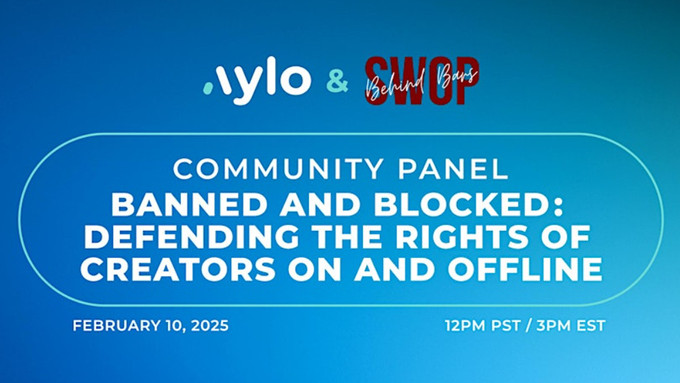
LOS ANGELES — Aylo and Sex Workers Outreach Project (SWOP) Behind Bars presented, on Tuesday, an online panel on creators’ rights, debanking and deplatforming.
Titled “Banned and Blocked: Defending the Rights of Creators On and Offline,” the event was co-hosted by SWOP Behind Bars Executive Director Blair Hopkins and Aylo VP of Brand and Community Alex Kekesi. It featured, as panelists, sex worker rights activist Savannah Sly of New Moon Network, and outspoken creator/activists Cherie DeVille and Siri Dahl. Dahl hosts the annual Corn Telethon.
The discussion addressed how deplatforming by banks, payment processors and digital platforms impacts adult content creators, other sex workers and related advocacy organizations, as well as what strategies are being used to combat those challenges.
Hopkins began by inviting panelists to speak on how debanking and online bans have affected their own work and lives.
Sly recounted having an account with a payment processor shut down for “suspicious activity” while she was in her early 20s and working as a dominatrix. Since then, she noted, she has met countless sex workers who have lost bank accounts and access to payment applications.
“We see it all the time, and it’s really destabilizing,” Sly attested.
Being unable to access your money, she added, is dangerous and causes instability in your life, as well as for advocacy organizations working for sex worker rights.
Dahl described setting up a business account a few years ago with a startup bank marketed as being for creators with LLC businesses — only to see it shut down after six months. She speculated that the action was almost certainly due to most of her deposits being from OnlyFans parent company Fenix International, though no one at the bank could tell her why her account was shut down or even how long it would take until she could receive back the money that was in it. It ultimately took two months for that check to arrive, she added.
“The bank just hits the button, deletes the acct and then never looks back,” Dahl said.
Dahl also noted that she has repeatedly experienced digital deplatforming.
“I’m on my 10th Instagram account,” she shared.
DeVille said that she too had been deplatformed from a variety of social media and had been forced to switch banks. In addition to posing a practical challenge, she noted, such experiences carry an emotional toll, creating a constant sense of insecurity. Deplatforming and debanking, she said, force creators and other sex workers to spend time navigating workarounds instead of earning money.
“It’s really hard to be sexy and creative when you’re worried about paying rent, paying taxes, buying your food,” DeVille said. She shared that a friend of hers had been denied access to her bank account while fleeing the January 2025 Southern California wildfires, right when she most needed her funds.
Sly related how community organizations that support sex workers by hosting events, educating and conducting street outreach face similar predicaments.
“When their bank account gets shut down, that is a ton of time, a ton of energy,” Sly said. “It’s totally unjust.”
DeVille added that when debanking and deplatforming happen at an institutional level, it provides more ammunition for those who claim that such measures are justified.
Kekesi raised the question of why adult creators are targeted for deplatforming and how bank policies play a role.
Dahl discussed the frequent conflation of sex work with sex trafficking by organizations like NCOSE and Exodus Cry. Religious anti-porn groups, she noted, raise funds by presenting themselves as anti-trafficking but then spend that money to create big media campaigns to fight the legal porn industry.
Kekesi pointed out that such efforts ultimately hurt sex workers, whom such groups are supposedly trying to protect. DeVille agreed, noting that deplatforming and debanking push people into less stable work and onto less stable platforms.
“It is all a lie,” DeVille said. “It’s all a Trojan horse. It’s all a blanket they are pulling over people’s eyes to get rid of legal, ethical porn.”
Dahl posed the question, “How do you message this to regular people so that they can understand the reality of what’s going on?”
The other panelists praised a recent video Dahl posted online, in which she argues that supporting sex trafficking survivors “cannot lead to meaningful change without also supporting sex workers’ labor rights.”
Hopkins turned the conversation to what sex workers and their allies can do on an advocacy level to raise awareness and reshape the narrative around these issues.
DeVille urged allies to pass along the message, especially since sex workers themselves are often seen as “discredited.”
Kekesi urged adult companies to embrace opportunities for mainstream access, such as working with researchers and scholars. She noted that reports such as “Account Closed Without Notice,” by Canadian scholars Maggie MacDonald and Val Webber — who serve as advisors to Ethical Capital Partners, which owns Aylo — help validate and document issues like debanking and deplatforming, and are consulted and taken seriously by lawmakers.
Sly concurred that “having allies who can get a foot in the door” is important and cited a recent report issued by the Office of the Comptroller of the Currency, which identified adult entertainment as one of a number of industry sectors that have been subjected to restricted access by banks.
Sly recommended that industry advocates “cross the bridge and form some relationships with those other industries facing discrimination.”
Sly and DeVille both highlighted the Free Speech Coalition as a key organization for making that happen. DeVille lamented that FSC is insufficiently funded and urged creators and companies to support it.
“Lobbying is crucial to your income,” DeVille affirmed. “You can’t expect other people to do this for you. We are all involved in this and we are a relatively small community.”
Panelists also discussed their personal efforts to engage fans on issues impacting creators.
Dahl urged fellow creators to speak out on a regular basis about how they are affected by laws and policies.
“I do this a lot with my fans,” she said. “I get so irritated that we have to deal with this crap, and fans are completely clueless about it … We have to force people to confront that these are real issues.”
DeVille emphasized that debanking and deplatforming constitute a freedom of speech issue with implications far beyond the adult industry.
“Do you want the government to decide what content is appropriate for adults?” she asked. “Do you want everything behind an age gate, where they scan everything?”
Sly applauded Dahl and DeVille for using their platforms to talk about issues that are important to them.
“I love seeing adult content creators use their platforms in that way,” she said, adding that adult creators are potentially “incredibly powerful” if they make their voices heard en masse, something she has seen in her work with Erotic Professionals and Allies United.
Hopkins likewise recommended that creators and allies investigate resources available via FSC and Woodhull Freedom Foundation.
In closing, the panel discussed next steps for those supportive of creators and sex worker rights.
Sly urged support for community organizations that are serving and protecting creators and sex workers, including SWOP, Pineapple Support, Woodhull and FSC.
“Look and see how you can get plugged in when they have a call to action,” Sly advised.
DeVille urged talking to as many people as possible about these issues, even though porn is a subject that some people shy away from — for the sake of everyone’s freedom of speech.
“Don’t let us be the canary that dies in the coal mine,” she said. “Then it’s just too late to escape.”



