



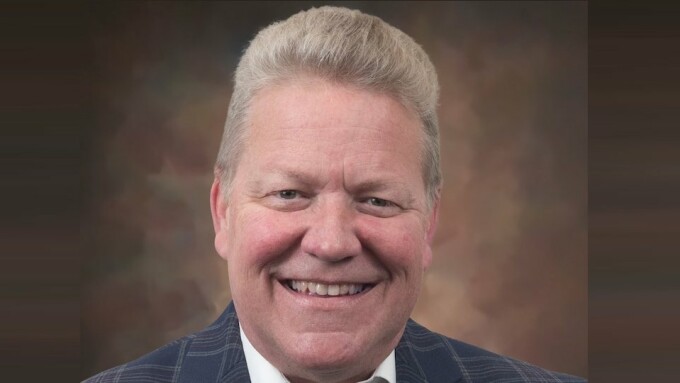
RICHMOND, Va. — State Sen. Bill Stanley, author of the age verification law that led Pornhub to shut down access in the commonwealth of Virginia, has defended the controversial, vaguely worded mandate by claiming that adult websites are harmful because their content is “not normal.”
Stanley, an attorney and politician with no professional expertise on human sexuality or psychology, shared his notions about porn with local outlet WTOP News for a piece on the backlash against Virginia’s unpopular SB1515.
Stanley’s bill was signed into law by Gov. Glenn Youngkin in May and went into effect on July 1, the same day that a similar bill went into effect in Mississippi.
As XBIZ reported, the Free Speech Coalition described the new Virginia law as “extremely vague” about what methods sites can use to comply, and questioned the legislation’s references to “a commercially available database that is regularly used by businesses or governmental entities for the purpose of age and identity verification” or “another commercially reasonable method of age and identity verification.”
The day before the law went into effect, Pornhub decided to shut down access to its platform in both Virginia and Mississippi, explaining that the new state laws — drafted with the cooperation of groups that have targeted the site specifically and whose avowed goal is to “eradicate pornography” — present too much risk.
Pornhub previously followed the same strategy in Utah, shutting down site access in that state when another copycat version of the original Louisiana law that set the pattern for current Republican anti-porn efforts nationwide went into effect there.
Stanley told WTOP News that he was surprised at the backlash from his constituents, and claimed that his family had received threats over his authorship of the law.
“It’s like, dude, why am I getting threats?” Stanley said in a mocking tone. “Because you now have to put in your name and address or an ID to access the internet, bro? I mean, seriously. Your porn — it’s that important to you?”
The state senator then theorized that adult sites are harmful “in the sense of body shaming issues, developing proper relationships, what is normal — because what are on these websites are not normal.”
Stanley Vows to Continue Fighting Adult Content
Stanley is a Ted Cruz-aligned Republican who has been in the Virginia legislature for 12 years. He originally ran on his notoriety as a member of Paula Jones’ legal team in the 1990s, which made public the sexual assault allegations against Bill Clinton.
In the WTOP interview, he vowed to keep reintroducing his bill even if it is struck down as unconstitutional.
“Hopefully, it won’t be challenged,” Stanley told WTOP. “But if it is, I hope that it passes constitutional muster. If it doesn’t, for some small reason in the bill, then I’ll be back next year to change it to put it back where it is.”
FSC Director of Public Affairs Mike Stabile told WTOP that Stanley’s law is flagrantly unconstitutional.
Noting that adult content is legal speech, Stabile said, “You may not like pornography. You may be personally opposed to it, but I think that everybody should be concerned about the government coming in and saying certain legal speech is subjected to greater restriction than other types of speech.”
The sponsor of the Arkansas copycat bill, Sen. Tyler Dees, admitted in February that the state-by-state age verification initiatives are merely a stepping stone toward the ultimate goal of a federal mandate.
“My hope is that we protect children and their innocence in [the] state of Arkansas and then send a message across the country that we need something similar built into federal law as well,” Dees told tech news site Motherboard.
FSC has called the current Republican campaign against adult material online, including the copycat age verification schemes, “the most aggressive censorship we’ve seen in decades.”
Main Image: Virginia State Sen. Bill Stanley (R)



