



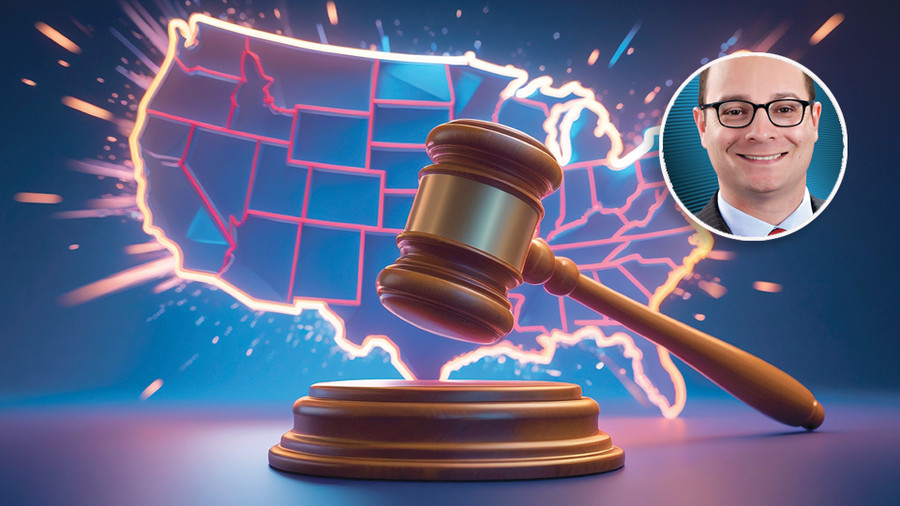
For those who are counting, there are now 20 enacted state laws in the United States requiring age verification for viewing online adult content, plus numerous proposed laws in the works. This ongoing barrage has been exhausting for many in the adult industry — and it may be about to escalate in the form of a potential new AV law, this time at the federal level.
The Shielding Children’s Retinas from Egregious Exposure on the Net (SCREEN) Act is a legislative proposal recently introduced by Republican Sen. Mike Lee of Utah. Much like the various state AV laws that the adult industry has come to know, the SCREEN Act would require adult sites to implement age verification technology to prevent minors from accessing pornographic content.
There is time to get organized, prepare and fight against this blatantly unconstitutional attempt at censoring free speech.
Sen. Lee is touting the support he has garnered for the SCREEN Act from various conservative organizations, including the National Center on Sexual Exploitation, National Decency Coalition, Heritage Action, Ethics and Public Policy Center, American Principles Project, Family Policy Alliance, Institute for Family Studies, Family Research Council, Concerned Women for America, Ethics and Religious Liberty Commission, Culture Reframed, Enough is Enough, Envoc, Foundation and Council on Pornography Reform, Eagle Forum, Eagle Forum of Alabama and The Silent Addiction.
What’s in the SCREEN Act?
Should the bill become law, it would:
- Reject simple age attestation — i.e., simply entering a birthdate or clicking “Yes, I am over 18” — as an acceptable method of age verification.
- Require IP address verification and public transparency of the process.
- Allow companies to choose verification measures and contract with third parties.
- Implement data security requirements.
- Prohibit companies from collecting unnecessary data beyond verifying a user’s age and from retaining information longer than is necessary to demonstrate compliance.
- Require consultation with appropriate experts for enforcement.
- Require regular audits to ensure compliance.
- Direct the Government Accountability Office to report on compliance and issue recommendations to Congress.
Website operators would have one year, after the date of enactment, to implement the SCREEN Act’s requirements. Violations would be treated as an “unfair or deceptive act or practice” under section 18(a)(1)(B) of the FTC Act.
Is the SCREEN Act Constitutional?
The bill faces potential constitutional challenges, primarily under the First Amendment and past Supreme Court rulings related to online content regulation. Here are the key constitutional issues in play:
- First amendment/free speech concerns. The act regulates online pornography, which, while subject to certain restrictions, is still protected speech under the First Amendment. Prior Supreme Court decisions, such as Reno v. ACLU (1997) and Ashcroft v. Free Speech Coalition (2002), have struck down laws attempting to restrict minors’ access to adult content because they were too broad and infringed on the rights of adults. Courts often require that content-based regulations be narrowly tailored and use the least restrictive means to achieve their goals—a test previous age verification laws have failed to meet.
- Overbreadth and chilling effect. If the SCREEN Act imposes burdens on adult users, such as requiring government IDs or biometric verification, it could discourage lawful access to adult content by raising privacy concerns. This could also create a chilling effect, where lawful speech is self-censored due to government-imposed barriers. We have already seen major adult sites withdraw services in states where AV laws have been enacted, due to concerns over user privacy and the feasibility of compliance.
- State vs. federal authority. The Commerce Clause of the U.S. Constitution gives the federal government power to regulate interstate commerce, including the internet. Some state-level age verification laws, like Louisiana’s, have been challenged in court, with opponents arguing that such regulations unduly burden interstate commerce and are best handled at the federal level.
- Technological feasibility and privacy issues. Courts may question whether requiring age verification technology is practical, secure and narrowly tailored enough to meet legal scrutiny. Government-mandated ID verification raises Fourth Amendment privacy concerns and could lead to data security risks.
Similar laws have been struck down before, making it likely that the SCREEN Act would face legal challenges. If it is deemed too broad or restrictive, courts may invalidate it as unconstitutional. However, if the law is perceived as narrowly tailored — e.g., focusing only on commercial porn sites and clear, workable verification methods — it might survive such challenges.
What Should the Industry Do Now?
The adult industry has several options in the form of legal, technological and advocacy-based strategies to address the SCREEN Act and similar legislation:
- Mount legal challenges. If the law takes effect, industry advocates can challenge it in court on some of the grounds listed above. They can argue that the law imposes unconstitutional burdens on adult users and content providers, and work with civil liberties groups like the ACLU and Electronic Frontier Foundation to fight legal overreach.
- Advocate for alternative solutions. The industry can continue to promote parental control tools such as filtering software that allows parents to block content without infringing on adult users’ rights. It can also propose self-regulation in the form of voluntary age verification standards that don’t require government intervention, and/or industry-backed initiatives such as collaborating with tech companies on AI-based content filtering solutions that protect minors while preserving privacy.
- Develop compliance strategies. Should the law take effect, industry stakeholders could work with lawmakers to ensure compliance methods are technologically feasible and don’t infringe on user privacy, and could work to develop privacy-conscious AV solutions that do not store sensitive user data, such as encrypted third-party verification.
- Public awareness and advocacy. The industry could work to educate the public about the risks of overbroad censorship and government-mandated online surveillance, highlighting the danger of AV laws leading to data breaches and exposing users’ private browsing habits. It could also engage in lobbying efforts to amend or soften restrictive provisions before implementation.
- Business adaptation strategies. Adult companies could explore alternative content distribution models like direct subscriptions or private networks that do not rely on traditional adult sites. They could diversify their revenue streams to minimize reliance on ad-based adult content platforms that could be severely affected by restrictive laws.
The SCREEN Act is a potentially major development in the United States government’s ongoing war against the adult industry. Thankfully, the bill is still in the early stages of the legislative process, so there is time to get organized, prepare and fight against this blatantly unconstitutional attempt at censoring free speech. I hope that organizations such as Free Speech Coalition, NetChoice, the Electronic Frontier Foundation, the Woodhull Freedom Foundation and others will strategize, collaborate and join forces in this battle to protect free speech. As always, I encourage you to reach out to your legal advisors for additional information on how the SCREEN Act may impact your business.
Corey D. Silverstein is the managing and founding member of Silverstein Legal. His practice focuses on representing all areas of the adult industry and his clientele includes hosting companies, affiliate programs, content producers, processors, designers, developers, operators and more. He is licensed in numerous jurisdictions including Michigan, Arizona, the District of Columbia, Georgia and New York. Contact him at MyAdultAttorney.com, corey@myadultattorney.com and 248-290-0655.
- Free Speech Coalition
- Woodhull Freedom Foundation
- Electronic Frontier Foundation
- Silverstein Legal
- National Center on Sexual Exploitation
- ACLU
- Culture Reframed
- Family Research Council
- American Principles Project
- Envoc
- Enough Is Enough
- Family Policy Alliance
- Concerned Women for America
- NetChoice
- National Decency Coalition
- Heritage Action
- Ethics and Public Policy Center
- Institute for Family Studies
- Ethics and Religious Liberty Commission
- Foundation and Council on Pornography Reform
- Eagle Forum
- Eagle Forum of Alabama
- The Silent Addiction



