

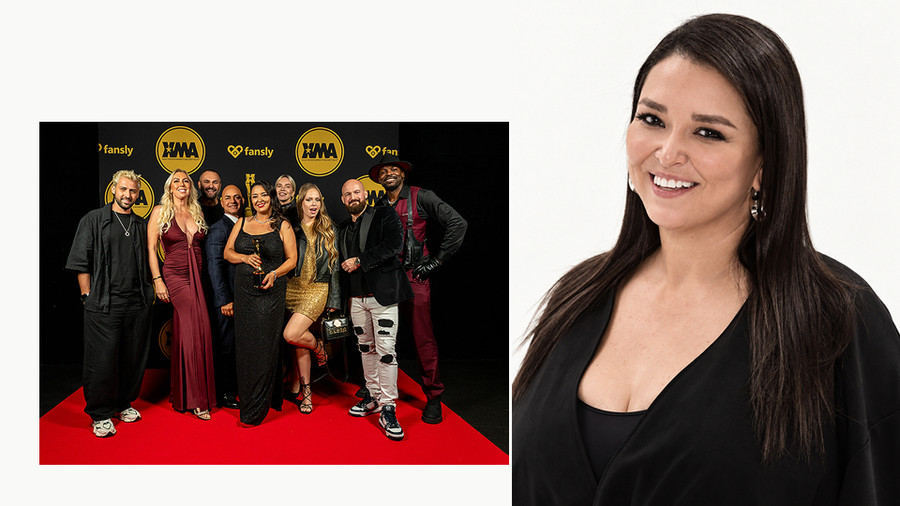
Anyone who spotted the JulModels team zipping around the venue during XBIZ Amsterdam could tell they meant business. Throughout the week, they connected with performers, met with industry partners and joined panel discussions about where the market is headed. The event culminated with founder Julia Grandi taking the Euro XMAs stage to accept her record sixth directing award.
So if it seems like Grandi and her team understand every side of the business, it's because they do.
Twenty years in this industry gives you a very interesting perspective. You see companies come and go, platforms change, and the way we produce and distribute content completely transforms. But for me, the one thing that has always stayed at the center of this business is the talent.
Grandi began her career as a performer before moving into talent scouting, founding JulModels in 2006 and building an award-winning directing career. Along the way, she gained firsthand experience with talent representation, professional production, promotion and content distribution.
"Twenty years in this industry gives you a very interesting perspective," Grandi says. "You see companies come and go, platforms change, and the way we produce and distribute content completely transforms. But for me, the one thing that has always stayed at the center of this business is the talent."
From Clicks to Royalties
Since those early days, the industry has changed dramatically. Performers now have more direct access to fans, greater control over their careers and new ways to earn from content long after they post it. Professional scenes, however, have largely retained the traditional model: Performers receive an agreed-upon fee for the shoot, but their financial participation usually ends there, even when the scene continues attracting views and subscriptions.
“Performers started asking a very reasonable question: Why should professional content be different?” Grandi says.
She found a possible answer in the affiliate programs paysites already used to reward people who referred new customers. Performers helped create the content and had audiences eager to see it, yet they rarely received those ongoing commissions.
“For a long time, this bothered me because somewhere else in that same system, ongoing payments already existed: affiliate commissions,” she explains. “Someone was already being rewarded for bringing a new customer to that content.”
Grandi began imagining a system in which performers could become those affiliates.
“One of my biggest dreams was actually very simple: What if affiliate payouts could become model royalties?” she recalls. “What if the value generated by fan traffic could create a long-term financial relationship between performers and the professional content they helped create?”
The company’s latest program, JulRoyalty, grew from that question. Performers can find their existing scenes and clips from participating paysites, share tracked links with fans, earn royalties from resulting purchases or subscriptions and monitor the results through a dedicated dashboard. The product is open to independent performers, talent represented by any agency and agencies using it with their own rosters. Participants do not need to be signed with JulModels.
With the system in place, the real test was whether performers would promote those scenes, fans would follow their recommendations and paysites could convert that traffic into sales. When transactions began coming through each day, the royalties were modest at first, but the process was working.
“Honestly, I love those dollars and cents because, for me, they are not small at all,” Grandi says. “They prove something much bigger: It works. The loop works, and that changes the question. Now we are asking ourselves: How big can we scale it?”
Building for the Long Game
Scaling that loop is where product owner Evan comes in. He joined the team in April with a background in paysite development and an understanding of what happens after a fan clicks: where they land, whether they find the scene they wanted and what ultimately persuades them to subscribe.
“My role as product owner is to turn that idea into a useful, functional tool,” Evan says. “We are building a system where promoting professional content delivers results for both performers and paysites.”
To do that, the team considers the entire journey, from integrating a partner’s content library and matching performers with their scenes to guiding fans toward the right page and tracking the commissions that become royalties.
Sales data gives the team insight into how people use the product, revealing where fans drop off, which changes improve conversions and how well it fits into performers’ routines.
“We assess each improvement against a specific outcome,” Evan says. “Will it help a performer start using the product, make promotion easier, bring a fan to the right content or make the results clearer?”
Talent manager Johnny contributes the performer perspective to those decisions. Her team regularly discusses current projects and new opportunities while helping talent develop recognizable brands and stronger relationships with their audiences.
“I always encourage performers to think long-term,” Johnny says. “Their content and audience are assets they build over time, and every opportunity to monetize them can become part of their career strategy.”
Turning those assets into income means connecting performers’ audiences with their professional scenes without adding another burden to careers already balancing social media, independent content, fan communication and studio work.
“Models should not have to manage everything themselves,” Johnny says. “Their role is to maintain their presence and create content, while professionals can take care of fan communication, marketing, strategy and the work behind the scenes.”
To provide that support, the team is also developing automated promotion tools.
“We are building AI agents to automate social media promotion,” Evan says. “Our goal is to take promotional automation to the next level and reduce the manual work required from performers and the team.”
A feature now in testing reviews both a paysite’s content grid and a performer’s posts on X.com, then uses that information to draft promotions tailored to the scene and the performer’s usual voice.
For Johnny, the royalties are unlikely to transform a performer’s finances overnight. Their potential lies in creating another source of value that can grow alongside the performer’s career.
“You don’t invest today expecting to become rich tomorrow, but you build something that can continue creating value for you over the years,” she explains.
From Cents to Scale
Alongside simplifying promotion, the team is expanding its partner catalog and giving performers a clearer view of how their efforts translate into earnings.
“Transparency means a clear connection between actions and results: what a performer promotes, where they send their audience and what income that generates,” Evan explains. “This helps them make more informed decisions and see how individual actions can gradually build an additional income stream.”
With real-world transactions demonstrating that the system works, the team is turning its attention to expanding its reach.
“If it works with one performer and one fan, we can scale it to hundreds of performers,” Grandi says. “If it works with one paysite, we can connect more.”
The immediate goal is to make the JulRoyalty program reliable, transparent and easy to use. The larger ambition is to connect more performers with their professional content and transform modest commissions into significant long-term income.
“If it generates a few dollars today, our job is to figure out how to turn those dollars into hundreds and thousands,” Grandi says. “That is the part that excites me most.”