



ATLANTA — An influential self-described “biblical” right-wing group has become the main media mouthpiece for Georgia’s version of the age verification legislation being sponsored around the country by anti-porn religious conservative activists.
The proposal, House Bill 910, was introduced in the state legislature this week by veteran Republican Rep. Rick Jasperse. It would require websites publishing what the law defines as “material harmful to minors” — including pornography — to verify the age of all users. The bill has been assigned to the Republican-controlled House Judiciary Committee.
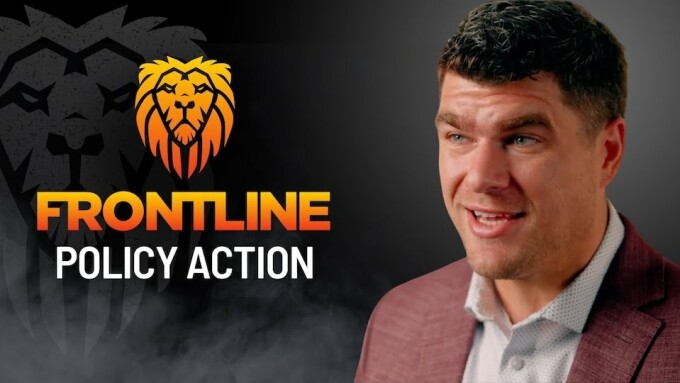
The media campaign promoting the bill is being led by Georgia’s well-funded Frontline Policy Action, which the Georgia Recorder describes as a “right-wing lobbying group.”
Frontline Policy Action is led by religious Republican activist Cole Muzio, who regularly appears in professionally produced YouTube videos promoting the group’s agenda. Muzio regularly provides quotes for mainstream media and publishes detailed manifestos through the group’s website.
According to the group's own literature, Muzio launched Family Policy Alliance of Georgia and Family Policy Foundation of Georgia in 2017, during the first year of Donald Trump’s presidency, in partnership with the national Family Policy Alliance.
In 2021, the group’s website explains, “those efforts were relaunched as Frontline Policy Action (a 501(c)4 organization) and Frontline Policy Council (a 501(c)3) to meet the immediate need in Georgia: to have a state-focused, biblical organization that could tactfully address issues of life, religious freedom, educational opportunity, God’s design, human dignity, free speech, and principled government. We are, first and foremost, Christian organizations that exist to glorify God and equip His people to transform the culture.”
A Self-Described Uncompromising 'Culture Warrior'
Muzio fancies himself a “culture warrior” in a battle in which there can be “no middle ground.” His campaigns have included school book bans and speaking against teaching students about Georgia’s history of racism, which he incorrectly terms “critical race theory.”
“In this Culture War,” he writes, “they wanted us to ‘accept’ civil unions, then gay marriage. They wanted us to accept that Bruce Jenner could be Caitlyn Jenner, and that we should let adults just be who they want to be. But, that ‘slippery slope’ has kept sliding to an all-too-inevitable place. These sick adults want our kids.
“There can be no compromise,” he harangues, “no looking the other way, no willingness to accept the premise of their argument. It is time to put on the full armor of God, stand firm, take action, and defeat this radical agenda once and for all.”
Muzio’s goal, he states, is to “win at the Capitol, at the ballot box, and in our culture to protect children and defend God’s Good and Perfect Design.”
In 2021 Muzio tweeted in support of a statement by fellow Georgia Republican Marjorie Taylor Greene, who posted, “It’s completely unfair that porn can be retweeted” while “self-evident science” — Greene’s transphobic remarks — could not.
Speaking in support of Jasperse’s proposed anti-porn age verification law, Muzio issued a newsletter claiming exposure of minors to porn “can lead to devastating consequences, including addiction, altered brain development and a decline in academic performance.”
“With this bill,” the newsletter continued, “we will preserve the innocence and ensure the healthy development of our children’s formative years.”
Serious Free Speech Concerns
Richard Griffiths, spokesman and president emeritus of the Georgia First Amendment group, told the Georgia Recorder that while it is not his group’s “thing” to support porn, nevertheless “there are real free expression concerns with access-limiting proposals, particularly when you start trying to define what’s harmful content.”
Griffiths added, “It becomes a tricky thing here when we start thinking about how access should be administered. Should the government be the arbiter of that, or should a parent be the arbiter of that? Many parents put controls on their home internet to limit access to where their youngsters can go, to make sure it’s age appropriate. That feels much better a solution than having a government-imposed situation that might also violate the privacy of those who are not juveniles.”
Like similar laws sponsored by religious conservative legislators and activists around the country, Georgia’s HB 910 was carefully drafted to avoid First Amendment challenges over criminal state prosecutions by enabling any parent or guardian to sue infringing websites.
An Aylo rep told the Georgia Recorder that, in practice, the various age verification laws resulting from the current nationally coordinated anti-porn campaign “have just made the internet more dangerous for adults and children. The best solution to make the internet safer, preserve user privacy, and prevent children from accessing adult content is performing age verification at the source: on the device. The technology to accomplish this exists today. What is required is the political and social will to make it happen.
“We are eager to be part of this solution and are happy to collaborate with government, civil society and tech partners to arrive at an effective device-based age verification solution,” the rep added. “The safety of our users is our number one concern. We will always comply with the law, but we hope that governments around the world will implement laws that actually protect the safety and security of users.”
Main Image: Frontline Policy Action's Cole Muzio (Photo: YouTube)



