



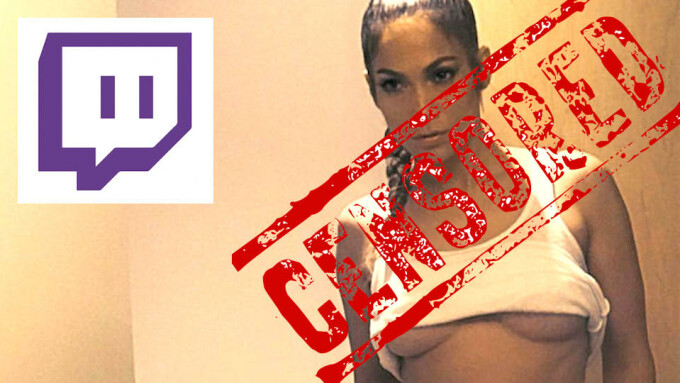
SAN FRANCISCO — Less than a month after an abortive attempt to relax its censorship of adult content, Twitch continues to be embroiled in increasingly specific attempts to define the precise degree to which its streamers may display their bodies.
On Wednesday, Twitch Chief Customer Trust Officer Angela Hession published a blogpost prohibiting implied nudity, effective immediately.
According to Hession, the update comes in response to a recent “meta” —short for “most effective tactic available” — in which streamers “use black censor bars or other items to block their bodies or clothing, or position the camera frame such that the viewer is led to believe that the streamer is fully or partially nude.”
In the post, Hession notes that although “most streamers have labeled this content appropriately with the Sexual Themes label and are wearing clothing behind the object or outside the camera frame, for many users, the thumbnails of this content can be disruptive to their experience on Twitch.”
Hession then goes on to elaborate on a variety of body parts and situations, often resulting in further ambiguities, which have already been mocked by several frustrated users on social media.
“For those areas of the body where coverage is required, the coverage must be fully opaque; sheer or partially see-through clothing does not constitute coverage,” she states, also reiterating that standing company policies do not permit streamers “to be fully or partially nude, including exposing genitals or buttocks,” “to imply or suggest that they are fully or partially nude, including, but not limited to, covering breasts or genitals with objects or censor bars” or “to show the visible outline of genitals, even when covered.”
For those who present as women, Twitch asks that they cover their nipples and “do not expose underbust.” Cleavage, on the other hand “is unrestricted as long as these coverage requirements are met and it is clear that the streamer is wearing clothing.” Streamers are also very specifically instructed to cover the area extending from their hips to the bottom of their pelvis and buttocks.
In 2021, the vagueness of Twitch’s “underbust” policy became fodder for a creator named Tweedraws, who posted a digital drawing on X.com — then Twitter — asking “WTH is ‘underboob’?”
“This also depends on where your nipples are,” they quipped.
A 180-Degree Change of Course
Twitch’s increasingly granular regulation of streamers’ bodies represents a 180-degree change of course since the company’s abortive effort three weeks ago to revise its rules to allow some “artistic” nudity.
At the time, Hession explained that the platform had “received consistent feedback” from streamers that its policies around sexual content were confusing and difficult to follow.
“We want streamers to feel confident they understand our rules and viewers to feel confident they will get the experience they expect,” Hession wrote when announcing the relaxation of the nudity policies.
But less than 48 hours later, twitch CEO Dan Clancy announced that the company had reinstated its ban on sexual content.
Clancy alleged via a company blog post that “much of the content” created under the briefly updated policy caused community concern.
“These are concerns we share,” Clancy stated. “Upon reflection, we have decided that we went too far with this change.”
Moving forward, he added, “depictions of real or fictional nudity won’t be allowed on Twitch, regardless of the medium.”
Popular dances, such as twerking, grinding and pole dancing, appear to still be allowed without a label.



