



NCOSE Goes All-In on Banning Adult Content Online With 2023 Target List

NCOSE Goes All-In on Banning Adult Content Online With 2023 Target List

WASHINGTON — Religiously inspired anti-porn lobby NCOSE this week released its latest annual “Dirty Dozen” list of companies it is currently targeting, focusing exclusively on online platforms.

Unlike the organization’s previous lists — which variously included hotel chains, government and military departments and even the entire state of Nevada — NCOSE’s 2023 target list signals the group’s doubling down on its single-minded campaign to eradicate or severely limit access to adult content online.

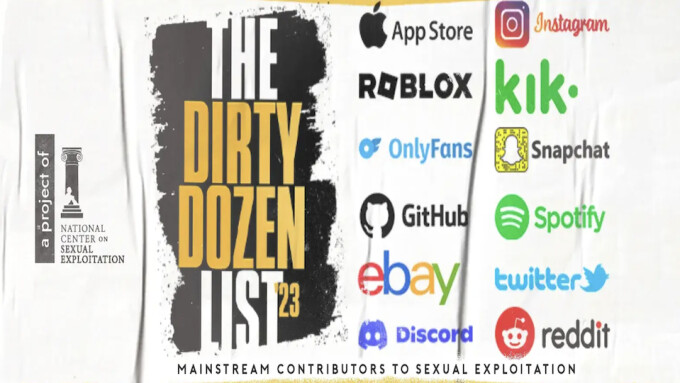
The 12 companies that NCOSE — formerly known as Morality in Media — is spotlighting as “dirty” in 2023 are: Apple’s App Store, Discord, eBay, Instagram, Kik, Microsoft’s GitHub, OnlyFans, Reddit, Roblox, Spotify and Twitter.

Identifying Instagram as “dirty” confirms NCOSE’s commitment to ensuring that the platform continues its policy of discrimination against sex workers and sexual content. As XBIZ reported, NCOSE has boasted of holding policy meetings with Instagram leadership, which Instagram parent company Meta has not denied.

The inclusion of Reddit and Twitter reinforces the group’s current core mission of forcing those two open platforms to ban all adult content — a goal NCOSE is also pursuing by including Apple’s App Store among this year’s “dirty” companies and lobbying it to pressure Reddit and Twitter to eliminate all adult content and sex worker accounts.

“Those on our 2023 Dirty Dozen List were included for facilitating a diverse set of sexual exploitation issues,” declared NCOSE’s Vice President and Director of Corporate Advocacy Lina Nealon while unveiling the group’s list on Instagram.

Nealon, who by her own admission spends time on Snapchat impersonating a 14-year-old girl for research purposes, also claimed that “sexual abuse and exploitation are on the rise and are facilitated by digital platforms.” She called for tech platforms to “stop their products from threatening the safety of children and enabling sexual abuse to happen to people of all ages.”

Religious News Sites Echo NCOSE's Target List

Religious news sites immediately picked up on and amplified NCOSE’s annual hit list. The Baptist Press asserted that the anti-porn group provided “documented examples directly captured from the tech sites and corroborating information supporting the accusations of sexual exploitation.”

Last month, NCOSE launched a new campaign to eradicate all adult content on Reddit. In an open letter, the group called for the platform to take action against “hardcore pornography and sexually explicit content.”

Founded in 1961 by clergy, NCOSE rebranded in 2015, adopting its current name, the National Center on Sexual Exploitation — but has maintained its media censorship focus, even recently labeling mainstream publications like Sports Illustrated and Cosmopolitan “hardcore pornography.”

NCOSE considers all sexually explicit content, regardless of consent, to be exploitative, likens it to trafficking and has denied the very possibility of consensual sex work.


Copyright © 2026 Adnet Media. All Rights Reserved. XBIZ is a trademark of Adnet Media.
Reproduction in whole or in part in any form or medium without express written permission is prohibited.

More News

AV Bulletin: Midyear Roundup

Since the U.S. Supreme Court’s decision in Free Speech Coalition v. Paxton, more state age verification laws have been enacted around the United States, as well as proposed at the federal level and in other countries. Meanwhile, lawsuits resulting from AV laws have begun to play out in the courts. This roundup provides an update on the latest news and developments on the age verification front as it impacts the adult industry.

Judge Dismisses Last NCOSE-Backed Suit Over Kansas AV Law

A federal judge on Monday dismissed a lawsuit alleging that adult site SuperPorn violated Kansas’ age verification law, citing lack of jurisdiction after similarly dismissing two related cases earlier this year.

ASACP Updates 'Restricted to Adults' Labeling Resource Page

The Association of Sites Advocating Child Protection (ASACP) has updated its Restricted to Adults (RTA) labeling resource page.

Federal AV Proposal Scores Minor Win in House but Remains in Doubt

A newly announced bipartisan agreement in the U.S. House of Representatives Committee on Energy and Commerce may soon bring a proposed federal age verification law before the full House, but the measure continues to face an uphill battle.

Arizona Governor Vetoes 'Protect Act' With New Consent Provisions

Arizona Governor Kate Hobbs on Friday vetoed HB 2133, the “Protect Act,” which would have imposed new requirements for adult content uploaded online.

Brazil Begins Monitoring 18 Adult Sites for AV Compliance

Brazil’s National Data Protection Authority (ANPD) is now monitoring 18 high-traffic adult websites for compliance with the country’s Digital Statute for Children and Adolescents (Digital ECA), which requires such sites to age-verify users located in Brazil.

Ofcom Fines First Time Videos $100,000 for AV Noncompliance

U.K. media regulator Ofcom on Thursday imposed a fine of 80,000 pounds (more than $100,000) against First Time Videos, which operates FTVGirls.com and FTVMilfs.com, for failing to implement age checks required for compliance with the Online Safety Act.

Curves Ahead: How BBW Creators are Turning Differentiation Into Competitive Advantage

For centuries, curves have been celebrated as a symbol of beauty, sensuality and power. From the soft opulence of Rubens paintings to the glamorous silhouettes of pinup icons, fuller figures have long occupied a place in art, fashion and fantasy.

Woodhull Freedom Foundation to Host Virtual 'Pride' Edition of 'Fact Checked' Series

Woodhull Freedom Foundation is hosting a Pride Month virtual edition of its series “Fact Checked by Woodhull.”

'InMelanin' Relaunches Through PAYSITE

InMelanin.com has officially relaunched through PAYSITE.

Show More

