



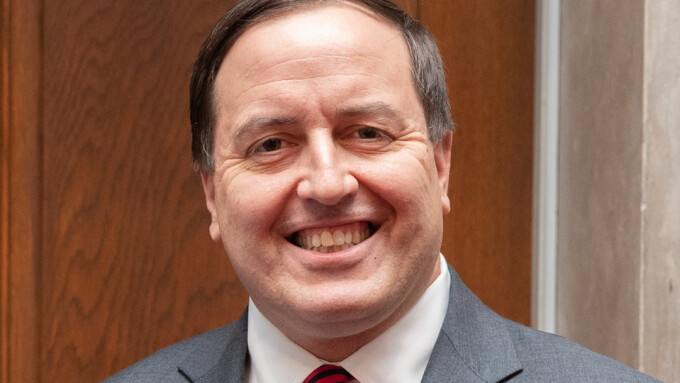
JEFFERSON CITY, Mo. — Missouri Secretary of State Jay Ashcroft has clashed with the St. Louis County Public Library as he pursues his current campaign against what he calls “materials that appeal to the prurient interest of any minor.”
As XBIZ reported, in October Ashcroft proposed a ban on funding for what he called “prurient” library books, explaining at the time that he meant “smut.”
The St. Louis County Public Library’s Board of Trustees, Ozarks First News reported, approved last week a resolution calling for Ashcroft’s proposal to be rejected, citing “concerns about ‘censorship and equitable access’ and saying that policies already exist supporting the best interests of children and families, reflecting the diversity of race, culture, socio-economics, and lifestyle.”
This week, Ashcroft — who is eyeing the Republican nomination for governor of Missouri in 2024 — responded to the Library's objections by telling Ozarks First what he means by “prurient.”
“That means erotic,” Ashcroft said. “That means salacious. That means pornographic. That’s the dictionary definition.”
The Ongoing Republican Attempt to Redefine 'Prurient'
Ashcroft’s proposed rule states that “no funds received shall be used to purchase or acquire materials in any form that appeal to the prurient interest of any minor.”
However, Ashcroft's approach involves redefining the term “prurient,” which bears a very specific legal meaning, central to the legal differentiation between obscenity and free speech protected under the First Amendment.
Industry attorney Lawrence Walters, of Walters Law Group, explained to XBIZ in 2020 that the word “prurient” is defined in the law as “a shameful or morbid interest in sexuality.” Walters pointed out that obviously, adult businesses take the position that their content “does not involve a shameful or morbid interest in human sexuality, but a healthy one.”
Concerns About Censorship
Ashcroft “would not mention specific book titles but says constituents have brought the issue to him repeatedly,” Ozarks First reported. “A 30-day public comment period began on Nov. 15. He said his office received thousands of comments. He urged everyone to weigh in and to be specific with their ideas for changes.”
Earlier this year, Ashcroft claimed to have seen “smut” and “books written for ‘tweeners’ displayed in libraries near a computer intended to be used by young children,” according to the report. Neither “tweener” nor “smut” are legally recognized categories of persons or content.
Ashcroft attacked the St. Louis County Public Library as behaving “kind of like a child, whining and screaming. If they really have a problem with the rule, I would expect librarians above all to read the rule and say, ‘Hey, this is how it should be better.’ There are materials that should not be at the train table where a 5-6-year-old are playing with ‘Thomas the Train,’ but maybe they’re fine in the ‘teenage’ section. The library’s going to make that call.”
Ashcroft's Political Legacy
Ashcroft's father, John Ashcroft, served as attorney general under President George W. Bush and is enshrined in free speech legal history as the losing party in Ashcroft v. Free Speech Coalition, the Supreme Court decision that declared a 1996 censorship law that banned all porn in the name of fighting child pornography to be unconstitutional and overbroad.
The elder Ashcroft’s track record as an anti-sex crusader included a notorious 2002 incident, when he ordered his department to spend $8,000 on blue drapes to hide two giant aluminum art deco statues of partially nude women in the Great Hall of the Department of Justice, “because he didn't like being photographed in front of them,” according to CBS and ABC News.



