



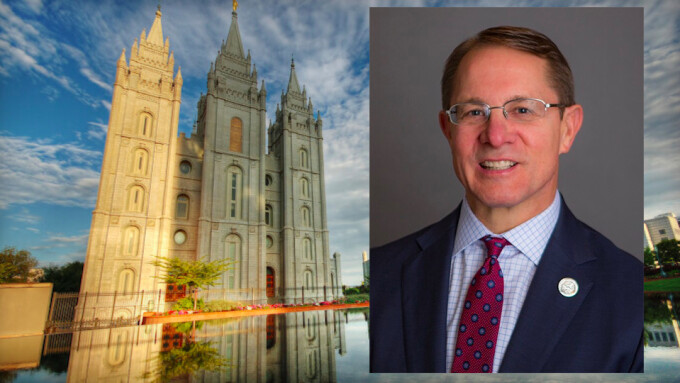
SALT LAKE CITY — A Utah state representative has authored a bill to explicitly ban what he considers “pornographic and indecent books” in the state’s public schools.
HB 374, introduced by Utah Rep. Ken Ivory (R-West Jordan) and targeting what he called “Sensitive Materials in Schools,” passed out of committee without much debate yesterday, although it was “circled” — put in unscheduled limbo — in the state House today.
Although it is already illegal to have “pornographic or indecent” materials in Utah schools, Ivory’s law would give schools “the power to remove books” so deemed “without having to go through the normal review process,” Salt Lake City’s KSL News Radio reported today.
Activist Nicole Mason, from conservative pressure group Utah Parents United, claimed that “our children are right now given unrestricted access to pornographic material in school libraries.”
Another activist at the hearing specifically targeted “All Boys Aren’t Blue,” a book of personal essays by LGBTQ+ author George M. Johnson.
Utah is notorious as a wellspring of anti-porn rhetoric — much of it sensationalized and obsessional, and linked to the state's politicians' porous relationship with the hierarchy and doctrines of The Church of Jesus Christ of Latter-day Saints. The state has been used as a staging ground by national crusaders to pass dubious legislation concerning perceived "porn harms" without much opposition, including measures to invoke a nonexistent "public health crisis" around porn to divert state funds to faith-based organizations.
Activists Framing Censorship as 'Child Protection'
Today, the Salt Lake City Tribune published an opinion piece by Prof. Richard Price calling HB 374 the culmination of “a movement of book banners” who “have sought to frame their censorship activity as about protecting kids from ‘porn’ in school.”
The problem for these censors, Price pointed out, is that “none of these books are ‘porn.’ This label is just attached to anything that Ivory and the UPU do not like and that tends to be stories that represent LGTBQ people as well as people of color.”
According to Price, UPU’s curriculum director Brooke Stephens singled out “All Boys Aren’t Blue” and “calls it obscene because one chapter discusses how Johnson was molested by their older cousin. But obscenity law requires the book to be read as a whole and UPU censors refuse to abide by this reality.”
“Johnson’s book is about what it was like growing up Black and queer in America and to take this rich text and call it obscene because they talk about being sexually abused is absurd and disturbing,” Price’s opinion piece continued. “It ignores the very law UPU claims to celebrate while also reducing Johnson’s experience, their existence, to one episode. Therefore, criminal obscenity complaints have been rejected by police and prosecutors around the country.”
A War Against Empathy
Price wrote that in his research on censorship and book banning he is often asked, “What are book banners afraid of?”
“The simple answer is they believe that only stories that represent their lives, generally straight and white, deserve a place in schools and libraries. Stephens and others describe simply presenting the stories of LGBTQ kids as 'grooming,' as trying to turn their kids gay and/or trans.”
“Luckily for them,” Price concluded, “there is zero scientific evidence to support the idea that simply reading about a gay or trans character turns their kid gay or trans. What it does affect is empathy. Straight, cisgender kids are more likely to empathize with the experience of their LGBTQ friends and classmates. It is that empathy which UPU and Ivory think should be stamped out in Utah schools, and I hope the Legislature refuses to follow along.”
Main Image: Utah State Rep. Ken Ivory (R-West Jordan)



