



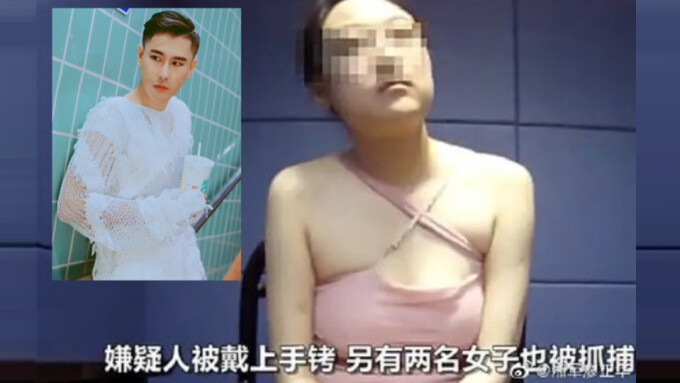
SHANGHAI — The Chinese government recently publicized the June arrest of a Shanghai-based actor-producer-director for allegedly producing pornography, but contradictions in the reporting on the prosecution of Shen Juhui shine a light on both the underground production of sexual content in China and the state’s ongoing moral panic campaign against “celebrity culture.”
The arrest of Shen — or Chen — Juhui was first reported in English on Oct. 29 by Malaysian trends and news site Hype, which headlined, "Award-Winning Director Chen Juhui Arrested For Filming Pornographic Videos.” Singapore news site Today also covered it two days later and Malaysia’s newspaper Malay Mail provided a summary on Nov. 2.
Hype reporter Rachel Chuah quoted a Chinese-language report by Beijing News/China News, which on Oct. 29 published an item about the 38-year-old Shen having been arrested by Shanghai police on June 23 “for illegally filming indecent films.”
According to Beijing News, Shen — an entertainment industry multi-hyphenate trained at the Shanghai Theatre Academy, with experience acting and also directing for TV and small films — “originally ran a media company, but due to a sharp decline in income due to the impact of the pandemic, decided to shoot indecent films at the suggesting of a friend and illegally sell them online.”
Beijing News reported that Shen sold each film for more than 30,000 yuan, or around $4,700, and that since October 2020 he had made almost one million yuan, around $150,000.
Riding the Wind, Riding the Moon and Traveling with Worries
At the time of the arrest, according to Beijing News, Shen’s “face was pale and his legs were weak.” He was seized by the cops alongside a 30-year-old actress named Mei Xiang, who told police that Shen had “coaxed her to release films overseas,” and that he had made her shoot “more than a dozen indecent films, one after another.”
The report claimed that police had responded to a complaint by the mother of a 12-year-old boy who had used his mobile phone to pay thousands of yuan on an app. The mother called the police worried about fraud, and they claim they discovered one or more of Shen’s films on the device.
Clips from the films in question were allegedly being distributed within China using texting app WeChat.
Chinese police announced Shen’s arrest the last week of October through the popular social media platform Weibo. They did not provide the names of the director and the actress, but said they had in their possession a notebook that allegedly detailed the cost for each shoot. Shen and Mei were then identified by Weibo users.
The Malaysian and Singapore news outlets dubbed Shen “an award-winning director” due to his wins at the Xi Bei Micro Film Festival for an “online movie” called “Cheng Feng Cheng Yue Cheng You Qu,” or “Riding the Wind, Riding the Moon and Traveling with Worries.”
Film Dreams and Self-Destructive Prospects
A Hong Kong blog this week, however, detailed a more telling context for the arrest.
According to iNews, Shen was not so much an “award-winning director” as “an ordinary filmmaker.”
“It's not uncommon to see chaos in the entertainment industry, but it seems that this is the first time that a ‘regular director’ has been arrested for pornography,” the iNews blogger wrote.
Shen, according to this account, was “an ordinary filmmaker who hit a wall” with his company because of the pandemic and the subsequent economic slowdown.
The blog paints the picture of a jack-of-all-trades entrenched in the competitive Shanghai entertainment ecosystem, an aging "cool dude" who hosted mediocre TV shows and produced infomercials, did some singing and acting, worked on plays, advertising and children’s shows, and ran his own small production unit and company.
The awards from the Xi Bei Micro Film Festival, the blogger noted, were minor trophies from a festival whose “big name” belies the fact that “it is actually just an ordinary event in Yangquan City, Shanxi.”
Shen’s production company, the Shanghai Liangxing Culture Communication Co., Ltd., was active for about a decade without ever really taking off.
“The company has also produced ‘Strange Talk,’” the Hong Kong blogger explained, “a program that tells the story of personal and supernatural experiences, and it is not clear whether it is profitable.”
Shen’s business, the blogger added, is “basically what a typical local media company [would be] doing. Shooting commercials, web dramas and programs and undertaking some extra odd jobs. The revenue is basically enough to maintain operations. However, the arrival of the epidemic made it difficult for [him] to develop many businesses, and it was also the original cause of the incident.”
“The porn industry has always been a gray area,” the writer continued, “but for Shen Juhui... choosing to shoot pornography illegally is tantamount to self-destructive prospects. But this also reflects the dilemma faced by an ordinary film and television practitioner during the epidemic — how to continue to survive?”
In essence, the blogger concluded, “this incident is full of irony [for] film and television circles: all-round professionals, who owned a media company that has been in operation for 10 years, chose to shoot pornographic films in the end. And young actors became pornographic under the excuse of fulfilling their ‘silver screen dreams.’”
This World Is Not Just Black or White
The Chinese government's publicizing of Shen’s arrest, and the portrayal of Shen as an important entertainment industry player, are best understood in the context of a countrywide crackdown in China against “celebrity culture” and its perceived immorality.
On Oct. 21, the official Weibo page of the Chaoyang Branch of the Beijing Municipal Public Security Bureau reported that famous pianist Li Yundi had been arrested for hiring a sex worker, and charged with participating in prostitution. According to the anti-Chinese-government newspaper The Epoch Times, the Chinese Communist Party's CCTV, People's Daily, Rule of Law Daily and other official outlets posted comments about Li Yundi's arrest, which became a national trending topic.
The Epoch Times quoted skeptical dissidents who commented, “Why does the CCP always magnify non-governmental prostitution news every time a major event occurs? Cultivating and controlling the sexual interests and activities of celebrities can be used as a pawn to shift the focus at any time.”
The Washington Post reported that Li Yundi’s arrest was described by state media as “a warning to celebrities that they, too, must avoid breaching the bottom line or challenging the law.”
Beijing police, the Post continued, also “published a cryptic post that appeared to allude to Li, showing a photo of a piano.”
Under the image of the piano, the state authorities ominously warned: “This world is not just black and white, but we must differentiate between black and white. This absolutely cannot be mistaken.”



