



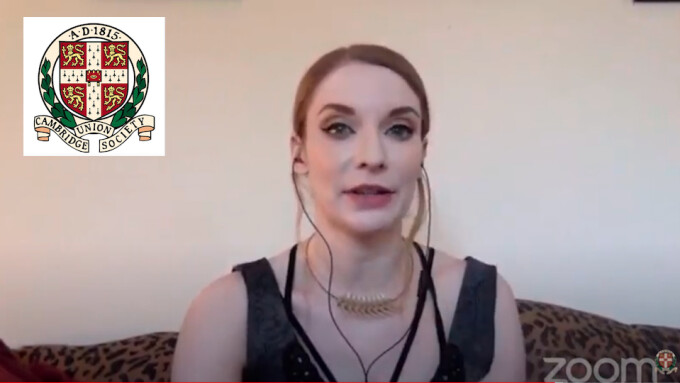
CAMBRIDGE, United Kingdom — The Cambridge Union, a 205-year-old debating society connected to the U.K.’s Cambridge University, hosted a debate today concerning online pornography.
The debate, framed within the peculiar customs of the Cambridge Union, was scheduled months ago to occur live in Cambridge, but was relocated to Zoom due to COVID-19-related travel and social distancing protocols.
Six debaters presented timed speeches, three against online pornography and three in favor. The moderator, a bespectacled young man broadcasting from his room while wearing a tuxedo, allowed no questions or interaction between the debaters.
"This House Regrets Pornography"
The debate seemed from the beginning tilted in favor of the anti-porn position, having been named “This House Regrets Online Pornography,” promoted by the Cambridge Union with a photograph linking porn with rape and giving the opening statement to a representative of religiously motivated anti-porn lobby NCOSE (formerly known as Morality in Media).
The moderator also interjected comments like “wonderful speech” after one of the anti-porn debaters spent several minutes spreading misinformation and anti-porn propaganda.
The anti-porn activists asked to support the “This House Regrets Online Pornography” position were NCOSE’s Haley McNamara; Jo Bartosch (who describes herself as “a feminist writer and campaigner against the sex industry” and “the Founder and Director the of anti-pornography think tank Click Off”); and PhD student Raquel Rosario Sánchez, the spokesperson for a group called FiLia.
None of them had direct experience with the actual adult industry or sex work and consistently equated porn with the reductive notion of cis heterosexual male consumers watching cis female performers.
Trying to rebut their usual, debunked War On Porn propaganda points (porn is “a public health crisis,” “porn addiction is a medical condition,” “porn relies on human trafficking,” “child porn and porn are the same thing,” “no woman can consent to be in porn" and so on) were two sex workers: U.K. cam model Epiphany Jones and performer and U.S. VR entrepreneur Ela Darling; and British anti-censorship activist Jerry Barnett.
As can be seen in the embedded video, the debate began with NCOSE’s Haley McNamara robotically reading a propaganda statement retelling the usual pseudoscientific rhetoric of her group. NCOSE, which as XBIZ reported, deliberately rebranded to conceal their religious motivation years ago, is responsible for the copycat legislation that evangelical lawmakers in several U.S. states have been using to divert public health funds toward anti-porn “training” programs.
Cam model Epiphany Jones spoke next, giving testimony about how she had entered sex work when she needed work as a single mother. Jones agreed that “verification could be stricter” on porn sites, but pointed out that without sex worker platforms, she “would be at the mercy of pimps, and at the mercy of gangs.” Jones also explained, from her personal experience, what it meant to be a consensual sex worker.
Self-described “abolitionist” Jo Bartosch then spoke about why she was “opposed to pornography” even though, she said, “I want you all to masturbate without shame,” but only using “your imagination” for arousal in a fantasy “non-monetized” sexual landscape. Bartosch’s descriptions of the modern porn industry were bizarre at best. “Pornography is about male supremacy and not about sex,” she declared and described sex workers, two of whom were present in the debate, as merely “bodies full of drugs and self-loathing.”
Bartosch also went on a tangent about supposedly voiceless “black men” and “Eastern women,” appropriating the voices of sex workers of color, many of whom could easily speak for themselves about their reasons and for doing this type of work consensually.
Bartosch’s bottom line was there is “so little action” against online pornography and she demanded that “the driver of this criminal abuse be interrogated,” without specifying how and by which “sex police” or government body.
A Morality Movement
Jerry Barnett provided the most concise rebuttal to the War On Porn crusaders. The author of “Porn Panic” delineated the propagandistic nature of the anti-porn talking points, pointed out their real religious motivation and unmasked their unnecessary pseudo-scientific deceptions.
“The old right-wing Christian groups have relabeled with feminist language,” Barnett stated. “The rescue industry is a morality movement, not a rescue movement.”
Raquel Rosario Sánchez ignored all of Barnett’s points and continued building a more elaborate structure over Jo Bartosch’s shaky foundations. “Online pornography constitutes a form of violence against women,” Sánchez decreed, ignoring the many gay, bisexual and straight men, lesbians and trans people who have chosen a career as an adult performer.
Finally Ela Darling provided a series of rebuttals to the anti-porn crusaders based on research she has done and on her own personal experiences. Visibly moved, Darling spoke of how during the pandemic, being at home, people are isolated and online porn platforms like OnlyFans or ManyVids or the many camming platforms can provide “a sense of connection to another person, even if it is transactional.”
Darling gave testimony of the adult entertainment community as a supportive community, mentioning Adult Performer Advocacy Committee (APAC), the Free Speech Coalition (FSC) and its PASS system and Pineapple Support as examples of stigma-free self-regulation. She also mentioned that while NCOSE and other deceptive moralistic groups get their propaganda picked up by politicians and members of the press, both mainstream and tabloids, adult industry journalism that sets the record straight, such as XBIZ, is regularly shadowbanned by search engines.
Darling also spoke of marginalized people in the community like the disabled or closeted LGBTQ people who use pornography to “grow, and free themselves from the social notion” that they must be alone or sexually unfulfilled.
"It was an honor to participate in the debate, and I am proud to have spoken alongside Epiphany and Jerry, two very bright and well-informed people," Darling told XBIZ. "I think Epiphany and I did a good job of speaking for ourselves and sharing our own experiences among people who felt compelled to speak for us, despite our clear presence on the call."
"Regardless of how the debate turns out, I hope we were able to clear up some stereotypes and prejudices against the people of our industry," Darling added.
A vote by members of the Cambridge Union who watched the debate “deciding” the issue will be forthcoming.
To watch the full video, click here.



