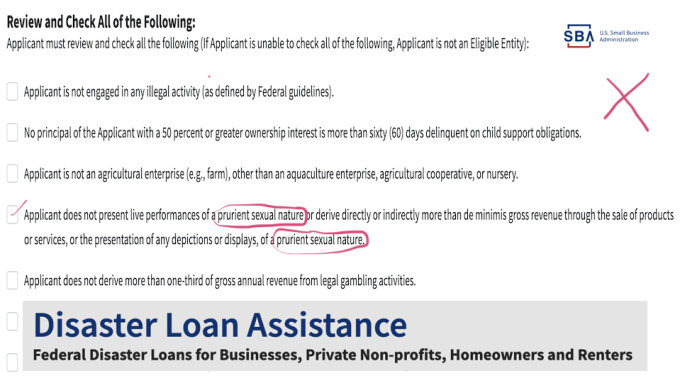
WASHINGTON, D.C. — The federal application for COVID-19-related disaster relief for small businesses, issued by the Trump administration’s U.S. Small Business Administration (USSBA) this week, explicitly disqualifies any sex worker or sex oriented business who may derive income from “presenting live performances of a prurient sexual nature” or “through the sale of products or services, or the presentation of any depictions or displays, of a prurient sexual nature.”
On the first page of the application, the USSBA asks potential applicants for economic relief to first check if they do not belong to one of the disqualifying categories, which include “engaging in any illegal activity (as defined by Federal guidelines),” being a deadbeat parent with delinquent child support obligations, legal gambling, lobbying or having a conflict of interest by being a member of Congress or a government entity.
The longest exclusion, which appears to be deliberately worded to target the largest segment of sex workers and sex-related businesses possible, states:
“Applicant does not present live performances of a prurient sexual nature or derive directly or indirectly more than de minimis gross revenue through the sale of products or services, or the presentation of any depictions or displays, of a prurient sexual nature.”
The word “prurient sexual nature” has a very specific meaning to U.S. advocates of state censorship of sexual expression, as it is one of the terms used by courts as part of “the Miller test” (also known as “the three-prong obscenity test”).
The Miller test, developed in the 1973 case Miller v. California, is used by courts all the way up to the United States Supreme Court for determining whether speech or expression can be labeled “obscene,” making it unprotected speech under the First Amendment.
The first part of the Miller test tries to determine whether "the average person, applying contemporary community standards,” would find that “the work, taken as a whole, appeals to the prurient interest.”
In theory, sex-oriented businesses and sex workers incorporated as a small business — the number of which has dramatically increased after California passed AB5, aka “the Uber law” over regulating freelance employment — could attempt to apply for the federal relief claiming their activities are not “prurient.”
Then, after costly litigation, courts would have to apply the Miller test, standard jurisprudence in obscenity cases, requesting that courts and judges provide an interpretation of what “the "average person” can find offensive.
Several U.S. courts — which have been newly packed with conservative and religious judges in the last three years under Trump, after Sen. Mitch McConnell blocked all judicial appointments during the last years of the Obama administration — would then have to determine what “prurient” (and perhaps even “obscene”) is, which is something advocates of state censorship have been increasingly requesting when it comes to sexual expression.
To read the U.S. Small Business Administration’s application for disaster relief, which may disqualify the majority of sex workers and sex-related businesses under a “pruriency clause,” click here.