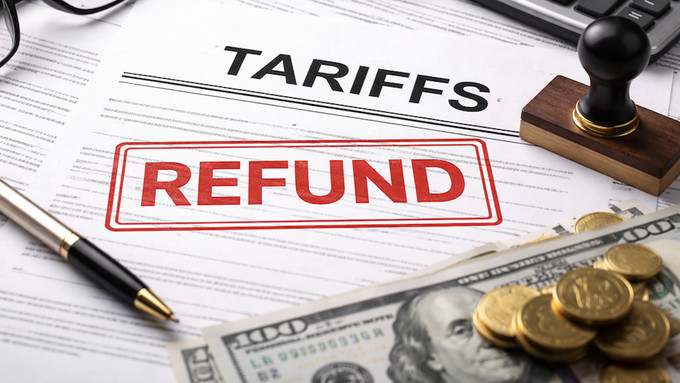
WASHINGTON — U.S. Customs and Border Protection (CBP) will begin the process of refunding duties paid under the Trump administration’s sweeping program of tariffs by providing, starting April 20, an online tool for submitting refund claims.
According to a CBP bulletin, that date will mark the launch of the initial phase of the Consolidated Administration and Processing of Entries (CAPE) tool. CAPE is intended to simplify refund requests in the wake of the U.S. Supreme Court’s February ruling rejecting President Trump’s claim that the International Emergency Economic Powers Act (IEEPA) of 1977 granted him the authority to impose the broad regimen of import levies.
The CAPE tool will be accessible via CBP’s Automated Commercial Environment (ACE) portal, and is “designed to consolidate refunds of IEEPA duties including interest rather than processing refunds on an entry-by-entry basis,” the bulletin states.
A new IEEPA Duty Refunds web page details the steps for requesting refunds of IEEPA duties. Further information is available on an IEEPA Duty Refunds Fact Sheet and a CAPE Phase 1 trade information notice.
As XBIZ reported last year, the Trump administration’s sharp escalation of import taxes, especially on goods from China, had strong negative effects on the sex toy business and related sectors.
In the wake of the Supreme Court’s decision overturning the tariffs, hundreds of impacted companies filed lawsuits with the U.S. Court of International Trade, seeking refunds, including a number of adult brands.
While refunds will be issued for IEEPA tariffs previously paid, the Trump administration has not backed down on imposing global tariffs. The administration responded to the SCOTUS ruling by invoking the Trade Act of 1974, under which the president can levy tariffs for up to 150 days without congressional approval.
Twenty-four U.S. states are suing the administration to block that workaround. Oral arguments in the case took place Friday before the Court of International Trade.
The Trump administration has also initiated trade investigations against numerous countries, including China and Mexico, under Section 301(b) of the Trade Act of 1974. That provision authorizes the imposition of tariffs if a foreign country’s trade practices are determined to be unfair and harmful to U.S. trade.