



Supreme Court Puts Texas Online Platform Liability Law on Hold

Supreme Court Puts Texas Online Platform Liability Law on Hold

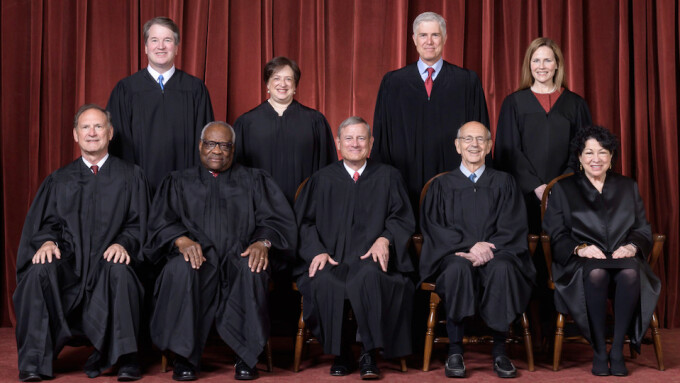
WASHINGTON — In an unusual 5-4 vote that did not follow ideological lines, the Supreme Court has temporarily blocked a controversial Texas social media law that would have made social media platforms liable for moderating content based on what the law defined as “viewpoints.”

The Republican-backed law was drafted with the full support of Texas governor Greg Abbott as an answer to conservative and other right-wing complaints about supposed “liberal bias” in platform moderation, including the lifetime Twitter ban of former president Donald Trump.

Today, the Supreme Court blocked the law from taking effect “until a Fifth Circuit challenge of the legislation has been decided,” legal news site Law360 reported.

The split vote “reinstated a lower court order blocking enforcement of the Texas social media law known as HB 20, which prohibits certain ‘censorship’ or viewpoint discrimination by large internet platforms such as Twitter and Facebook.”

The five justices who blocked the law were Roberts, Kavanaugh, Barrett, Sotomayor and Breyer.

Liberal Justice Elena Kagan dissented, denying the application to vacate stay; conservative Justices Alito, Thomas and Gorsuch dissented for different reasons.

As XBIZ reported, the law had been upheld earlier this month by a peculiar 5th Circuit decision which was communicated without any explanation as to the court’s reasoning and with two of the judges remaining anonymous.

Last week, the 11th Circuit Court of Appeals issued a ruling that blocks the major provisions of a similarly controversial social media law in Florida, backed by Gov. Ron DeSantis, which also would have held social media platforms liable for moderation policies in the name of political, but not sexual, "free speech."

Both the Texas and Florida laws opened the door to lawsuits accusing online platforms of "viewpoint discrimination," an ill-defined term with dubious legal standing. It is mostly used by conservatives and the U.S. right wing, who claim they are being censored on social media — though some of the same politicians and right-wing activists advocating against what they call "corporate" censorship also demand a return to state-driven censorship of sexual expression via obscenity prosecutions, and consider LGBTQ+ content to be "pornography."


Copyright © 2026 Adnet Media. All Rights Reserved. XBIZ is a trademark of Adnet Media.
Reproduction in whole or in part in any form or medium without express written permission is prohibited.

More News

Eli Thomas Launches 'VerifiedCollab' Verification Platform

Performer Eli Thomas has launched VerifiedCollab, a verification platform for creators and producers.

House Committee to Weigh Online Safety Bill With Federal AV Requirement

The U.S. House of Representatives Committee on Energy and Commerce will meet Thursday to consider and potentially amend the Kids Internet and Digital Safety (KIDS) Act, which includes provisions to make age verification by adult websites federal law.

SWR Data Publishes 'Creator Income' Report

Adult industry market research firm SWR Data has published a report on creator incomes.

Pineapple Support to Host 'Neurodivergent Performers' Support Group

Pineapple Support is hosting a free online support group for neurodivergent performers.

'Legal Impact' Webinar Unpacks North Carolina's New Consent Law

Industry attorney Corey D. Silverstein on Thursday held a webinar focused on North Carolina’s HB 805, a new law that has significantly altered performer consent requirements in the state.

FSC Launches Privacy-First Age Verification Solution for Members

The Free Speech Coalition (FSC) announced today that it has granted members exclusive access to the PrivateAV age verification solution.

Brazil: New AV Requirements Set to Take Effect March 17

President Luiz Inácio Lula da Silva this week gave final approval to new regulations requiring adult websites to age-verify users located in Brazil starting March 17.

FSC Recommends Platforms Integrate StopNCII.org Tool

In a blog post, Free Speech Coalition (FSC) has recommended that platforms integrate the StopNCII.org tool to prevent the sharing of non-consensual intimate imagery (NCII).

Utah 'Porn Tax' Bill With VPN Provisions Passes State Senate

The Utah state Senate has passed a bill that would impose a 2% tax on the revenues of adult websites doing business in that state, and make sites liable if Utah minors use VPNs to circumvent geolocation.

Show More

