



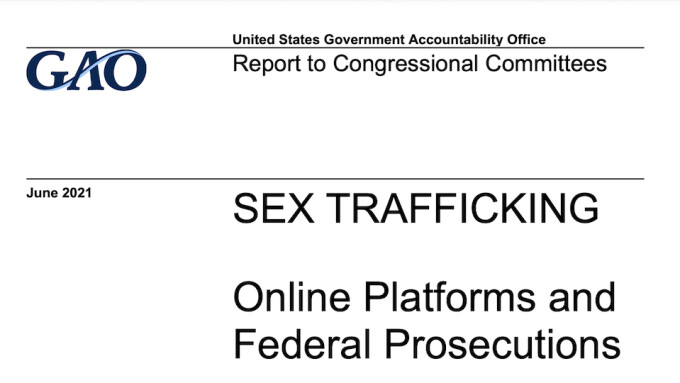
WASHINGTON — The Government Accountability Office (GAO), a top federal oversight body, released a report on Monday evaluating the effectivity of FOSTA/SESTA since its April 2018 implementation.
The report was mandated by the law itself, which, in the words of its official summary, “includes a provision for GAO to provide detailed information on restitution and civil damages.”
The GAO report examined “(1) DOJ enforcement efforts against online platforms that promote prostitution and sex trafficking, from 2014 through 2020; and (2) the extent to which criminal restitution and civil damages have been sought and awarded for aggravated violations under section 3 of FOSTA.”
GAO also “reviewed federal criminal cases brought against those who controlled platforms in the online commercial sex market from 2014 through 2020; visited a selection of online platforms in this market; and conducted a legal search to identify criminal and civil cases brought pursuant to section 3 of FOSTA.”
The GAO “also interviewed DOJ officials and representatives from third parties" and concluded that in over two-and-a-half years, “criminal restitution has not been sought and civil damages have not been awarded under section 3 of FOSTA.”
The number of cases brought by prosecutors was paltry; the report accurately noted the most high-profile ongoing case invoked in discussions of FOSTA — that of Backpage.com, currently still proceeding through federal courtrooms in Arizona and California — was not actually a FOSTA case, having been filed before its passage.
Otherwise, according to the report, “in June 2020, DOJ brought one case under the criminal provision established by section 3 of FOSTA for aggravated violations involving the promotion of prostitution of five or more people or acting in reckless disregard of sex trafficking. As of March 2021, restitution had not been sought or awarded. According to DOJ officials, prosecutors have not brought more cases with charges under section 3 of FOSTA because the law is relatively new and prosecutors have had success using other criminal statutes. Finally, in November 2020 one individual sought civil damages under a number of constitutional and statutory provisions, including section 3 of FOSTA. However, in March 2021, the court dismissed the case without awarding damages after it had granted defendants’ motions to dismiss.”
In the words of sex worker rights expert and journalist Melissa Gira Grant — who published her in-depth analysis in the New Republic today — the GOA report “helps validate many of these concerns shared by sex workers and survivors of trafficking.”
“As the report notes,” Grant wrote, “rather than helping identify and prosecute traffickers, what SESTA/FOSTA did was push online sex work ads to the margins.”
Click here to read Grant’s story, titled “The Real Story of the Bipartisan Anti–Sex Trafficking Bill That Failed Miserably on Its Own Terms."
The GAO report (GAO-21-385) is included in its entirety as a .pdf below.



