



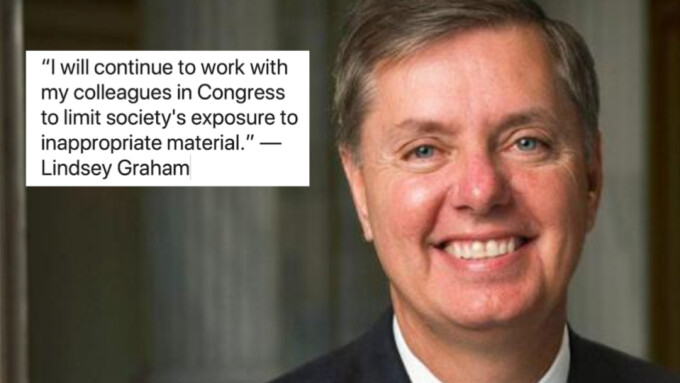
WASHINGTON — In an email replying to questions about his vocal support for several pieces of legislation that would effectively establish state censorship over legal adult content, Senator Lindsey Graham (R-S.C.) unequivocally stated that his goal was to “to limit society's exposure to inappropriate material.”
Graham was replying to concerns about his support for legislation aiming to repeal Section 230, the so-called “First Amendment of the internet,” and also over the "Stop Internet Sexual Exploitation Act” (SISEA).
SISEA was introduced 10 days ago by Senators Ben Sasse (R-Neb.) and Jeff Merkley (D-Ore.) in the aftermath of a publicity campaign by religiously motivated group Exodus Cry, whose “Traffickinghub” campaign was platformed by the New York Times’ Nicholas Kristof in a sensationalistic editorial on December 4.
In an email exchange reviewed by XBIZ, Graham wrote back to a question about his position on legal adult content online and stated:
I have concerns about our children's ability to access pornographic material through the internet and email. While I wholeheartedly support the First Amendment, I do not believe exposing young people to pornography is an acceptable exercise of freedom of speech. I appreciate your support on this issue, and I will continue to work with my colleagues in Congress to limit society's exposure to inappropriate material.
In one short paragraph, Graham transitions from “children’s ability to access pornographic material” to “exposing young people to pornography” to “limit society’s exposure to inappropriate material.”
This rhetorical slippage — going from something few people disagree with (limiting children’s access to adult content) to something most people condemn (establishing state censorship of free sexual expression) in the span of only a few words— is consistent with the demands of religiously motivated War On Porn groups, such as NCOSE (a rebrand of 1960s anti-porn group Morality in Media), Exodus Cry (an offshoot of Missouri’s International House of Prayer) and Fight the New Drug (whose connections to the Mormon Church, despite of their loud protestations, are too numerous to mention).
Before Kristof’s article on December 4, it was fairly unusual for a politician to outright confirm the suspicions of everyone from digital rights activists like the Electronic Frontier Foundation (EFF) to most sex workers and adult industry professionals: that the goal of these campaigns has been to censor adult access to adult content all along.
But after Kristof personally — and successfully — pressured, via tweet, several politicians (including supposedly liberal Oregon Senator Jeff Merkley) and all major credit card companies to “do something” about Pornhub, it seems like now politicians with a large religious base feel encouraged to voice their actual intentions out loud.



