



AdSecure Releases Q3 Ad Security Violations Report

AdSecure Releases Q3 Ad Security Violations Report

DUBLIN — AdSecure has released its third Security Violations Report, this time covering Q3.

AdSecure is an ad verification solution used by ad networks, ad operations teams and publishers. For its report, the company analyzed over 300,000 ad campaigns across multiple regions, devices and browsers for its partners between July 1 and September 30.

The company was interested in seeing what cybercriminals did during the Summer in Europe when residents traditionally take their vacations; and according to the World Economic Forum, the majority of Europeans holiday in Europe, so AdSecure looked at detections for five security violations in Europe during this time.

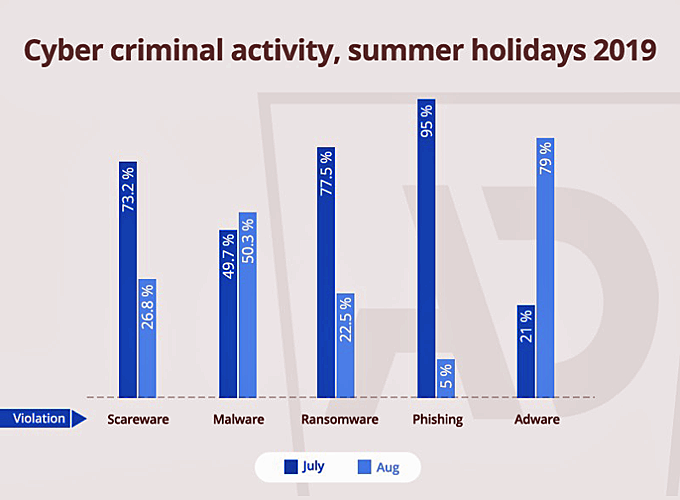
Among its findings, ransomware and scareware dropped by two thirds in August, compared to July, however, AdSecure noted that criminals concentrated their scareware attacks on iPhones, with 67.3 percent detections on Mobile Safari, presumably in an attempt to take over holidaymakers’ mobile phones.

Malware had no real change over the period showing that malware attacks remain high, while phishing saw the biggest overall drop; as many people were on holidays and not checking personal and work emails, with the decline in phishing, it appears that criminals shifted their focus on to adware distribution.

Adware rose significantly in August with cybercriminals preferring to target mobile devices (95.5 percent were detected on mobile) with criminals perhaps assuming few holidaymakers take their laptops abroad.

“Cybercriminals don’t take holidays in July and August and continue to target potential victims,” AdSecure’s Product Manager Mat Derval said. “They adapt their types of attacks and device distribution in order to try to trick victims during the holiday season, especially on mobile.”

“For scareware attacks, 78.7 percent were detected on mobile with 67.3 percent on Safari and 32.7 percent on Android. Similarly, with adware, 95.5 percent of attacks detected were also on mobile devices,” Derval added. “Scareware is a strong tactic to distribute adware. Since most of the time, the apps that scareware asks you to install to repair your phone or fix some viruses, actually contain adware or malware.”

With one out of every 250 scans carried out by AdSecure revealing some type of malware during Q3, AdSecure has created an infographic with some of their key findings during this quarter’s Security Violations Report.
For more information, visit AdSecure.com.


Related:  

Copyright © 2026 Adnet Media. All Rights Reserved. XBIZ is a trademark of Adnet Media.
Reproduction in whole or in part in any form or medium without express written permission is prohibited.

More News

AV Bulletin: Midyear Roundup

Since the U.S. Supreme Court’s decision in Free Speech Coalition v. Paxton, more state age verification laws have been enacted around the United States, as well as proposed at the federal level and in other countries. Meanwhile, lawsuits resulting from AV laws have begun to play out in the courts. This roundup provides an update on the latest news and developments on the age verification front as it impacts the adult industry.

Judge Dismisses Last NCOSE-Backed Suit Over Kansas AV Law

A federal judge on Monday dismissed a lawsuit alleging that adult site SuperPorn violated Kansas’ age verification law, citing lack of jurisdiction after similarly dismissing two related cases earlier this year.

ASACP Updates 'Restricted to Adults' Labeling Resource Page

The Association of Sites Advocating Child Protection (ASACP) has updated its Restricted to Adults (RTA) labeling resource page.

Federal AV Proposal Scores Minor Win in House but Remains in Doubt

A newly announced bipartisan agreement in the U.S. House of Representatives Committee on Energy and Commerce may soon bring a proposed federal age verification law before the full House, but the measure continues to face an uphill battle.

Arizona Governor Vetoes 'Protect Act' With New Consent Provisions

Arizona Governor Kate Hobbs on Friday vetoed HB 2133, the “Protect Act,” which would have imposed new requirements for adult content uploaded online.

Brazil Begins Monitoring 18 Adult Sites for AV Compliance

Brazil’s National Data Protection Authority (ANPD) is now monitoring 18 high-traffic adult websites for compliance with the country’s Digital Statute for Children and Adolescents (Digital ECA), which requires such sites to age-verify users located in Brazil.

Ofcom Fines First Time Videos $100,000 for AV Noncompliance

U.K. media regulator Ofcom on Thursday imposed a fine of 80,000 pounds (more than $100,000) against First Time Videos, which operates FTVGirls.com and FTVMilfs.com, for failing to implement age checks required for compliance with the Online Safety Act.

Curves Ahead: How BBW Creators are Turning Differentiation Into Competitive Advantage

For centuries, curves have been celebrated as a symbol of beauty, sensuality and power. From the soft opulence of Rubens paintings to the glamorous silhouettes of pinup icons, fuller figures have long occupied a place in art, fashion and fantasy.

Woodhull Freedom Foundation to Host Virtual 'Pride' Edition of 'Fact Checked' Series

Woodhull Freedom Foundation is hosting a Pride Month virtual edition of its series “Fact Checked by Woodhull.”

'InMelanin' Relaunches Through PAYSITE

InMelanin.com has officially relaunched through PAYSITE.

Show More

