



Facebook Fights Facial Recognition With AI, Adult Performers May Benefit

Facebook Fights Facial Recognition With AI, Adult Performers May Benefit

LOS ANGELES — Even as a range of regulators from Australia to the U.K. and beyond contemplate the broad use of facial recognition for online age verification (AV), a new report reveals that Facebook is working to blunt the effectiveness of this technology for video streams.

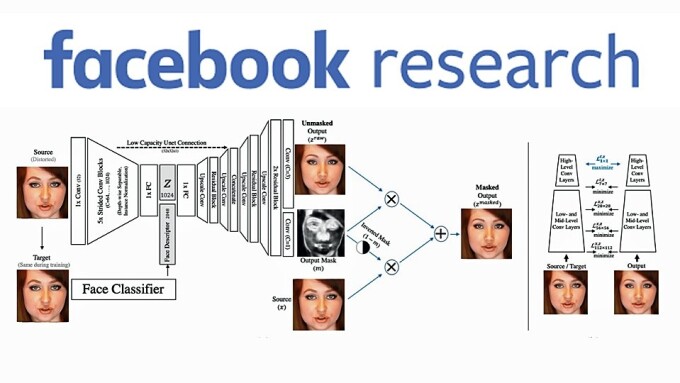
The report, “Live Face De-Identification in Video,” was produced for the International Conference on Computer Vision by Facebook AI Research and Tel-Aviv University team members Oran Gafni, Lior Wolf and Yaniv Taigman.

“We propose a method for face de-identification that enables fully automatic video modification at high frame rates,” the report’s abstract noted. “The goal is to maximally decorrelate the identity, while having the perception (pose, illumination and expression) fixed.”

“We achieve this by a novel feed-forward encoder-decoder network architecture that is conditioned on the high-level representation of a person’s facial image,” the abstract explained. “The network is global, in the sense that it does not need to be retrained for a given video or for a given identity [creating] natural-looking image sequences with little distortion in time.”

Gafni posted a video on YouTube that shows the process.

Although protecting the identity of adult talent from stalkers and unwanted exposure was probably not the motivating factor in developing facial de-identification technology, this video modification tool may provide an unexpected boon for performers who strive to protect their privacy — an ironic twist for a company like Facebook that has been so condemned for its perceived privacy shortcomings.

It’s also interesting to note the interplay of the rise of “deepfakes” and the facial recognition/counter-recognition war being waged. Combine this with the appeal of “selfie filters” among content creators and it is clear that portraying our customized, idealized digital selves without fear of unwanted personal identification will remain a high priority for technology developers — and for the privacy-minded adult entertainment community.


Download the White Paper

Related:  

Copyright © 2026 Adnet Media. All Rights Reserved. XBIZ is a trademark of Adnet Media.
Reproduction in whole or in part in any form or medium without express written permission is prohibited.

More News

BranditScan Launches 'White Glove' Subscription Tier

BranditScan has launched its new White Glove subscription tier for creators.

German Court: Regulator Can't Block Entire IG Accounts, Only Posts

A German court has ruled that while a regional media regulatory agency may block specific Instagram posts that include material deemed harmful to minors, it cannot ban an entire Instagram account due to such a post.

Brazil Lays Out Preliminary Guidelines for New AV Requirements

President Luiz Inácio Lula da Silva on Wednesday signed a decree establishing guidelines for new regulations requiring adult websites to age-verify users located in Brazil.

Senate Committee Debates Section 230 Reform

The U.S. Senate Committee on Commerce, Science, and Transportation held a hearing Wednesday on potential changes to Section 230 of the Communications Decency Act, which protects interactive computer services — including adult platforms — from liability for user-generated content.

Pearl Industry Network Offers Free Creator Memberships

Industry trade group Pearl Industry Network (PiN) has launched its free creator membership initiative.

Sam Bird Acquires Fanblast

Sam Bird, former co-director of global talent agency Surge, has acquired creator monetization tool Fanblast and named himself CEO.

'SheHerGirls' Launches Through Paysite.com

The braintrust behind PoleVixens has officially launched a new membership site, SheHerGirls, also through Paysite.com.

FTC Invites Public Comment on 'Click to Cancel' Rulemaking

The Federal Trade Commission (FTC) announced this week that it is seeking public comment on whether it should amend its Negative Option Rule to better address deceptive or unfair practices.

Aylo Rebuts Indiana AV Suit Claims Over VPN Access

Aylo this week asked a Marion Superior Court judge to dismiss Indiana’s lawsuit alleging that the company violated the state’s age verification law by failing to prevent access by users who employ VPNs and similar means to avoid geolocation.

'PSMTickling' Launches Through Paysite.com

PSMTickling.com has officially launched through Paysite.com.

Show More

