



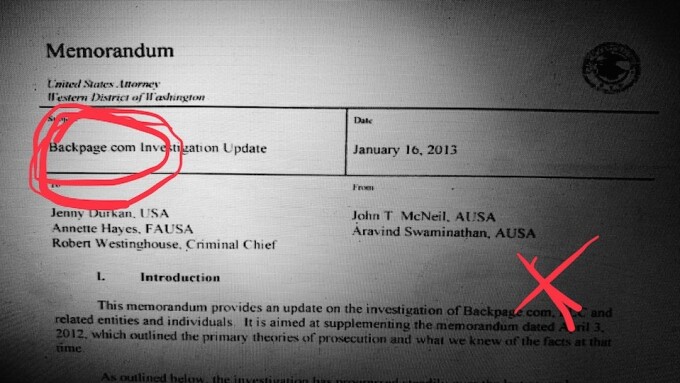
SEATTLE, Wash. — Libertarian publication Reason magazine, which has been closely covering the Backpage case, has just published two memos written by federal prosecutors in 2012 and 2013 that seriously contradict the government’s allegation that Backpage’s business model included child prostitution and “sex trafficking.”
The article, “Secret Memos Show the Government Has Been Lying about Backpage,” was penned by Reason’s Associate Editor Elizabeth Nolan Brown, who has become one of the leading experts in the intricacies of this complex case.
Both memos, also reproduced by Reason in their entirety, were “accidently sent by federal prosecutors to Backpage defense lawyers last year.“
The government’s case against the Backpage owners was a catalyst for the political forces that pushed for the FOSTA/SESTA legislation in 2017 and 2018, ignoring the criticism from civil liberties advocates and virtually the entire sex worker community that it purported to be helping.
“In April 2012, Brown writes, two federal prosecutors sent their boss a memo about Backpage, the site that had, since 2004, been operating like a parallel Craigslist. What would unravel over the course of the 24-page document contradicts almost everything we've heard from federal authorities about Backpage since.”
In the April 3 memo, Catherine Crisham and Aravind Swaminathan, assistant U.S. attorneys for the Western District of Washington, wrote to Jenny Durkan — then the head federal prosecutor for the district, and currently mayor of Seattle — that "information provided to us by [FBI Agent Steve] Vienneau and other members of the Innocence Lost Task Force confirm that, unlike virtually every other website that is used for prostitution and sex trafficking, Backpage is remarkably responsive to law enforcement requests and often takes proactive steps to assist in investigations."
Vienneau, Brown reports, told prosecutors that "on many occasions," Backpage staff proactively sent him "advertisements that appear to contain pictures of juveniles" and that the company was "very cooperative at removing these advertisements at law enforcement's request."
Brown’s description of the 2013 memo is even more damning to the government’s case:
Over the next year, their office would undertake a large investigation into Backpage's internal processes and potential criminality.
This included a "preliminary review of more than 100,000 documents," subpoena responses "from more than a dozen entities and individuals," interviews with around a dozen witnesses, and "extended grand jury testimony from an additional six witnesses," mainly Backpage employees. Still, it failed to produce "the kind of smoking gun admissions which we had hoped would propel this investigation to indictment," wrote Swaminathan and another assistant U.S. attorney, John T. McNeil, in a January 2013 memo.
This memo's subject line — "Backpage.com Investigation Update" — and the earlier one from Crisham and Swaminathan would wind up being accidently sent by federal prosecutors to Backpage defense lawyers last year. But both would be ruled off-limits for defense use, placed under seal, and only subject to public courtroom discussion last week after prosecutors tried to sanction defendants for a few paragraphs from the memos appearing in a June Wired article.
"At the outset of this investigation, it was anticipated that we would find evidence of candid discussions among [Backpage] principals about the use of the site for juvenile prostitution which could be used as admissions of criminal conduct," wrote McNeil and Swaminathan in their 2013 update. "It was also anticipated that we would find numerous instances where Backpage learned that at site user was a juvenile prostitute and Backpage callously continued to post advertisements for her. To date, the investigation has revealed neither."
They recommended that bringing criminal charges would be unwise.
For Elizabeth Nolan Brown’s “Secret Memos Show the Government Has Been Lying about Backpage,” visit the Reason website.
For more of XBIZ’s ongoing coverage of the Backpage case, click here.



