



LOS ANGELES — First it was called “a sin,” and then it was “a public health crisis,” and now porn is being labeled as “harmful to the environment,” with a recent report from The Shift Project alleging porn's role in boosting greenhouse gas emissions (GHG).
In “Climate Crisis: The Unsustainable Use of Online Video,” a group of French researchers reveal that digital technologies emit 4 percent of global GHG, with their energy consumption increasing by 9 percent annually.
The recent report is a follow-up to the group’s previous call for “digital sobriety,” and for changing digital media usage to be compatible with climate imperatives and the constraints of resources.
Digital sobriety “requires the regulation of uses” — a position embraced by many of the industry’s most vocal critics, creating an interesting mix of bedfellows as it dovetails with “The Green New Deal” and other highly publicized climate change initiatives.
Calling itself “the carbon transition think-tank,” the Shift Project noted that “digital sobriety consists of prioritizing the allocation of resources as a function of uses, to conform to the planet’s physical boundaries, while preserving the most valuable societal contributions of digital technologies. This requires questioning the pertinence of how we use digital technologies, one of which is online video,” added the report’s authors, who revealed the environmental impact of digital technology and the consequences of data consumption — and video consumption in particular. The group also provides tips to help content creators “decrease the impact of the production and online posting of videos as a professional or a simple amateur.”
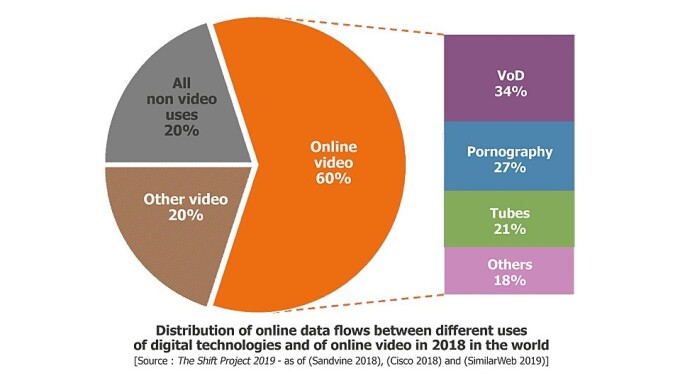
According to the report, online video generates 60 percent of world data flow and thus over 300 million tons of CO2 emissions annually, representing 20 percent of digital device greenhouse gas emissions (use and production included), and 1 percent of all global emissions — a volume as much as Spain emits.
The report finds that online porn viewing accounted for 27 percent of this volume, or approximately 82 million tons of atmospheric CO2 emissions in 2018. In response, the Shift Project is calling for a societal debate on the uses of digital technologies, stating that “not choosing is no longer a viable option.”
“In a world confronted by such limitations as those imposed by climate change and the depletion of natural resources, not choosing between uses will lead to the random imposition of constraints rather than to arbitration between options,” the group stated. “From the standpoint of climate change and other planetary boundaries, it is not a question of being ‘for’ or ‘against’ pornography, telemedicine, Netflix or emails: the challenge is to avoid a use deemed precious from being impaired by the excessive consumption of another use deemed less essential.”
Whether this view holds merit depends upon the willingness of adult industry activists and free speech advocates to get involved.



