



LOS ANGELES — Ongoing lawsuits against consumers accused of infringing on the copyrights of porn producers are making mainstream headlines, as Bloomberg looks at this phenomenon and how the U.S. courts are reacting.
In “Porn Purveyors’ Use of Copyright Lawsuits Has Judges Seeing Red,” authors Susan Decker and Christopher Yasiejko detail the events leading up to the jailing of a pair of pornographers for coercing consumers to pay $6 million in suit settlements and point to critics’ demands that Congress do something about “porn copyright” suits.
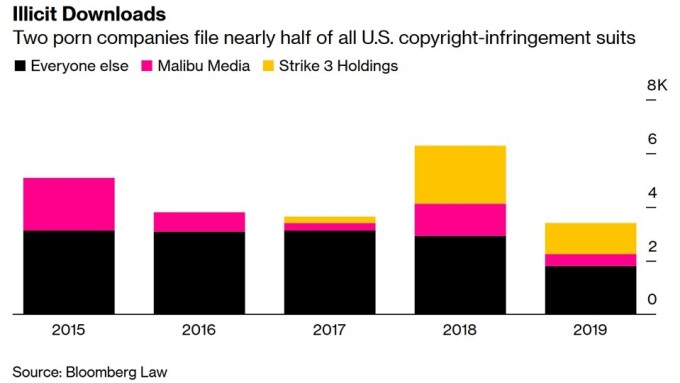
The report notes that pornography producers and sellers account for the lion’s share of copyright-infringement lawsuits in the U.S. and recounts how courts are cracking down on porn vendors that file thousands of lawsuits in what is characterized as “a high-tech shakedown.” The report also quotes an Electronic Frontier Foundation (EFF) senior attorney as claiming porn companies have “a business model that seeks to profit from litigation and threats of litigation rather than profiting from creative works.”
That statement will undoubtedly raise the hackles of hardworking adult producers and performers who have faced declining revenues as pirates steal the well-earned fruits of their labor, while smugly justifying their crime as “It’s only porn...”
According to an analysis by Bloomberg Law’s Tommy Shen, two companies are responsible for nearly half of the 3,404 copyright lawsuits filed in the U.S. so far this year: Malibu Media LLC, which has filed some 8,000 lawsuits nationwide since 2012, and Strike 3 Holdings LLC, operator of properties including Tushy and Vixen, which has filed approximately 3,500 lawsuits in the past two years.
While the companies claim they are merely enforcing their lawful rights, critics scorn their bold tactics, with the companies retorting that critics’ objections are based on the social acceptability of the content rather than the law.
Part of the problem is that many pirates go to great lengths to protect their identity, resulting in “John Doe” filings based on IP addresses, with rights holders resorting to pressure on internet service providers to identify the names of the users controlling the piracy-pushing accounts.
Although judges have approved many thousands of such requests in copyright-infringement lawsuits, a district judge in Washington, Royce Lamberth, citing his reluctance to “accept the risk of misidentification” in suits he considered smacking of “extortion,” took an active role.
“[Strike 3] treats this court not as a citadel of justice, but as an ATM,” Lamberth said. “Its feigned desire for legal process masks what it really seeks: for the court to oversee a high-tech shakedown. This court declines.”
While these companies are in the spotlight, it is Prenda Law that made the most headlines in this arena.
“They would upload the movies themselves to peer-to-peer sites, use shell companies to sue anyone who took the bait and made up elaborate tales to hide their actions. Between 2011 and 2014, they collected some $6 million based on settlements of $3,000 or less, according to federal prosecutors,” the report revealed. “One lawyer, who cooperated with prosecutors, was sentenced in July to five years for mail fraud and money laundering in what a federal judge called a ‘vile’ scheme; the other is appealing his 14-year federal prison sentence.”
Patrick Cerillo, an attorney who represented Malibu Media, claimed the company’s intent is to deter pirates, with investigators noting a decline from around 120 pirated uploads per title to an average of 8 to 15.
“You can’t look at the content of these plaintiffs and say that they don’t deserve the same rights as a musician or an author to protect their copyrights because it’s seedy, it’s not mainstream, it’s deviant,” Cerillo said. “People lose sight of the fact that this is a law that protects the creativity of individuals and companies. And that creativity can be stifled if you can’t protect it.”
Regardless of the content, every legally copyrighted creation should enjoy equal protection under the law, without activists or activist judges seeking to impose their own moral viewpoint when the law is clear: copyright infringement is theft and should be punished. Treating this material differently than music or mainstream movies only serves the warped interests of those who would delegitimize lawful adult entertainment while empowering those who prey on its works.
The full Boomberg article is available here.



