



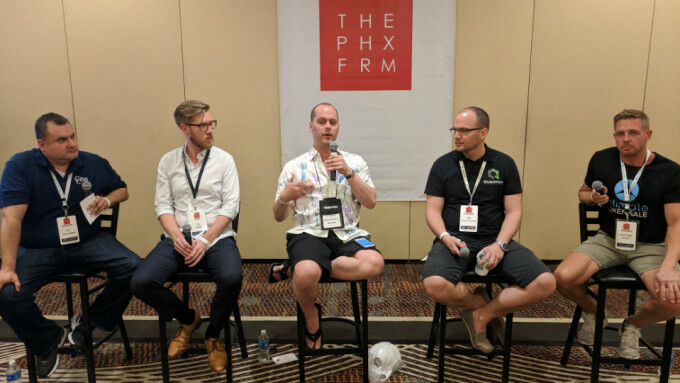
TEMPE, Ariz. — Masters of the digital universe shared their hard-won wisdom at The Phoenix Forum, during an illuminating panel on “New Tech,” where panelists examined the most relevant innovations impacting the adult business landscape.
The two trends that dominated the conversation were advances in content distribution networks (CDN) and the rise of cryptocurrencies.
Moderated by the dapper-as-ever Brad Mitchell, famed owner of MojoHost, the panel included Filip Karaicic, COO of Quantox Technology, Raymond Kelsey, director of brand management for CCBill, Ian McClarty, president of Phoenix NAP and Lukas Taylor, head of business development for intimate.io.
Breaking the ice, Mitchell celebrated the fact that this was his 17th time attending The Phoenix Forum, and that his company essentially offers high-tech support “with a bunch of superstar computer ninjas back at the office.”
After each panelist introduced themselves, Mitchell asked what cutting-edge tech was foremost on everyone’s radar.
Kelsey said that banks are very slow to adopt new technology, but that fraud protection was a hot topic for CCBill. “We’re leveraging lots of AI to help clients avoid having their sites abused,” he shared. “Machine learning can run through millions of computations that would take 10 analysts a very long time.”
Karaicic concurred that AI was critical, praising the importance of “advanced analytics, combined with AI.”
He stated that “this goes hand in hand with automation processes, which help clients save hours of their own time,” and that it all boils down to “getting to know the behavior of your users, understanding what’s going on and reacting in real-time to any changes that are happening.”
One of the ways users are behaving, Taylor wryly noted, is that “basically everyone watches porn or beats off to cam models, so we’re all about having a sex-positive environment” and as a cryptocurrency, intimate.io helps merchant providers by “trying to decentralize away from the bank, so you have an option on your billing page to pay crypto.”
Essentially, he explained that two parties have to agree in every transaction — a customer and a service — and that crypto helps remove the middleman.
“I think it’s important for adult to look at how customers are purchasing services," he said. "In the next one to five years, you’ll see a huge adoption of crypto, and I think adult can kind of stick it to the banks.”
McClarty asked Taylor if he is concerned about government regulation of crypto, to which Taylor replied, “The government needs to get involved, take a more collaborative approach and there should be a cohesion between government regulators and crypto. The U.S. government doesn’t know what the hell it’s doing, but when regulations do come, I see that as a positive, because then it means the currency has become official, so to speak.”
Kelsey jumped in, echoing the fact that the government needs to be educated on crypto, to which Taylor responded, “It’s all about ‘Know Your Customer.’ With intimate.io, you have all the transactional history there. It’s great with a cam model being bullied or abused, because they’ll have the history of that transaction, and whoever is a bad actor, with a negative reputation, won’t have much success purchasing cam services down the line.”
This reputation-based currency system “builds a layer of trust” he observed.
Mitchell pressed, asking how intimate.io can keep users from having multiple profiles, to which Taylor relayed, “They certainly could, but their overall reputation will catch up eventually. We’re based on a reputation and feedback layer, which we can arbitrate if there are any negative comments disagreed upon, but that feedback layer allows for that web of trust to be built.”
Pivoting to more traditional billing, Mitchell inquired of Kelsey, “Anything new for billing tech, that adds to the bottom line of customers?”
Incorporating the previous crypto convo, Kelsey emphasized, “Everyone would love for me to sit up here and say we’ll have all the different coins available, but that’s not true. We’re waiting to see when the market is ready. Most important is that clients make sure their content can be viewed on every platform, in every form, because if your site doesn’t support that, you’re taking away customers before they even get there. You would get the greatest ‘tech’ benefit, honestly, by just upgrading all the old stuff you’re using.”
McClarty agreed, “Google is going to take a much harder stance on responsiveness, if your CDN is not up to date,” prompting Mitchell to examine CDN infrastructure.
Breaking it down, he illumined, “The theory behind CDN is, the closer your content is to the server, the faster users can experience it."
On that note, McClarty praised the power of cloud storage to enhance portability. “If you do it right,” he began, “you can migrate and move content around easier and with replication, if you get attacked, you can bring it up elsewhere."
Bringing Karaicic into the mix more fully, Mitchell asked, “How do people leverage your services to be cost-effective?”
Karaicic offered, “Everything starts with code. If it’s not written in a proper way, no server will help you.”
Smiling, Mitchell said, “No amount of service will help shitty coding.”
Karaicic concurred, explaining, “You might end up wasting resources on getting more bandwidth, server power or something you don’t need, which brings us to another topic: customized solutions. So many of you are using platforms that basically offer easy product creations, but it’s generalized, meaning it’s not built just for you.”
Without customization, the coding is not fully optimized, and the process of tacking on plugins ends up creating what Karaicic described as a “Frankenstein solution.”
For that reason, Mitchell pointed out that “one of the benefits of working with larger shops like Quantox, is you could otherwise end up in ransom to bad coding.”
Elaborating on the perks of superior coding, even if it is a bit more expensive, Karaicic said, “It might seem good getting freelancers doing work for lower rates, but stability and reliability is more important.”
As the panel entered the final stretch, an audience member asked about virtual reality. Nearly every panelist agreed that VR, despite years of hype, was in a stagnant phase, and that augmented reality is where the future seems to be heading. Instead, attendees seemed far more intrigued by the practicalities of billing and content delivery, with crypto serving as the flashier conversational fare. What a difference a year makes, in cutting-edge tech!



