



Video: 'Pensieve' AI Tackles Video Rebuffering

Video: 'Pensieve' AI Tackles Video Rebuffering

LOS ANGELES — Whether it’s a cam, free, pay, tube or VOD site, online adult entertainment today relies on streaming video content and other media in demand by consumers. Unfortunately, frame buffering and other limited-bandwidth-related problems hamper viewing, especially on low-speed mobile and other connections.

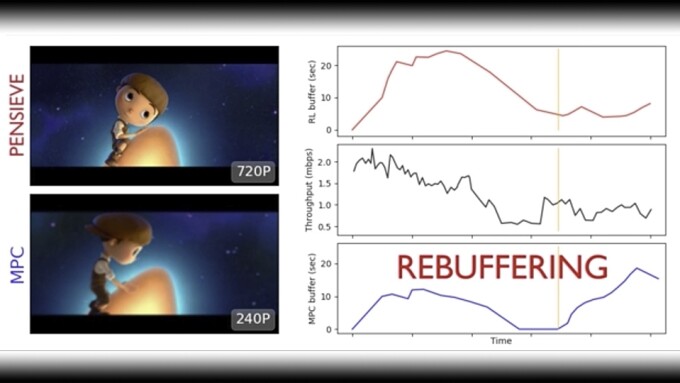
This situation may be about to change, however, with a new initiative from MIT’s Computer Science and Artificial Intelligence Lab (CSAIL) and an elite team helmed by professor Mohammad Alizadeh, which is developing an AI system known as “Pensieve,” designed to optimize video stream algorithms on the fly to deliver the  best playback possible.

“Studies show that users abandon video sessions if the quality is too low, leading to major losses in ad revenue for content providers,” says Alizadeh, noting that “Sites constantly have to be looking for new ways to innovate.”

Pensieve reportedly provides a superior solution to current technologies, such as adaptive bitrate (ABR), which balances quality and speed, but also pixelates videos while attempting to maintain a reasonable level of playback quality, by analyzing real-time network conditions to select the best quality settings — a method that minimizes drawbacks seen in other approaches.

In recent testing, Pensieve’s neural network has shown its ability to reduce rebuffering by up to 30 percent while boosting quality up to 25 percent — with significant room for further improvement and applicability to bandwidth-intensive virtual reality streams.

“The bitrates you need for 4K-quality VR can easily top hundreds of megabits per second, which today’s networks simply can’t support,” Alizadeh adds. “We’re excited to see what systems like Pensieve can do for things like VR. This is really just the first step in seeing what we can do.”

Pensieve is set for an Open Source release, making it available to users at all ends of the spectrum.

For more information, click here.

Related:  

Copyright © 2026 Adnet Media. All Rights Reserved. XBIZ is a trademark of Adnet Media.
Reproduction in whole or in part in any form or medium without express written permission is prohibited.

More News

Texas Court Orders Adult Site Domain Locked for AV Violations

A district court in Texas has issued a writ requiring domain registry Verisign to “lock” an adult website’s domain over noncompliance with the state’s age verification law.

Adult Web Hosting Service 'QloudHost' Launches

QloudHost, a new web hosting service for adult websites, has launched.

Peter Hooke Launches New Paysite

Peter Hooke has launched an official website through PAYSITE.

Pineapple Support Names Ny Ny Lew as Brand Ambassador

Pineapple Support has named Ny Ny Lew as its newest brand ambassador.

Federal AV Proposal Passes House, Faces Senate Opposition

The U.S. House of Representatives on Monday passed the Kids Internet and Digital Safety (KIDS) Act, which includes provisions to make age verification by adult websites federal law, but the bill still faces tough going in the Senate.

Devin Drills Launches New Paysite

Creator Devin Drills has launched an official website through PAYSITE.

AV Bulletin: Midyear Roundup

Since the U.S. Supreme Court’s decision in Free Speech Coalition v. Paxton, more state age verification laws have been enacted around the United States, as well as proposed at the federal level and in other countries. Meanwhile, lawsuits resulting from AV laws have begun to play out in the courts. This roundup provides an update on the latest news and developments on the age verification front as it impacts the adult industry.

Judge Dismisses Last NCOSE-Backed Suit Over Kansas AV Law

A federal judge on Monday dismissed a lawsuit alleging that adult site SuperPorn violated Kansas’ age verification law, citing lack of jurisdiction after similarly dismissing two related cases earlier this year.

ASACP Updates 'Restricted to Adults' Labeling Resource Page

The Association of Sites Advocating Child Protection (ASACP) has updated its Restricted to Adults (RTA) labeling resource page.

Federal AV Proposal Scores Minor Win in House but Remains in Doubt

A newly announced bipartisan agreement in the U.S. House of Representatives Committee on Energy and Commerce may soon bring a proposed federal age verification law before the full House, but the measure continues to face an uphill battle.

Show More



