



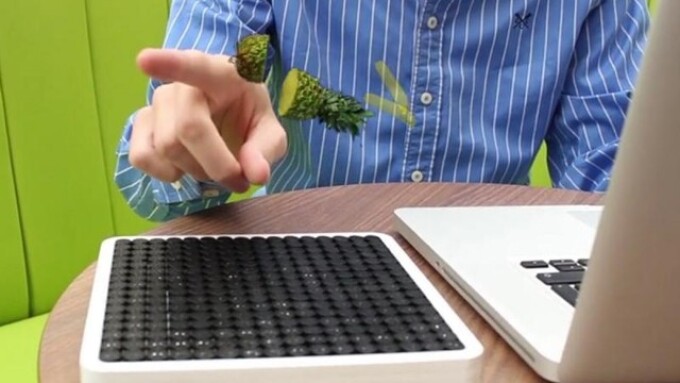
LOS ANGELES — The evolution of the man/machine interface, known as haptics, is taking a new twist — where the “touch” of technology is now going touch-less, thanks to the efforts of upstart Ultrahaptics.
According to the company, Ultrahaptics has developed a unique technology that enables users to receive tactile feedback without needing to wear or touch anything. The technology uses ultrasound to project sensations through the air and directly onto the user, which can “feel” touch-less buttons, get feedback for mid-air gestures, or interact with virtual objects.
Founded in 2013 based on technology originally developed at the University of Bristol, Ultrahaptics is on the forefront of developing tactile tech for top tier companies, and has recently launched an evaluation program across multiple markets to explore the applications and future of this next-level interface, which is the perfect complement to the coming wave of immersive Virtual Reality environments.
Ultrahaptics creates tactile sensations in mid-air, allowing users to feel without touching, and without using gloves or other attachments — since the feeling is projected directly onto the user’s bare hands — imparting what many users will consider to be “a magical experience.”
This revolutionary technology enables tactile cues for gestures, and the ability to feel invisible interfaces, textures, virtual objects and more.
Co-developer Professor Sriram Subramanian told Reuters that the Ultrahaptics technology relies on a principle known as acoustic radiation force.
“If you go to a night club or a rock concert, you feel the music in your chest. It’s the same principal — you feel the sound vibrating your chest,” Subramanian explains. “Instead of using the bass sounds, what we use is low frequency ultrasound — about 40 kHz — and that way we can target it at a precise point on your finger tip or on your palm, and then you feel the palm vibrate and it feels precise as well.”
Subramanian notes that as Virtual Reality systems roll out, there is a tendency towards wanting to do things touch-less, to immerse users in the virtual realm more fully.
“One of the advantages of having a touch-less system is that the interaction comes to you,” Subramanian says. “Instead of going and touching the light switch, you just wave your hand and the light comes on. And this is going to be ubiquitous, and as it becomes ubiquitous, people are going to need this kind of tactile feedback.”
While not touted as one of the markets where Ultrahaptics will take hold, adult entertainment is likely among the arenas where its potential may be most welcome. This is especially true when considering the reluctance of many consumers to insert their manhood into a mechanical device — making a touch-less touch an ideal compromise that may soon be coming to a virtual realm near you.



