
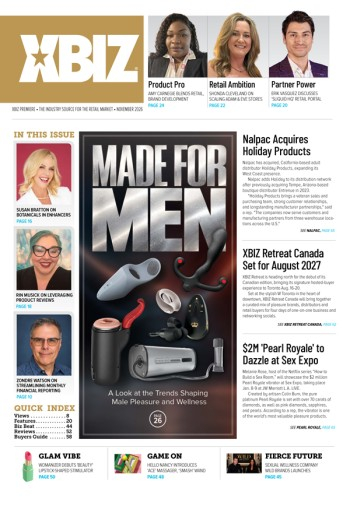
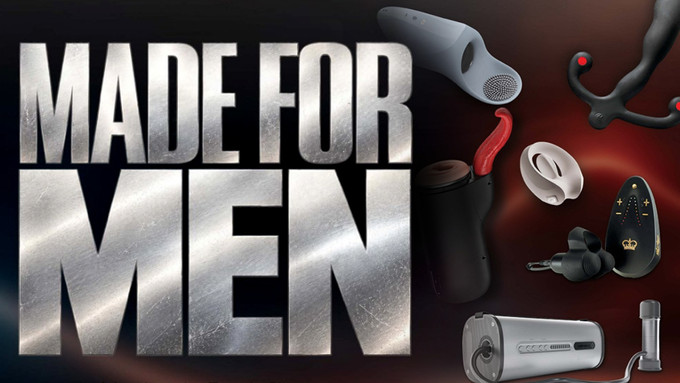
The male pleasure category was once defined by familiar products: non-powered sleeves and strokers, manual penis pumps, rings and a relatively small selection of prostate toys. Today, manufacturers draw inspiration from consumer electronics, sexual wellness, gaming, streaming content and app-driven interaction, while still relying on one of the category's oldest staples: the basic stroker.
That tension between familiar and futuristic is shaping the market. Some shoppers want automated motion, suction, multiple motors, content synchronization and remote partner control. Others want a straightforward product that is discreet, affordable, easy to clean and immediately understandable. Retailers are therefore selling into a market that is becoming more sophisticated without becoming uniformly high-tech. The opportunity lies in understanding how different customers define value and helping them navigate an increasingly wide spectrum of experiences.
Smarter, Simpler
Technology has become one of the most visible areas of innovation in male pleasure, but sources differed sharply on how much it drives sales.
“Connected products become more compelling when the technology serves a clear purpose, particularly when it creates a shared experience between partners or allows couples to interact remotely,” said Loretta Goodling, buyer for Honey’s Place Goodling. “The long-distance couple use case is particularly interesting because the technology becomes part of the relationship and experience, rather than simply another product feature.”
Others see a much larger shift underway. Carly S., owner of online retailer HornyStoner.com, describes app connectivity as part of a broader transition from passive viewing of adult content toward interactive participation.
“They can even interact with AI models and explore experiences that feel more personalized and responsive,” she marveled.
Kiiroo Head of Marketing Maxime Kamstra sees connectivity as even more foundational and a part of some consumers’ daily life.
“The online world is evolving quickly through AI, gaming, creators and interactive content,” Kamstra reflects. “As those experiences become more responsive and immersive, people expect the physical world to take part too. A toy should be able to move with that world, rather than stay a standalone device whose possibilities are fixed on the day you buy it.”
For Pipedream Products, the demand is real enough to shape product development, though April Lampert, vice president of sales and business development, cautions against adding technology simply because the market expects it.
Lampert says younger consumers increasingly see interactive technology as a baseline rather than a novelty, while older consumers are adapting at a different pace. That generational divide could become more relevant as the category expands into the same lifestyle territory occupied by smartwatches, headphones and gaming hardware.
“Many men are already comfortable with technology in the rest of their lives,” said Alicia Sinclair, founder and CEO of COTR. “They wear fitness bands and rings that track sleep, and they use apps to count calories. As tech becomes part of how we manage our health and lifestyle, it’s natural for pleasure products to follow. App control, custom vibration patterns and remote play add a layer of personalization that this customer expects.”
Not every retailer is seeing that demand translate into sales. Alejandra Preciado of Fantasias Boutique says customers in her stores tend to focus more on the device’s movement and physical functionality than on apps.
Retailers should keep that gap in mind. “High-tech” may be a powerful marketing shorthand, but it does not automatically describe what every shopper wants.
“Consumers do not necessarily want a complicated device that requires several steps before they can use it,” ZALO Sales Manager Mary affirms. “The best sextech, in my opinion, is technology that feels almost invisible. It makes the experience better without becoming the experience itself.”
Brian Sloan, inventor of Autoblow, is less cautious about the need for innovation.
“Interactive features and build quality are the only things driving interest in male pleasure products,” Sloan says. “Guys are finished with the same masturbator design, recycled into 12 new colors and 47 new orifices. They are just bored, and they need something new.”
More Sensations in One Product
If connectivity is one side of current innovation, multifunctionality is the other. Male pleasure products increasingly combine sensations that once would have required separate products. Stroking can be paired with vibration, thrusting, suction, squeezing, scrotal stimulation or automated movement. The result is a growing number of devices positioned less as single-function toys and more as customizable systems.
Mary sees multifunctionality as one of the category’s clearest directions, but she cautions that feature count can become meaningless when the functions do not work together.
“For male pleasure, combinations that bring together vibration with stroking, thrusting, suction or other dynamic movement are particularly interesting because they create a more immersive experience,” she says. “However, I think multifunctionality should be approached carefully. Adding five functions does not automatically make a product better.”
Control is a recurring concern. BMS Enterprises Account and Marketing Manager John Stoll says shoppers prefer multifunctional products when they can adjust individual features independently.
“The combination of functions also needs to be sensible,” Stoll says. “For example, vibration and thrusting together are proving to be an extremely popular combination because both functions are immensely popular by themselves. We’re also seeing products introduced that combine air sensation, whether through pulsation or suction, with vibration.”
Hot Octopuss CMO Kelly Gordon makes a similar distinction between variety and clutter.
“What people respond to is the variety of sensation more than the number of features,” Gordon says. “Combining different kinds of stimulation is appealing, but only if each element is done well and feels distinct. If the two motors just feel like louder and quieter versions of the same thing, there’s no real benefit to the user.”
CalExotics' Lupe Martinez points to suction and vibration as a strong pairing and says separately controlled functions allow customers to tailor stimulation rather than accept preset combinations.
Fleshlight Global Sales Director Miguel Capilla sees potential in combinations of textured sleeve stimulation, suction and automation, while emphasizing that ease of use and maintenance remain central.
Fleshlight’s product-development direction also highlights another emerging strategy: upgrading a format customers already understand. The company’s upcoming product, VORA, is designed to add suction stimulation to compatible Fleshlight products, giving existing users a way to layer a new sensation onto a familiar sleeve.
Kiiroo’s approach focuses on flexibility of use. Kamstra says the same product can increasingly serve multiple moments: solo use, remote partner control, interaction between compatible toys or synchronization with digital content.
“The more adaptable and connected a toy is, the more reasons people have to keep coming back to it, and the longer it stays relevant,” she says.
For retailers, that flexibility creates a clearer upgrade path. Staff can introduce a progression: basic sleeve, powered stimulation, multiple sensations, automation, connectivity and ecosystem-style products.
The Value Equation
Even in a category increasingly defined by premium technology, price remains one of the strongest drivers of consumer behavior.
There is no universal sweet spot, as industry experts point to prices ranging from around €30 entry points in Portugal to $100-$300 on advanced masturbation products in other parts of the world. Honey’s Place reports strength in male toys priced around $20 to $50, along with even less-expensive impulse products, while Pipedream sees considerable movement between $50 and $99.
David Costa of Pleasure Club says entry price remains especially important for shoppers still approaching male pleasure with curiosity rather than an established purchasing habit.
“A lower entry price can make that first purchase much easier,” he says.
Carly S. agrees that economic pressure is favoring durable, affordable options, even as more consumers become aware of premium features.
“People want to feel like they’re getting their money’s worth, whether that means investing in a higher-end device with exciting technology or finding a reliable, body-safe product that’s going to last,” she says. “It’s less about having the most expensive toy and more about finding something that delivers a great experience at a price that makes sense for them.”
Lampert says higher-priced products need to justify themselves across materials, motors, brand reputation and presentation.
“Quality, functionality and uniqueness are what earn that higher price tag in a customer’s mind,” she says.
Sloan says Autoblow’s customer base is among those who are comfortable paying more for male pleasure goods.
“We only make what one might call the expensive stuff,” he explains. “We see that our customers are open to paying relatively higher amounts of money for materials and experiences that are far beyond those being offered.”
Gordon describes the midrange as a frequent sweet spot, while Capilla agrees that a premium price needs to be justified by benefits customers can understand and appreciate, including intuitive controls and ease of cleaning.
“Connectivity or additional functions should contribute to that value,” Capilla adds.
For retailers, the implication is straightforward: price architecture needs to be intentional. A strong assortment should offer a curious first-time shopper a low-risk entry point while preserving a clear reason to trade up.
Realism Isn’t Going Away
Male pleasure may be adopting cleaner aesthetics and wellness language, but anatomical realism remains commercially important.
“Realism is nowhere near plateauing,” Lampert reveals. “Anatomical, body-form designs remain our top-selling SKUs month after month, without fail. That kind of consistency tells you there’s still a strong, loyal customer base that wants that lifelike experience.”
Beyond realism, toys molded from content creators offer a more literal way to bring fantasy to life.
“Realism still matters enormously, but its meaning is changing,” Kamstra says. “A 1:1 replica stroker gives someone a physical connection to a specific creator. The realism is not only in how the product looks; it is in how convincingly the physical and digital sides come together.”
At the same time, product designs are becoming sleeker, and as stigma around pleasure products fades and devices are gifted, shoppers are also looking for more discreet shapes and packaging aesthetics.
ZALO’s design philosophy leans toward products that can look at home among personal-care and lifestyle objects without visually announcing every function.
“I think this is particularly relevant for male pleasure as the category continues to move toward sexual wellness and self-care,” Mary says. “The product does not have to visually communicate everything it is capable of doing.”
Gordon sees it as a clearer design shift.
“Realistic designs still have their place, but the trend is clearly toward products that look more like well-made consumer tech or personal care items than something you’d hide in a drawer,” she says. “Many customers, especially those buying for the first time, prefer discreet, abstract shapes that could sit next to a razor or a phone charger.”
Martinez sees room for both.
“I don’t think retailers need to choose one direction,” she says. “Showing a range of styles helps customers find a product they feel comfortable buying and excited to use.”
Capilla argues that realism can live inside a discreet presentation.
“Someone may want a realistic sleeve while also valuing a discreet exterior, convenient storage and straightforward maintenance,” he notes. “A wellness-oriented presentation can also be an approach to communicating pleasure without removing the elements of fantasy and enjoyment.”
Prostate Moves Closer to Mainstream
The definition of male pleasure is also expanding anatomically. Strokers continue to dominate among many sellers, but prostate and anal products are repeatedly identified as growth areas. John Stoll expects prostate-focused products to benefit as taboos around anal play continue to weaken.
Robert Stevenson, sales and marketing executive for Aneros, says awareness may be the most significant shift in the prostate segment.
“More people are talking about prostate stimulation, becoming curious about the products available and openly discussing their experiences,” Stevenson says. “The category is also receiving more mainstream attention, including coverage in men’s health publications and other media outlets.”
That visibility is helping reposition prostate products as something a shopper might approach as another form of pleasure exploration.
“It feels like we’re entering an ‘age of prostate toys,’ where consumers are increasingly curious about what prostate stimulation has to offer,” Stevenson enthuses.
Sinclair says prostate products also sit comfortably within a broader sexual-wellness conversation, particularly as shoppers become more interested in anatomy and different kinds of orgasm.
“The products that do well pair prostate stimulation with features like external perineum stimulation, flexibility and app control,” she says.
The opportunity extends beyond products explicitly labeled for men. Sinclair argues that non-gendered anal toys and universal vibrators can be integrated into couples’ displays rather than confined to a men’s section.
That approach fits a larger shift in how male pleasure is being framed. Several sources reject isolating the category by gender, since many products can work for partnered play or appeal to shoppers buying for someone else.
Pleasure Meets Sexual Wellness
The line between pleasure and sexual function is also becoming less rigid.
Goodling says Honey’s Place sees interest in both traditional pleasure products and items tied to enhancing size, including sleeves and pumps.
Gordon says the two motivations are increasingly linked.
“Pleasure is still the main driver, but more men are also asking about sensation, stamina or difficulties with things like erections or reaching climax,” she says. “Men are more willing to see sexual wellbeing as part of general health, and to look for products that support it without embarrassment.”
That shift changes the vocabulary retailers can use. Instead of talking only about masturbation or novelty, staff can discuss enhancing sensation, exploration, shared pleasure and sexual well-being without making medical claims.
It also expands the customer base. A product designed for a penis or prostate may be bought by the user, a partner, or a couple. A vibrating ring can stimulate more than one body, while a wand with an attachment can be used on both the vulva and penis. A connected masturbator may be purchased mainly for long-distance couple play, even if it’s listed in a male category.
The category’s future, then, may depend partly on loosening the idea of what “male pleasure” needs to look or sound like.
“The next generation of male consumers doesn’t always want products that scream ‘For Men’ through stereotypical packaging and messaging,” emphasized Raj Armani, co-founder of IMBesharam. “They are increasingly shopping based on the experience, functionality and design rather than simply gender.”
Selling The Experience
As the assortment grows, retail education becomes one of the category’s biggest opportunities. A first-time customer can now encounter an array of sleeves, strokers, pumps, vibrating rings, prostate massagers, suction products, automated masturbators, app-connected toys and systems designed to interact with media. For someone unfamiliar with the wide world of male toys, the shelf can quickly become overwhelming.
Costa encourages retailers to consider cross-selling products with displays.
“A masturbator, for example, can be presented alongside a good-quality lubricant and other products designed to enhance shared pleasure,’” he says.
He has seen curiosity surface at workshops and events.
“Ultimately, we believe retailers should sell the experience and the possibilities rather than just the product,” Costa says.
Carly S. argues that demonstration is particularly important with powered male toys.
“Watching a stroker move, thrust or respond to different settings is incredibly eye-catching, and it helps customers understand why they might want to invest in something beyond a traditional masturbator,” she pointed out. “A static product photo just doesn’t do these toys justice.”
She also recommends showing interactive functions rather than simply listing them.
“These are features that a lot of consumers still don’t realize exist, and seeing them in action can really open their eyes to what’s possible.”
Lampert calls education “everything,” citing staff training, signage, testers, online comparison charts, detailed descriptions and verified reviews as tools that reduce hesitation.
Mary recommends merchandising by experience or need rather than only by product type.
“Sections such as ‘first-time friendly,’ ‘couples,’ ‘connected,’ ‘quiet and discreet’ or ‘multiple stimulation’ can help shoppers navigate the category without needing to know the terminology beforehand,” she suggests.
That strategy also makes cross-selling more intuitive. Retailers can present lubricant, toy cleaner, storage products, compatible attachments and couples products as part of the same experience instead of unrelated add-ons.
Sinclair notes that retailers should remember the shopper is not necessarily the user.
“Partners often buy these products as gifts or for shared play, so displays and signage should speak to them as well,” she says.
For Armani, the most important step is removing friction from the buying process. His advice is simple: explain the experience rather than reciting specifications.
“Don’t just tell somebody a product has seven vibration modes, three suction levels and an app,” Armani says. “Tell him what is different about the experience and who the product is actually designed for.”
Where Male Pleasure Goes Next
Asked which categories are most likely to grow, sources offered a range of answers. That may be the clearest sign of how much the market has widened.
“At the premium end, realistic dolls and increasingly sophisticated interactive products could continue to expand as materials, robotics, AI and connectivity improve,” said Kyle of Adultclub.AI and Bettersex.AI.
Industry experts agree that interactive technology will continue to drive the category’s growth, while interest in other products within the category will also increase.
Sinclair points to prostate toys, rings and larger products as growing in popularity among male consumers.
“I also see opportunities in prostate and anal pleasure as more people become comfortable exploring these products,” Martinez adds. “More choices for different bodies and preferences will bring new customers into the category.”
Male pleasure is moving in two directions at once. The entry level is becoming more accessible, with discreet, affordable products that normalize masturbation and sexual wellness. The premium end is becoming more sophisticated, combining automation, multiple sensations, app control, media synchronization, and modular ecosystems. Between those extremes sits a broad middle market of shoppers who may want technology, but only when it makes sense.
That balance may ultimately be more important than chasing the newest feature.
As Armani puts it, “Masturbation is constant. The experience is what gets upgraded.”
Retailers that understand that distinction have room to build a category that supports experimentation without overwhelming shoppers. They can offer a basic sleeve to the customer who wants simplicity, a multifunctional device to someone seeking new sensations, a connected product to the tech-oriented buyer, a prostate massager to the curious explorer and a design-led product to someone who wants sexual wellness without the old visual language of novelty.
The category is becoming more expansive and innovative, but its core retail proposition remains surprisingly straightforward: give customers a reason to see the difference, understand the value and feel comfortable exploring it.
Or, in Armani’s words: “We upgrade the things we enjoy.”
Why should pleasure be any different?