



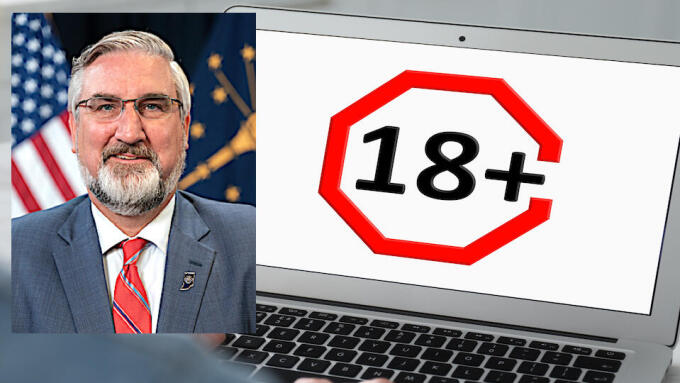
INDIANAPOLIS — Indiana’s Republican governor, Eric Holcomb, has signed into law the state’s version of the age verification bills being sponsored around the country by anti-porn religious conservative activists.
SB 17 was authored by Republican Sen. Mike Bohacek and requires age verification for material that Indiana deems “harmful to minors.” The new law will take effect July 1.
As XBIZ reported, the Indiana chapter of the ACLU issued a statement last week warning about the likelihood of the new law being used to target the LGBTQ+ community.
SB 17, the Indiana ACLU explained, goes far beyond its stated aim of limiting minors’ access to certain content online and “would ultimately violate the constitutional rights of adult Hoosiers.”
“This bill stipulates that any website that displays ‘material harmful to minors,’ is required to use an age verification method to guarantee only adults are accessing the website,” the civil liberties group wrote. “If the website fails to do so, the parents of a child harmed by the website’s content can sue for damages. And, as passed in the Indiana House, the bill would also allow the Attorney General to sue companies who fail to follow the law.”
SB 17 “will undoubtedly have a chilling effect on free expression online. The legitimate fear of having personal information exposed may deter adults from accessing legal and consensual adult content, thereby limiting their freedom to explore and express themselves in a private digital space,” the ACLU of Indiana concluded.
Indiana is the ninth U.S. state to pass a law mandating age verification for viewing adult content.
States are “only just beginning to implement” these laws, Bohacek told local news outlets earlier this month. “So it’s important for Indiana to be a leader for others to follow.”
Indiana's Powerful Catholic Church Is Behind Legislative Effort
Indiana’s powerful Catholic Church — the state is home to Notre Dame University — openly advocated in favor of SB 17 through its official “public policy voice,” the Indiana Catholic Conference (ICC).
ICC Executive Director Angela Espada told religious news site Today’s Catholic that she “can attest to the harm that easy access to online pornography can inflict on young people” because of her prior role as a deputy prosecutor in the Marion County prosecutor’s office.
Confusingly, Espada cited as an example a “grooming” scenario in which an adult accessed adult content and showed it to a minor — a situation that would not be addressed by SB 17.
“In situations involving a trusted individual, one of the devices used was exposing them to drugs, alcohol and pornography,” Espada stated, adding that “in states where robust age verification systems are already in place, pornography sites have shut down access to their services.”
Alexander Mingus, associate director of the ICC, expressed satisfaction that Democrats were offering unquestioning support to the anti-porn efforts of religious conservatives.
“It’s heartening to see this and other efforts across the country, and it being a truly bipartisan priority,” Mingus stated.
The U.S. Conference of Catholic Bishops sent a letter to Congress alleging that being exposed to pornography can be “traumatic” to minors and that adult content offers them “a distorted image of sexuality, relationships, and men and women, which may then affect their behavior, including addiction to pornography.”



