



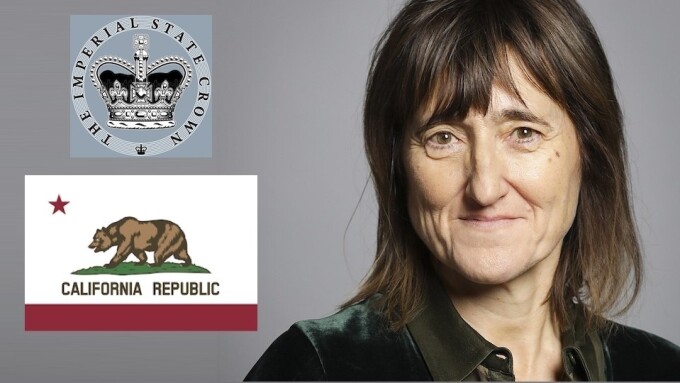
HOLLYWOOD, Calif. — The Baroness Beeban Kidron, a British aristocrat with California and Hollywood ties, was the subject last week of a fawning profile by Politico, in which she continued to defend her controversial campaigns for internet age verification in the U.K. and California.
Politico — owned by high-profile right-wing German press magnate Axel Springer — devoted a lengthy and almost hagiographic article to Kidron’s crusade to regulate and police online speech, with the vaguely defined mission of “protecting children.”
In the article, titled “How a British Baroness Is Shaping America’s Tech Laws for Kids,” Politico’s chief technology correspondent Mark Scott and tech policy reporter Rebecca Kern dismissively — and without offering any evidence — characterize an August 2022 XBIZ report which pointed out Kidron’s extensive professional and social relationship with convicted rapist Harvey Weinstein, as “viral online accusations” and part of a “lobbying” effort against the British aristocrat and her crusade against Big Tech.
“The lobbying became increasingly bitter,” they write. “Kidron became embroiled in barbed attacks, including viral online accusations — based on her decades-long movie career — that she had ties to disgraced producer Harvey Weinstein. She worked with him twice as a director but said she was not aware of his behavior that eventually led to his conviction on sexual assault and rape charges. Weinstein is appealing the charges.”
Politico links “viral online accusations” to an archived thread by XBIZ’s news editor citing his article and including a photo agency image of Kidron gleefully socializing with Weinstein.
Kidron comments, “I do find it really interesting that, in their effort to stop products being designed with some sort of consideration of childhood, that they’re willing to go that low,” without specifying to whom the conspiratorial “they” refers.
Sweeping Yet Vague 'For the Children' Proposals
As XBIZ reported, in August 2022, the California legislature passed the California Age-Appropriate Design Code Act, a highly controversial bill mandating sweeping yet vague age verification measures for any website “likely to be accessed by children.”
Governor Gavin Newsom signed it into law the following month, requiring websites — including all sites containing adult content accessible in California — to determine the age of all users with what the bill calls “a reasonable level of certainty.”
The California law, which goes into effect in July 2024, further mandates that websites and platforms must overhaul privacy and safety standards based on the age verification requirement.
Both the Electronic Frontier Foundation (EFF) and tech industry trade group NetChoice have questioned the constitutionality of the bill.
The California Age-Appropriate Design Code Act was patterned after the U.K.’s “Children’s Code,” a set of regulatory standards devised by the Baroness Kidron. Kidron also funds the 5Rights Foundation, a nonprofit that backed the bill. One of the 5Rights Foundation’s goals is to expand the scope of the federal Children’s Online Privacy Protection Act and change the definition of “child,” for online purposes, from anyone under 13 to anyone under 18.
Baroness Kidron is a 63-year-old former photographer, film producer and director, philanthropist and self-appointed “advocate for children’s rights in the digital world.”
Her U.K. feature films include “Vroom,” “Oranges Are Not the Only Fruit” and “Antonia and Jane.” In 1992 she moved to the U.S., where she worked with Miramax Pictures’ Weinstein. She directed “Used People,” the sex work documentary “Hookers, Hustlers, Pimps and Their Johns,” “Shades of Fear,” “To Wong Foo, Thanks for Everything! Julie Newmar” and romantic comedy sequel “Bridget Jones: The Edge of Reason,” starring Renée Zellweger, Colin Firth and Hugh Grant.
A Poshly Accented Baroness Who Wants to Save Kids from 'Big Tech'
In 2012, Queen Elizabeth made Kidron a Baroness and she was introduced in the House of Lords. She was appointed on the recommendation of the House of Lords Appointments Commission and is an unelected “life peer,” legislating in the U.K. as a member of the House of Lords Democracy and Digital Technologies Committee.
Kidron, the Politico writers gushingly wrote, “used a combination of perseverance and savvy politics to become arguably the most important and effective driver of data privacy and social media rules in the United States.”
Asked to describe “how tech companies had treated children for years,” Kidron told Politico that “they boiled kids alive online.”
The writers credit Kidron’s “fancy British accent” as one of the reasons her lobbying “pays off” in the sometimes provincial, awestruck world of local U.S. politics.
Politico reveals that Kidron has been lobbying U.S. Senators Richard Blumenthal (D-Conn.) and Marsha Blackburn (R-Tenn.), who are the co-authors of the equally controversial and vague federal Kids Online Safety Act.
“I think she’s been dynamite,” Blumenthal told Politico. “The age verification standards in the U.K. is a model for us. She has enormous influence. Her advocacy has impacted our way of thinking.”
But EFF told Politico that Kidron’s self-educated advocacy creates imprecise legislation that panders to “save the children” emotionality and is based more on grandstanding than on technical knowledge of the intricacies of online communications.
The California law’s drafting weaknesses, an EFF rep noted, “are concerning enough that we urge other states not to use it as a starting point for their own bills.”



