



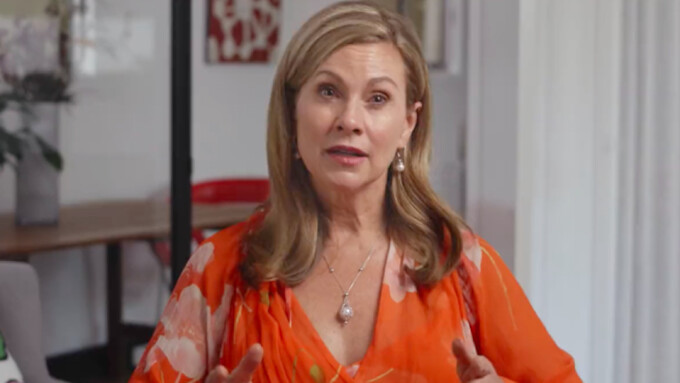
CANBERRA, Australia — Top censor and eSafety Commissioner Julie Inman Grant, who has acknowledged having conversations with U.S.-based, religiously-inspired anti-porn lobby NCOSE, submitted to the Australian government on Friday a road map to implement age verification for “online pornographic sites.”
The document, in the works for the past two years, has not been made available to the press or the public.
Before moving to Australia, Inman Grant received degrees from Boston University and American University, worked in politics in Washington D.C. and then for tech giants Microsoft, Twitter and Adobe. According to her official bio, she now claims to “lead the world’s first government regulatory agency committed to keeping its citizens safer online.” She was reappointed for a further five-year term by the Australian government in Jan. 2022.
“The age verification roadmap was handed to the Albanese government on Friday, coinciding with the deadline on the final draft of the online safety codes that have been developed by the tech industry,” reported public policy news site InnovationAus.com today.
A Road Map Commissioned by Scott Morrison's Right-Wing Government
The road map was originally commissioned by the right-wing government of Prime Minister Scott Morrison in June 2020 following a parliamentary inquiry into age verification for online adult content. The Morrison government endorsed Inman Grant’s proposal to institute a number of intrusive measures to determine people’s identity and age for accessing sexual content.
Inman Grant’s office would not release details of the road map but said in a noncommittal statement that in developing the document, eSafety had determined that “any potential technological solutions need to strike the right balance between safety, security and privacy. They must also go hand in hand with education and awareness raising for children and young people, as well as parents, carers, educators and other supporting adults.”
Inman Grant’s office also stated that eSafety was still working out ways to address what she calls “high-impact content that can be harmful to children,” which includes pornography.
What the commissioner called “mandatory industry-developed online safety codes” concerning online porn, however, do not appear to have been submitted by the Friday deadline, and the timeline for them remains unclear.
As XBIZ reported, the new guidelines, which Inman Grant tirelessly promoted nationally and internationally in the U.K. and the U.S., would necessitate a government definition of “pornographic website” or “adult website,” and would also have to specify whether non-porn-specific platforms such as Twitter and Reddit, which tolerate adult content, would also fall under that category unless they ban all sexual content.
In November 2021, Australian investigative outlet Crikey published a lengthy report on Inman Grant’s obsession with banning online porn.
The Crikey report revealed documents, obtained under Australia's Freedom of Information Act, in which the country’s top internet regulator revealed explicit animosity toward press coverage of her contacts with NCOSE and other foreign crusading organizations.
Inman Grant appeared on an NCOSE podcast at the Coalition to End Sexual Exploitation summit in July 2021, shortly after the Australian Parliament passed the country’s Online Safety Act.
Unlike the U.S., Australia does not have any blanket protections of free speech like the First Amendment, or a Section 230 analog protecting platforms from liability for third-party uploads.



