



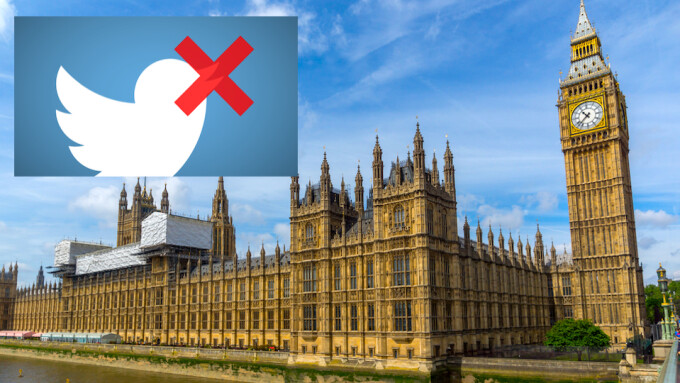
LONDON — U.K. government officials confirmed last week that social media sites “hosting large amounts of pornographic material, such as Twitter and Reddit” would have to “introduce systems to remove adult material in the U.K., or introduce age checks to determine whether users are over 18,” The Guardian reported yesterday.
This is one of the first official confirmations that the measure has as eventual targets not only “pornographic websites” — however politicians in power in specific districts decide to define that term — but also any website that tolerates sexually explicit content.
Eradicating adult content from open platforms has been one of the core objectives of the leading religiously inspired, U.S.-based groups that are at the forefront of the War on Porn, including NCOSE and Exodus Cry and their mouthpieces.
As many sex workers and advocates have pointed out, mandating age verification on any site that might host sexual expression deemed “pornographic” by local authorities would result, in practice, in a serious threat to free speech, to LGBTQ+ education and to the ability of sex workers to market their content and make a living.
Since sex workers are stigmatized and discriminated against by platforms such as Facebook, Instagram and YouTube, Twitter and Reddit are currently two of the few general-interest online spaces that tolerate adult content. They also provide sex workers with the ability to promote accounts on premium fan platforms such as OnlyFans, an option that has become crucial to their income and livelihood.
The Global War on Porn Heats Up
The Global War on Porn — led by increasingly well-funded American faith-oriented groups like NCOSE, coordinating with like-minded anti-porn crusaders worldwide — heated up earlier this month, when the Boris Johnson government in the U.K. engaged in a publicity blitz regarding its intention to fast-track mandatory age verification for adult content.
At the time, Johnson’s administration was under attack by opposition leaders over allegations of corruption and “sleaze,” a situation which has not completely resolved as of this writing, and which had some commentators predicting the collapse of the Prime Minister and his government.
It was in that context that, on Feb. 7, Johnson’s digital minister Chris Philp announced that the Johnson government had revived plans to make “pornography websites carry out age checks, which would require British users to provide data such as their credit card or passport details to prove they are over 18,” the Guardian reported.
“Parents deserve peace of mind that their children are protected online from seeing things no child should see,” Philp declared at the time. “We are now strengthening the online safety bill so it applies to all porn sites to ensure we achieve our aim of making the internet a safer place for children.”
Members of the government then took to the U.K. press — which, from The Times to The Guardian and from the BBC to the tabloids, has proven to be largely stigmatizing of sex workers and opposed to sex workers' rights and pornographic content — to generate stories about how “the forthcoming online safety bill will be altered to ensure that commercial porn sites are brought within its scope, updating the draft legislation, which now applies to providers of user-generated pornography such as OnlyFans.”
'A Privacy Minefield'
Even The Guardian, a supposedly “progressive” publication that nevertheless constantly platforms SWERF activists and anti-porn rhetoric, had to admit that privacy groups, digital rights advocates and even smaller porn companies were raising the alarm about the implications of the Johnson government’s swerve into anti-porn panic in the middle of an unrelated crisis.
“There is no indication that this proposal will protect people from tracking and profiling porn viewing,” Jim Killock, executive director of the Open Rights group, told The Guardian. “We have to assume the same basic mistakes about privacy and security may be about to be made again.”
Yesterday, The Guardian interviewed Mark Johnson, legal and policy officer at nonprofit Big Brother Watch, which added that the new proposal was “a privacy minefield” that “could pave the way for a digital ID system for the internet.”
“The online safety bill presents a clear attempt to age-gate the internet,” Johnson added. “This new announcement could lead to a new digital ID system for the internet more widely, even for sites like Twitter. This would be devastating for free expression and privacy and would inevitably result in digital exclusion.”
The government issued a statement in response to Johnson declaring that “we are not ‘age-gating’ the internet and this is a misunderstanding of how the bill will work."
Religious Groups Take Credit for Targeting Open Platforms
Meanwhile, evangelical groups were hailing the Johnson government’s explicit acknowledgement of targeting platforms that are not primarily pornographic as a victory for their relentless campaigns to eradicate online porn.
According to Evangelical Focus Europe, the groups “now welcome the new regulations as a long overdue change.”
“Age checks on porn sites should have been in place years ago,” said activist Ross Hendry of the Christian charity CARE. “Tens-of-thousands of children have stumbled across and continue to stumble across porn. A just society does not allow this to happen, and it is good that the government has finally recognized our campaign.”
“We await more detail from the government and will engage with the parliamentary process in the months ahead,” Hendry added.
The Christian Institute’s deputy director for communications, Ciarán Kelly, said that the religious groups “would be monitoring the bill to ensure that what the government delivers on age verification matches its rhetoric.”



