



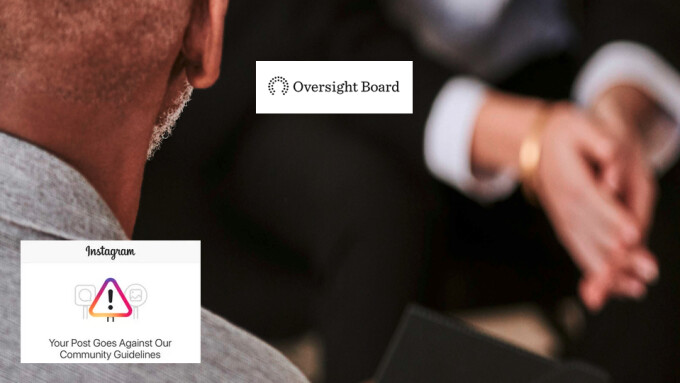
MENLO PARK, Calif. — Earlier this month, as the world was preoccupied with adapting to the new challenges of the post-COVID-19 reality, Facebook announced it had established an international entity named the "Oversight Board" to make decisions about free speech and content moderation on its platforms, which include Instagram.
This development directly affects adult performers and companies, all of whom have been targeted by Facebook/Instagram’s Term of Services (which bundle nudity and consensual sex with horrendous hate crimes and violent crimes), by its discretionary enforcement (celebrities and major brands are allowed nudity, as numerous examples attest), by search shadowbanning (which the companies deny they practice) and by a secretive internal culture regarding censorship decisions.
This Oversight Board — named simply that, not "Facebook's Oversight Board" — is funded by Facebook, who appointed its four co-chairs. Those co-chairs then appointed 20 members, with 20 more members to be appointed later.
Facebook spent $130 million setting up the Oversight Board trust, but claims the board is completely independent. Facebook also committed itself to abiding by the board's decisions.
The creation of this Oversight Board was announced on May 6 by Nick Clegg, VP of Global Affairs and Communications.
Clegg said that the announcement of this unprecedented board, essentially a self-appointed international censorship body deciding on the limits of free speech, marked "a fundamental change in the way some of the most difficult and significant decisions around content on our platforms will be made."
Clegg quoted Mark Zuckerberg’s decree that "Facebook should not make so many important decisions about free expression and safety on our own."
A Pseudo-Legalistic International 'Court'
Paraphrasing the Spider-Man comic, Clegg explained that “with our size comes a great deal of responsibility and while we have always taken advice from experts on how to best keep our platforms safe, until now, we have made the final decisions about what should be allowed on our platforms and what should be removed. And these decisions often are not easy to make — most judgments do not have obvious, or uncontroversial, outcomes and yet many of them have significant implications for free expression.”
This is how Clegg described the process: “Facebook helped kick off the member selection process by choosing four co-chairs, who have since been working with us to select the additional 16 members announced today. Membership selection will continue in this way until the board has selected up to 40 members, at which point it alone will take responsibility for selection of members in the future. The recommendation portal remains open for additional suggestions.”
“The members contract directly with the Oversight Board, are not Facebook employees, and cannot be removed by Facebook,” Clegg added.
Clegg’s statement added a strange, pseudo-legalistic “commitment” (which is, of course, not legally binding) giving this self-appointed board the appearance of a sort of “international court of appeals”:
Our Commitment
For our part, Facebook will implement the board’s decisions unless doing so could violate the law, and will respond constructively and in good faith to policy guidance put forth by the board.
The board won’t be able to hear every case we or the public might want it to hear, but we look forward to working with the board to ensure that its scope grows over time. As it does, we know the board will play an increasingly important role in setting precedent and direction for content policy at Facebook. And in the long term, we hope its impact extends well beyond Facebook, and serves as a springboard for similar approaches to content governance in the online sphere.
As always, we remain hugely grateful to everyone who has lent their time, energy, and expertise to this first-of-its-kind project.
The Oversight Board was also introduced through a New York Times op-ed, penned by the four co-chairs, ominously titled “We Are a New Board Overseeing Facebook. Here’s What We’ll Decide.”
News of the Oversight Board creation, conveniently shared during a time when public opinion was distracted by COVID-19, only resulted in muted reactions.
Some pushback came from some American right wing, conservative and religious voices concerned about the international nature of the body, its questionable allegiance to U.S. Constitution-based free speech issues and Facebook’s future policies regarding political messaging.
To visit the Oversight Board's website, click here.



