



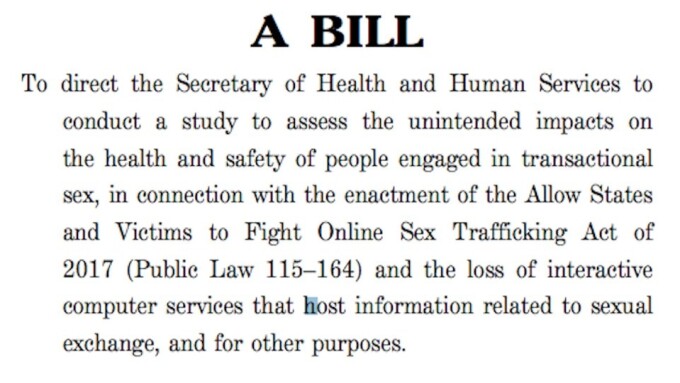
WASHINGTON — Legislator Ro Khanna (D-CA), along with one other representative and two senators, introduced a bill Tuesday to study the secondary effects of SESTA/FOSTA on sex workers' safety.
The SESTA/FOSTA Examination of Secondary Effects for Sex Workers Study Act (aka the "SAFE SEX Workers Study Act") was introduced in the House of Representatives by Khanna and Rep. Barbara Lee (D-CA), and in the Senate by Ron Wyden (D-OR) and Democratic presidential candidate Elizabeth Warren (D-MA). The bill, if passed, would require the Department of Health and Human Services (HHS) to conduct a study on sex workers' health and safety, particularly how they've been affected by the package of Senate bill SESTA (Stop Enabling Sex Traffickers Act) and House bill FOSTA (Allow States and Victims to Fight Online Sex Trafficking Act) that was passed last year.
"There has been a host of anecdotal reporting from sex workers and community health organizations that following the enactment of SESTA/FOSTA, sex workers have faced greater threats of physical and sexual violence, as they are increasingly pushed off online platforms and onto the streets to seek clients," said Khanna in a press release put out by the four co-sponsors. "Despite these reports, no national study has been conducted to assess the impacts of SESTA/FOSTA on sex workers."
SESTA/FOSTA was introduced to hold websites liable for knowingly facilitating sex trafficking, but the language had the secondary effect of additionally making sites liable for discussions of consensual sex work transactions. As a result, many sites that sex workers used to safely negotiate with potential clients, such as Craigslist, shut down their personal ad sections, forcing some sex workers back to the street to find clients.
"For far too long, SESTA/FOSTA has demonized and harmed sex workers," said Lee. "Instead of preventing sex trafficking, SESTA/FOSTA made it harder for sex workers to access critical health and safety resources."
While the new bill wouldn't repeal SESTA/FOSTA, it may be a step in that direction. It requires HHS to conduct a study in consultation with the National Institutes of Health (NIH), the Centers for Disease Control and Prevention (CDC) and the Substance Abuse and Mental Health Services Administration (SAMHSA), and report back to Congress within a year of being enacted.
"Anecdotal reporting suggests SESTA/FOSTA and the loss of certain web services have had profound impacts on sex workers," said the press release.
Khanna first mentioned that he was planning on introducing a bill to study SESTA/FOSTA in a Buzzfeed article in September about sex workers' rights lobbyist Kate D'Adamo. He tweeted about it again earlier this month and now appears to be following through on that promise.
Original sponsors of the bill include Representatives Alexandria Ocasio-Cortez (D-NY) and Pramila Jayapal (D-WA), and another heavyweight in the Democratic presidential race, Senator Bernie Sanders (I-VT).
While Khanna and Wyden originally voted "no" on FOSTA and SESTA, respectively, both Warren and Sanders voted for SESTA.
"As lawmakers, we are responsible for examining unintended consequences of all legislation, and that includes any impact SESTA/FOSTA may have had on the ability of sex workers to protect themselves from physical or financial abuse," said Warren in the press release
Several sex workers' advocacy groups commended the bill's sponsors for introducing the legislation.
"Our voices should be centered in this conversation and we are proud to know our elected officials are taking action in furtherance of our goals laid out in multiple meetings with members of the Sex Worker Advocacy Coalition (SWAC)," said Tamika L. Spellman, VP of Helping Individual Prostitutes Survive (HIPS). "On behalf of SWAC, we stand in full support of this proposed legislation as it will study the needs of sex workers impacted by the implementation of SESTA-FOSTA nationwide."
LGBTQ advocacy groups also joined in supporting the legislation.
"Every member of Congress should support finding out whether such a consequential law is helping people the way they hoped or is actually making things worse," said National Center for Transgender Equality Executive Director Mara Keisling.
"Understanding the impacts of losing online platforms for transgender people engaged in the sex trade will provide critical information for developing policies that support their health and safety, and for all sex workers," said Tyrone Hanley, senior policy counsel for the National Center for Lesbian Rights.
Khanna recently told Vox in an interview that while this is a necessary first step, changing or repealing SESTA/FOSTA has a long way to go.
"[W]e first have to get Congress comfortable with listening to the stories of sex workers," Khanna told Vox.
"It is hypocritical for our party to say we are for the most vulnerable, for the transgender community, for people of color, and not to listen to sex workers who often are part of those most vulnerable communities," he continued.
Read the entire press release here and the bill itself here.



