



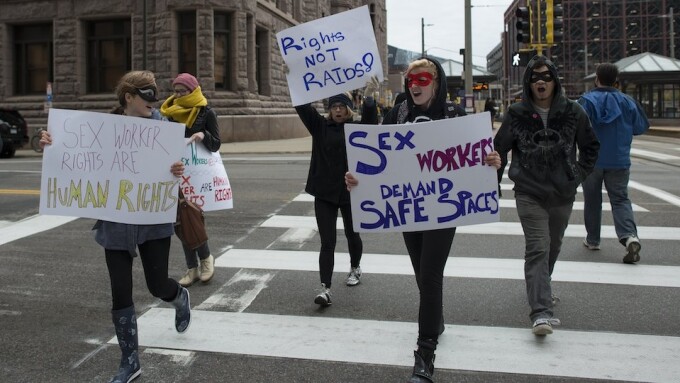
PHOENIX — Former Backpage owner Michael Lacey, who appeared alongside business partner Jim Larkin at a Libertarian gathering in Phoenix last Friday, claimed that the political/legal campaign to shut down the popular classifieds website was fueled by a "moral panic, based on a false premise [and it] has put sex workers in danger’s way.”
The false premise, as XBIZ today explored in an extensive op-ed was the deliberate conflation, by politicians like Kamala Harris (D) and Anne Wagner (R), of consensual sex work among adults with "human trafficking" or deliberate "pimping" of minors.
As journalist Stephen Lemons reported today for Front Page Confidential magazine, Lacey and Larkin appeared in front of a crowd of Arizona Libertarians who had donated at least $1,000 last year to the Reason Foundation.
Speaking at a panel at the swanky Arizona Biltmore while wearing mandatory ankle monitors, Lacey and Larkin regaled the crowd with tales about their career as newspapermen, alt-weekly moguls and their battles with local and national authorities, including former Maricopa County's sheriff and presidentially pardoned misdemeanant Joe Arpaio, over issues of censorship and free speech.
But the pugnatious former publishers, who built up a tiny campus paper into the Phoenix-based Village Voice Media alt-weekly empire before selling it in 2012 to concentrate on a lucrative side-business of classifieds called Backpage, terrified the government-skeptic Libertarian crowd with details of their ongoing legal nightmare.
Current California Senator and presidential candidate Kamala Harris spearheaded a 2016 crusade, strategically timed around that year’s national election, to punish Lacey, Larkin and Backpage CEO Marc Ferrer for refusing to shut down Backpage.
After the passage of FOSTA in 2018, the legislation that deliberately targeted the free speech provisions of Section 230 of the Communications Decency Act, the FBI arrested Lacey, Larkin and Ferrer, and seized all their assets, including Backpage.com.
The Feds replaced the webpage’s content with a stern message announcing the seizure of the site.
As the XBIZ op-ed noted, many sex workers “eloquently argued that shutting down Backpage would harm their lives and livelihoods, but Harris ignored her critics.”
At the Reason Foundation event, panel moderator and Reason editor-at-large Matt Welch said “at the very least, [Lacey and Larkin] are taking it on the chin for the media industry and for the First Amendment, and they deserve our respect. […] They’re facing an incredible trial and a bunch of seizures of their assets over their role at Backpage.com, which was the main target of the kind of anti-sex-trafficking legal panic.”
“As it turns out,” explained co-moderator Elizabeth Nolan Brown, the author of last year’s excellent story on the case for Reason magazine, “there’s been a huge concerted effort over the past two decades to deliberately conflate all prostitution or all sex work in general with sex trafficking.”
Harris’ much publicized Feb. 26 interview with The Root website, where she explained she was in favor of “decriminalization” of sex work, before erroneously defining it as a version of the “Nordic Model,” where people buying sex are penalized and the advertising of sexual services is often conflated with “pimping,” continued her attack on Backpage.
During that interview, Harris mischaracterized Backpage as a hub “for the sale of children, of minors."



